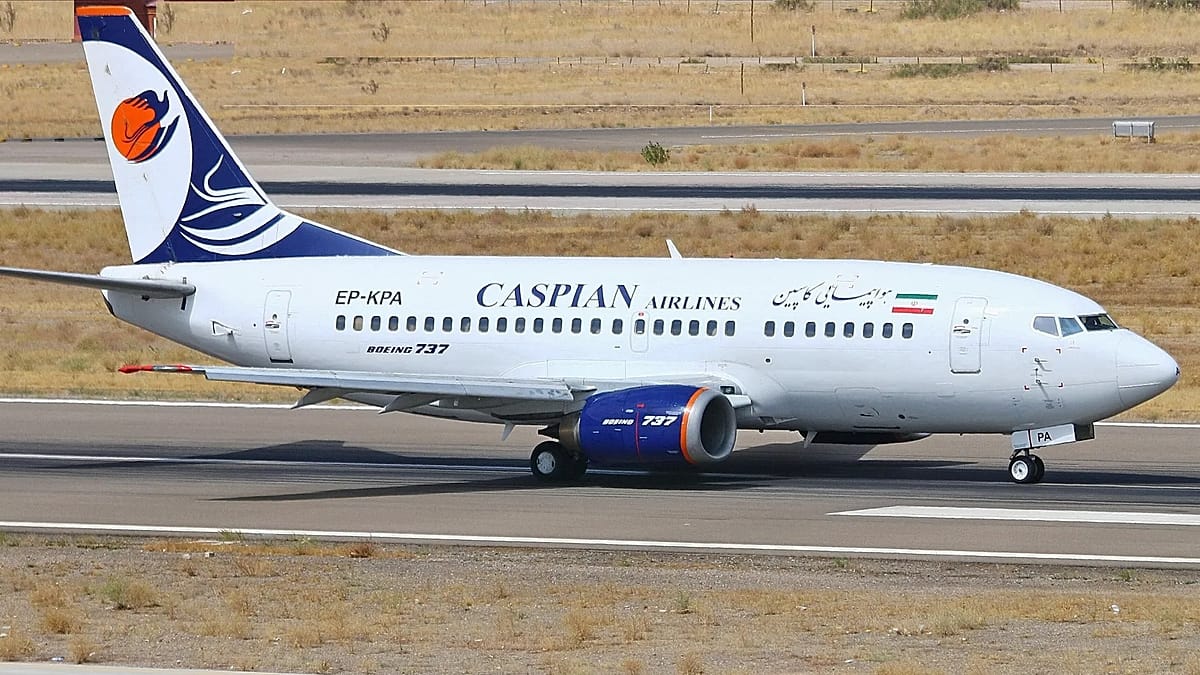
In an unusual enforcement action at Istanbul Airport, court-appointed bailiffs boarded a Caspian Airlines Boeing 737 on Monday and impounded the aircraft over a debt of roughly €3 million, forcing passengers who had already taken their seats for a flight to Iran to disembark.
The seizure was carried out on behalf of ACM Temsil Gözetim, an aviation representation and supervision company, according to Turkey's state-run Anadolu Agency. The aircraft, registered as EP-KPB, was held just before its scheduled departure, and passengers and cabin crew were returned to the terminal.
Caspian Airlines, based in Tehran and founded in 1993, operates as part of Iran's state aviation group. It flies Boeing 737s on domestic and international routes, including regular services to Istanbul.
Sanctions squeeze Iranian carriers
Iranian airlines have long struggled to maintain their fleets and meet financial obligations to foreign partners due to decades of US sanctions that restrict access to aircraft, spare parts, maintenance services, and international banking systems. The recent escalation in US-Iranian tensions has compounded these difficulties, with Iranian airspace repeatedly disrupted and international routes curtailed.
The Istanbul seizure came just days after sweeping US secondary sanctions on Iran's aviation sector took effect last Wednesday. On 8 September, the US Treasury designated 27 Iranian airlines and nine associated service providers under its Operation Economic Outcast, warning that foreign airports, fuel suppliers, ground handlers, and ticketing companies that continued to service Iranian carriers would themselves face sanctions and risk being cut off from the US dollar system.
The secondary sanctions triggered a rapid contraction of Iranian aviation internationally. Flights by Iranian carriers were suspended in Iraq, the UAE, Azerbaijan, and Oman. Iran's largest private carrier, Mahan Air, halted services to Turkey and Oman. In response, Lufthansa and Austrian Airlines suspended their own routes to Iran through 24 October, while Qatar Airways cited airspace restrictions in suspending services. China, Russia, and Pakistan have continued to operate flights to and from Iran.
Tracking data shows that daily international flights at Tehran's main airport fell from 80–90 before the sanctions to around 41 by Monday. Tehran has filed formal complaints with the United Nations, the International Civil Aviation Organisation, and the International Court of Justice.
The debt dispute that led to the Istanbul seizure is separate from the sanctions but highlights the financial strain on Iranian carriers. ACM Temsil Gözetim, the creditor, is a Turkish company that provides representation and supervision services for foreign airlines operating in Turkey. The exact nature of the debt has not been disclosed, but such claims often arise from unpaid handling fees, fuel charges, or leasing agreements.
For European travellers and businesses, the incident underscores the broader fallout from US sanctions on Iran, which continue to reshape aviation routes and trade links across the region. Turkey, a key transit hub, has become a flashpoint for these tensions, as it maintains air links with both Iran and the West.
The seizure also raises legal questions about the enforcement of foreign judgments and the rights of passengers caught in commercial disputes. Under Turkish law, bailiffs can impound assets, including aircraft, to satisfy court orders, but the process typically requires prior notification to the airline. In this case, the action was taken swiftly, leaving passengers with little warning.
As the US-Iran standoff continues, European airlines and airports are navigating a complex web of sanctions, airspace restrictions, and commercial pressures. The situation remains fluid, with further disruptions possible as the international community assesses the impact of the latest measures.