Ireland is facing mounting pressure to end its alumina sales to Russia, as the trade risks undermining EU efforts to curb Moscow's war machine. The issue has become a political liability for Dublin, which began its rotating presidency of the EU Council on 1 July.
The government is considering whether to support EU sanctions on alumina, a white powder essential for aluminium production. Aluminium is commonly used in weapons found on Ukrainian battlefields. However, no decision will be made until an internal probe into the final destination of Irish alumina exports is completed, with officials saying it is in its final stages.
Prime Minister Micheál Martin told reporters on Thursday that Dublin would discuss the findings with the European Commission, but noted that the Commission has never placed alumina on a sanctions list. “We don't want material to be supportive of the Russian war effort,” Martin said, adding that Europe must remain vigilant in supporting Ukraine.
Deputy Prime Minister Simon Harris, who also serves as finance minister, described Ireland as an “enthusiastic” supporter of EU sanctions policy. “Ireland will never cherry-pick when it comes to sanctions,” Harris said. “But it's important that we establish the facts.” He noted that the issue had been examined multiple times in the past, with information provided satisfying both EU and US authorities.
Zelenskyy's Direct Appeal
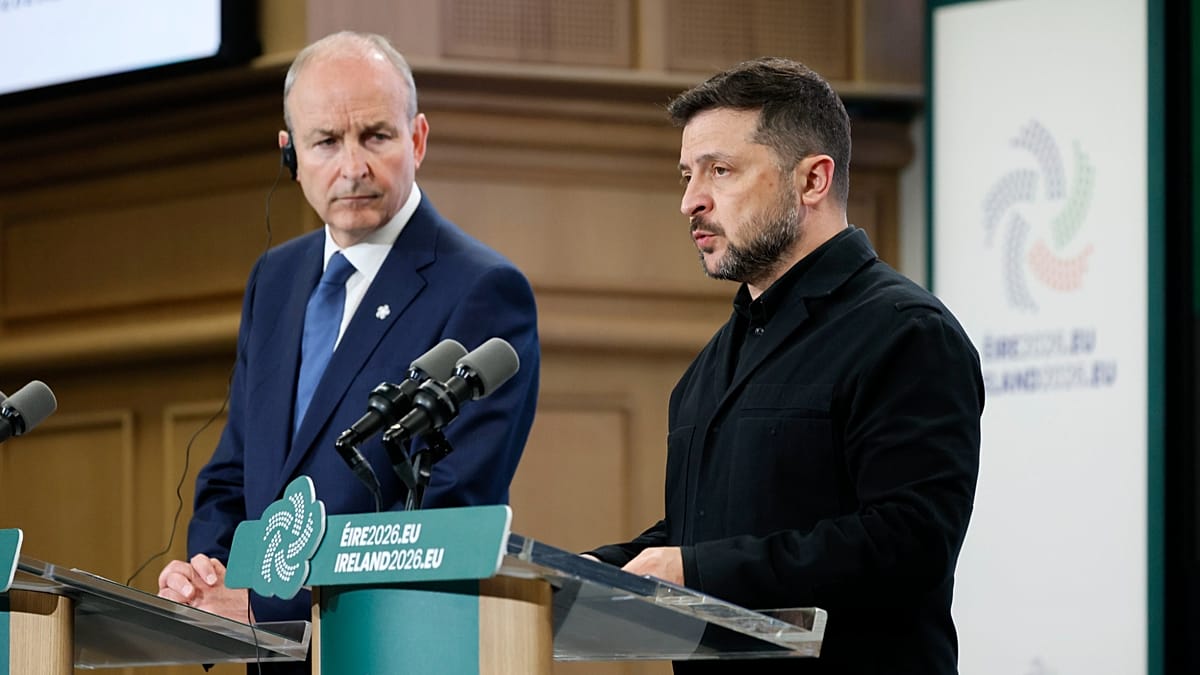
The pressure intensified after Ukrainian President Volodymyr Zelenskyy visited Dublin for the opening of Ireland's EU Council presidency. Speaking alongside Martin, Zelenskyy made clear his position: “Every tonne of raw materials that ends up in Russia is used against us in this war.” He argued that shrinking Russia's economy directly reduces its ability to launch massive attacks, which is reflected in Ukrainian casualty numbers.
Zelenskyy's visit was followed by a wave of Russian strikes on Kyiv that killed at least 21 people, underscoring the urgency of his appeal. The Ukrainian leader's call aligns with broader EU efforts to tighten sanctions, as detailed in leaked EU documents that highlight internal security concerns.
A bombshell investigation in late March exposed the business ties between Aughinish Alumina, Europe's largest alumina refinery located in western Ireland, and the Russian economy. The plant sells alumina to Russian smelters owned by its parent company, United Company Rusal. Rusal then sells the metal to a trader that supplies aluminium to sanctioned defence manufacturers, whose weapons have been used to kill Ukrainian civilians and bombard infrastructure.
Swedish authorities have concluded that Rusal remains under the effective control of Oleg Deripaska, a Russian oligarch under EU sanctions with close ties to the Kremlin. Aughinish insists its activities are legal because alumina is not subject to trade restrictions. The company says alumina exports to Russia represented about 45 percent of all sales in 2025, with a similar share expected in 2026. Virtually all EU-made alumina sent to Russia originates in Ireland.
Aughinish has reportedly warned the Irish government that EU sanctions on alumina would be so disruptive that it would require state intervention to salvage hundreds of jobs and guarantee supply chains. Both Martin and Harris pushed back against such claims. “We're not accepting threats from any quarter,” Martin said. Harris rejected what he called a “binary” choice between nationalisation and bankruptcy, noting that Europe has repeatedly found ways to protect its economy and supply chains.
The controversy comes as Ireland also focuses on advancing Ukraine's EU accession, a key priority during its presidency. The government in Dublin must now balance domestic economic concerns with its stated commitment to supporting Kyiv, as the alumina trade threatens to undermine its credibility on the European stage.