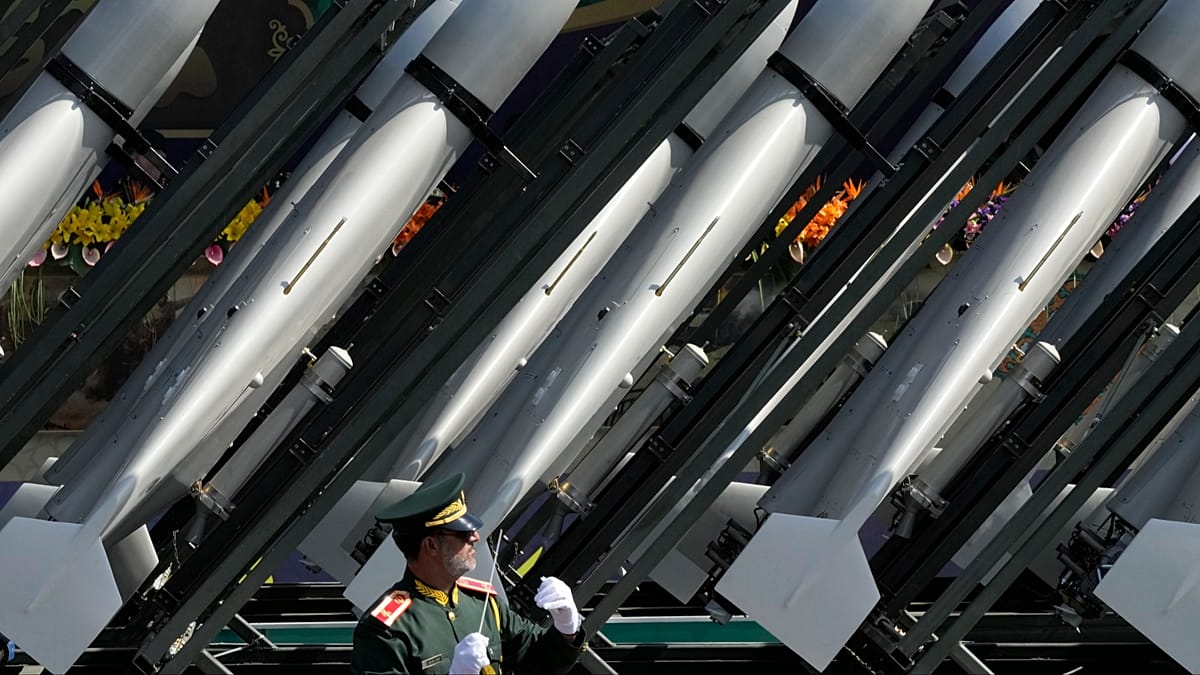
Tehran’s military leadership has signalled that it retains undisclosed capabilities and is ready for any scenario, including open conflict with the United States and NATO, as indirect nuclear negotiations with Washington remain suspended. Brigadier General MohammadJafar Asadi, deputy inspector of the Khatam al-Anbiya Central Headquarters—Iran’s wartime command centre—told state television on Tuesday that the Islamic Republic has not yet revealed all its options.
“We have repeatedly said that we have not yet revealed all of our trump cards. There are many capabilities and options that remain undisclosed, and if necessary, we will use them,” Asadi said. He added that Tehran “has no problem with war” and warned that NATO involvement would not alter Iran’s readiness. “When surrender is not an option, then war lies ahead,” he stated.
Asadi further noted that any renewed conflict would differ in “the nature of operations, geography of the battlefield, and types of weapons used.” The Khatam al-Anbiya Central Headquarters oversees strategic military operations across Iran’s armed forces under the broader authority of the Islamic Revolutionary Guard Corps (IRGC) and the Supreme Leader.
Diplomatic Pause and Internal Rifts
At the diplomatic level, uncertainty persists over the pause in indirect Iran–US communications aimed at reaching a preliminary understanding on nuclear and regional issues. Iranian state-linked Fars news outlet reported that no messages are currently being exchanged, and talks have been halted for several days. Saeed Ajorlou, a member of the Iranian negotiating team’s media unit, said proposals are still under review by Iran’s Supreme National Security Council and expert committees, with no final decision taken.
A separate source cited by Mehr news agency indicated that Iran is still evaluating a draft agreement but insists on “tangible benefits and enforceable guarantees” before moving forward, citing mistrust of previous US commitments. Meanwhile, US Secretary of State Marco Rubio said Washington remains engaged, noting that discussions now cover aspects of Iran’s nuclear programme that were previously off the table. However, he cautioned that progress does not guarantee a breakthrough.
US President Donald Trump claimed on Monday evening that negotiations have continued “at a rapid pace” despite Iran’s assertions to the contrary. The conflicting statements highlight the opacity of the backchannel talks, which have been mediated by Oman.
Hardliners Gain Ground
The suspension of negotiations is widely attributed to hardline factions within Iran’s power structure, particularly circles affiliated with the IRGC. Acting IRGC Commander-in-Chief Ahmad Vahidi has been identified as a key figure advocating a tougher stance. According to a joint assessment by the Washington-based Institute for the Study of War (ISW) and the Critical Threats Project (CTP) at the American Enterprise Institute, Vahidi and his close associates were behind Monday’s decision to halt talks.
Vahidi is said to belong to an exclusive circle that maintains direct contact with Ayatollah Mojtaba Khamenei, the new Supreme Leader who has remained out of public view since US-Israeli strikes on Iran on 28 February. In contrast, Speaker of Parliament Mohammad Bagher Ghalibaf, who leads Tehran’s negotiating team, is seen as representing a more pragmatic approach and has shown greater flexibility in the talks so far.
By pausing brokered negotiations, Tehran has further linked its decisions to its proxies in the region, especially Hezbollah, the Lebanese Shia militant group that remains at war with Israel. Foreign Minister Abbas Araghchi has stated that the Iran-US ceasefire framework “unequivocally” covers all fronts, including Lebanon, warning that violations in one arena could affect the broader arrangement. This regional entanglement adds another layer of complexity for European capitals monitoring the situation, as any escalation could have direct consequences for stability in the Eastern Mediterranean and beyond.
For European policymakers, the standoff carries significant implications. The European Union has long sought to preserve the Joint Comprehensive Plan of Action (JCPOA) framework and maintain diplomatic channels with Tehran. A breakdown in US-Iran talks could reignite tensions that affect energy markets, migration flows, and security in the Middle East—all of which have direct repercussions for EU member states. The recent rally in European markets on oil retreats underscores how sensitive the continent remains to shifts in Iranian diplomacy.
As the IRGC signals its readiness for confrontation, the coming days will test whether the pragmatic wing in Tehran can regain the upper hand—or whether the hardliners’ gamble on brinkmanship will push the region closer to a wider conflict.