European equity markets opened higher on Tuesday, while crude oil prices retreated sharply, as investors welcomed reassuring signals from US President Donald Trump that diplomatic efforts with Iran are making headway. The shift in sentiment marks a stark reversal from Monday, when oil spiked after Tehran suspended negotiations and threatened to fully close the Strait of Hormuz, a chokepoint for roughly a fifth of global petroleum shipments.
By mid-morning in London, US West Texas Intermediate crude had fallen about 4% from its Monday peak to $91.3 per barrel. Brent crude, the international benchmark, dropped a similar margin to $97.2 per barrel. The decline was largely attributed to Trump's comments on Monday afternoon, in which he assured reporters that talks with Iran are proceeding at a “rapid pace.” He also claimed to have spoken with the Prime Minister of Israel and representatives of Hezbollah’s leadership in an effort to de-escalate the conflict in Lebanon, which has threatened to derail broader peace negotiations.
The relief was palpable across European bourses. The Euro Stoxx 50 and the broader Stoxx 600 both traded roughly 0.9% higher at the start of Tuesday’s session. National indices followed suit: the UK’s FTSE 100, Germany’s DAX 30, France’s CAC 40, Italy’s FTSE MIB, the Netherlands’ AEX, and Switzerland’s CH20 all posted gains between 0.6% and 1%. The German index led the advance, reflecting optimism that a de-escalation in the Middle East could reduce energy costs for Europe’s largest economy, which is already grappling with high electricity prices amid its renewable energy transition.
Asia-Pacific Markets Mixed as AI Momentum Lifts Seoul
In Asia-Pacific, markets were mixed overnight. South Korea’s Kospi climbed around 2.6%, recovering from a modest correction on Monday after hitting an all-time high of 8,933 points. The rally was driven by continued momentum in artificial intelligence stocks, which have decoupled the index from broader geopolitical concerns. Japan’s Nikkei 225, by contrast, slipped roughly 0.5%, weighed down by a stronger yen and lingering uncertainty over trade dynamics.
The contrasting performance underscores how regional markets are reacting to different drivers. While European investors are focused on the potential for a diplomatic resolution to the Iran standoff, Asian markets remain attuned to sector-specific trends and domestic policy signals.
Trump’s latest overtures come after a volatile period in which oil prices surged as Iran halted talks and threatened the Strait of Hormuz. The US president has also claimed to have brokered a Lebanon ceasefire, leaving the door open for Iran talks, though details of any agreement remain murky. For European policymakers, the stakes are high: any sustained disruption to oil flows would compound inflationary pressures and complicate the European Central Bank’s efforts to manage monetary policy.
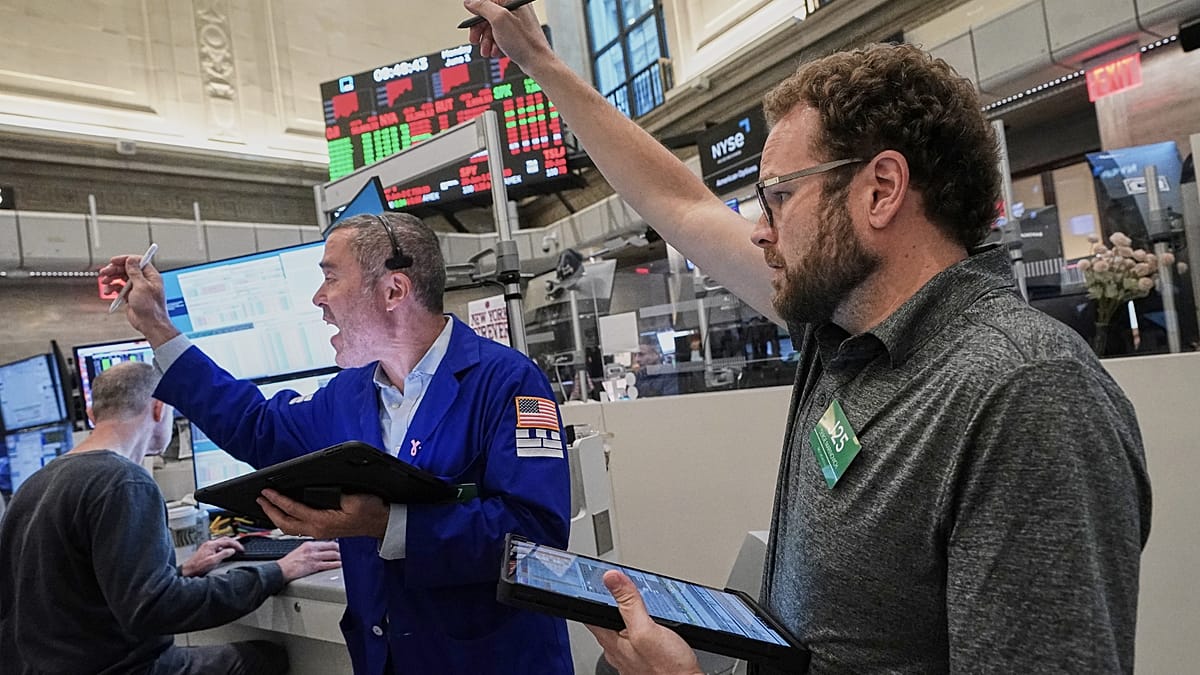
US futures were mostly flat ahead of the opening bell on Wall Street, suggesting that American investors are taking a wait-and-see approach. The broader market mood, however, remains cautiously optimistic, with many analysts viewing Trump’s diplomatic signals as a positive step toward reducing geopolitical risk premiums.
For now, the retreat in oil prices offers a reprieve to European consumers and businesses that have faced elevated energy costs. Whether the peace signals translate into a lasting agreement remains uncertain, but Tuesday’s market moves reflect a collective hope that the worst of the crisis may be behind us.