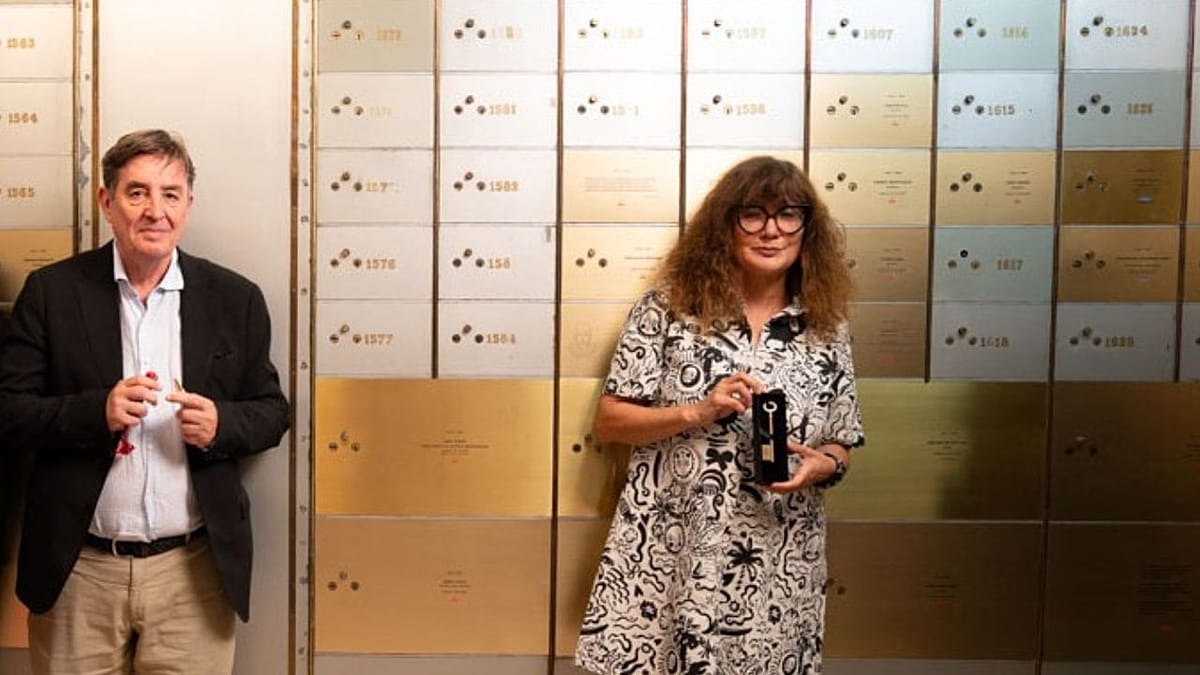
In a ceremony at the Instituto Cervantes in Madrid, Catalan filmmaker Isabel Coixet has sealed a small collection of deliberately anachronistic objects into the institution's Caja de las Letras, a bank-vault-style archive not to be opened until 2076. The gesture is both a personal time capsule and a public statement about what she fears may be lost.
Among the items deposited in box 1586 are a cassette tape featuring 18 songs, from Camarón and Lucho Gatica to the Catalan rumba of “La lista de la compra” by La Cabra Mecánica and María Jiménez; a collage made on the cover of a 1913 book, intentionally devoid of explicit meaning; and a letter written with a Bic biro, in which Coixet pays homage to torrijas, clay water jugs, and open-air summer cinemas.
A defence of the handmade
In her letter, read aloud during the ceremony, Coixet writes: “I am writing this with a Bic biro, my favourite. I wonder if they still exist. You, whoever you are, do not be taken in by treatises on the wonders of the world. The Bic biro is one of humanity's great inventions.” She also takes aim at speciality coffee chains, hoping her anonymous reader “never have the misfortune of coming across them.”
The filmmaker, born in Sant Adrià del Besòs in 1960, has long been a standard-bearer for the third wave of Spanish women directors. Her choice of the cassette's closing track, “La lista de la compra,” is pointed: “It seems to me that in 50 years' time all the things that song talks about – the kitchen table covered in crumbs, those unbearable mixed plates, sweat, scrubbing, scouring – may well be a thing of the past.”
Coixet's critique extends beyond nostalgia. In her speech, she condemned artificial intelligence and what she called global ecocide, framing her analogue relics as a bulwark against a future she fears is being engineered. The collage, she explained, quoting Florence Green from her film The Bookshop, is deliberately meaningless because “understanding makes the mind lazy.”
The event also featured a conversation between Coixet and Cristina Andreu, former president of the Association of Women Filmmakers and Audiovisual Media, reflecting on their careers. Luis García Montero, director of the Cervantes, praised Coixet's international trajectory: “Her films have travelled far and wide, but it would be a mistake to confuse that international trajectory with simple geography, because she has turned freedom and travel into a way of working her way towards the heart of things.”
Coixet's career is marked by four Golden Bear nominations at Berlin and a Palme d'Or nomination for Map of the Sounds of Tokyo. She has won eight Goya Awards, and in 2015 was made a Chevalier of the Order of Arts and Letters in France. She also received Spain's National Film Award and the Gold Medal of Fine Arts in 2009.
The Caja de las Letras, which began in 2007, now holds nearly 1,800 tributes from figures across the Spanish-speaking cultural world. Coixet's deposit joins a tradition that includes writers, artists, and institutions, both living and deceased. Her box will remain sealed for half a century, a deliberate act of patience in an age of instant gratification.
As Europe debates the role of AI in creative industries and the pace of environmental change, Coixet's gesture offers a quiet counterpoint: a reminder that some things – a song on a cassette, a handwritten note, a summer cinema – may be worth preserving, even if they no longer fit the digital template. Her legacy, like the objects she has sealed away, is a bet on the future's curiosity about the past.