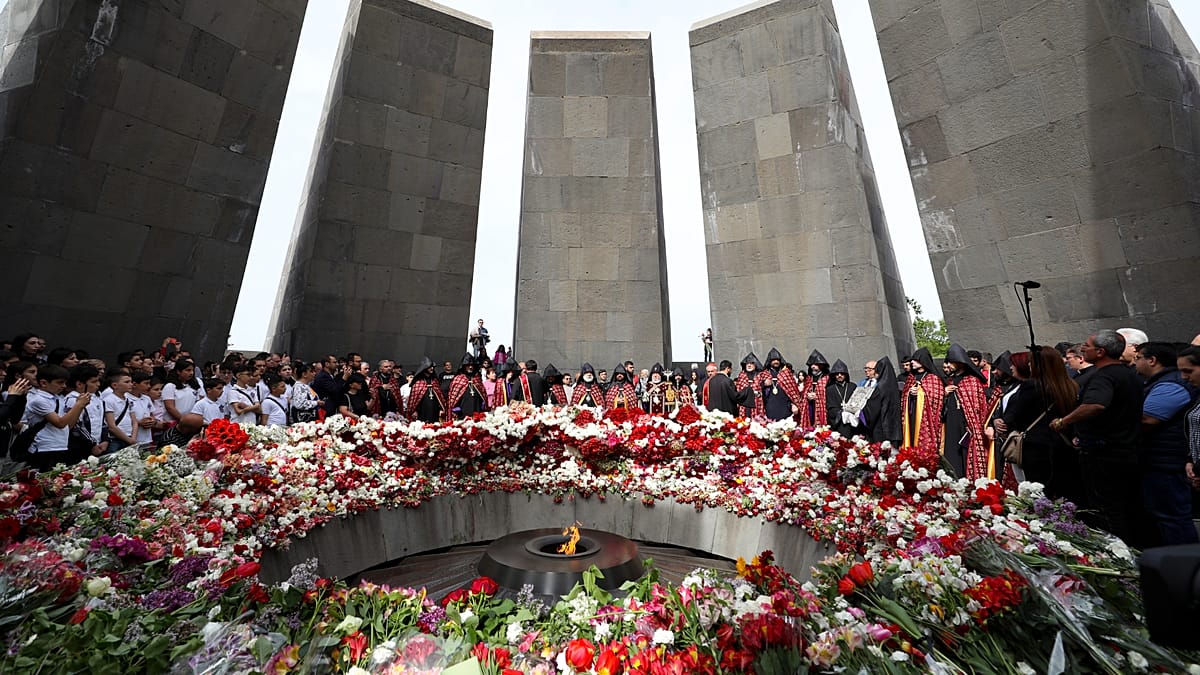
In a landmark decision that signals a further deterioration of ties between Jerusalem and Ankara, the Israeli government has formally recognized the massacres of Armenians during World War I as genocide. The cabinet unanimously approved a proposal by Foreign Minister Gideon Saar on Sunday, a move widely interpreted as a rebuke to Turkey and a reflection of the deepening rift between the two countries.
“A historic decision: the Israeli government has unanimously approved Foreign Minister Gideon Saar's proposal to recognise the Armenian genocide,” the foreign ministry said in a statement. The decision still requires ratification by the Knesset, Israel's parliament, before it becomes official policy.
Moral and Historical Duty
Speaking at the cabinet meeting, Saar framed the recognition as a matter of principle. “The Armenian genocide remains to this day the subject of an institutionalised campaign of denial and minimisation, including a manipulative rewriting of history, mainly by the Turkish government,” he said, according to a statement from his office. “I think the time has come for Israel, as a Jewish state, to formally accept this position... It is never too late to do the right thing... this is both a moral and historical duty.”
The move comes against a backdrop of sharply deteriorating relations between Israel and Turkey since the outbreak of the Gaza war in October 2023, following attacks by the Palestinian Islamist movement Hamas. Ankara has been a vocal critic of Israel's military operations in Gaza, recalling its ambassador and suspending trade ties. The genocide recognition is likely to further strain diplomatic and economic relations between the two regional powers.
Historians estimate that up to 1.5 million Armenians were killed by the Ottoman Empire during and after World War I. While more than 30 countries, including France, Germany, and Italy, have recognized the events as genocide, Turkey has consistently rejected the term, arguing that the deaths were part of a broader wartime context and not a systematic extermination.
Israel's decision also carries implications for its relations with Azerbaijan, a key ally and energy partner that shares a border with Armenia. Baku has long opposed any recognition of the genocide, and the move could complicate Israel's strategic ties in the Caucasus. However, Israeli officials have emphasized that the decision is based on historical and moral considerations, not on current geopolitical calculations.
The recognition is also notable given Israel's own history of trauma and persecution. Saar explicitly linked the two, stating that as a Jewish state, Israel has a particular responsibility to acknowledge such atrocities. The decision aligns with the stance of many European nations, which have increasingly recognized the Armenian genocide in recent years, often prompting diplomatic spats with Turkey.
For European observers, the move underscores the shifting alliances and tensions in the Eastern Mediterranean and the Middle East. Turkey, a NATO member and key player in European migration and energy politics, has seen its relationship with Israel deteriorate sharply, while also clashing with Greece, Cyprus, and France over maritime boundaries and energy exploration. The recognition could further isolate Ankara within the Western alliance, though it may also galvanize efforts by the Armenian diaspora in Europe to push for broader recognition.
The decision is likely to be debated in the Knesset in the coming weeks, with some far-right and religious parties expressing reservations about the timing and potential diplomatic fallout. However, given the broad consensus in the cabinet, ratification appears probable.