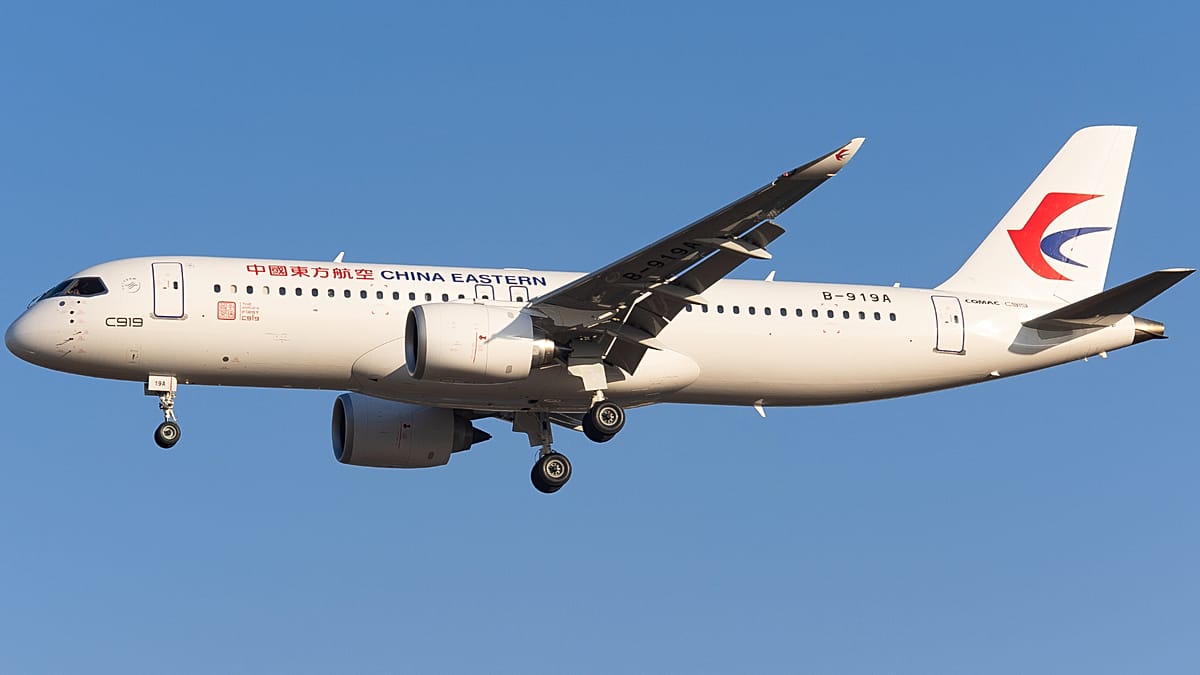
China's domestically produced C919 narrow-body jet has taken to the skies beyond its home market for the first time, completing a scheduled passenger flight from Beijing to Ulaanbaatar. The roughly two-hour journey, operated by Air China, landed in the Mongolian capital on [date], according to flight-tracking data from FlightRadar24.
The milestone is a symbolic step for the Commercial Aircraft Corporation of China (COMAC), the state-owned manufacturer that hopes to break the duopoly of Boeing and Airbus in the global aviation market. But the C919 still faces significant hurdles before it can seriously compete on the international stage.
A long road to global competitiveness
Despite its Chinese branding, the C919 relies heavily on foreign components, including engines and avionics from Western suppliers. It has not yet received certification from either the European Union Aviation Safety Agency (EASA) or the US Federal Aviation Administration (FAA), which severely limits its ability to be sold and operated in Western markets. Without those approvals, airlines in Europe and North America are unlikely to order the aircraft, and even Chinese carriers operating internationally may face restrictions.
COMAC originally aimed to have the C919 fully made in China by 2025 and to capture 10% of the domestic market. Those targets have passed without being met. As of mid-2026, COMAC had delivered only about 40 C919s, a fraction of the roughly 100 Airbus A320-family jets delivered to Chinese airlines in 2025 alone. The company's goal of producing 200 C919s annually by 2029 remains a distant prospect.
The C919 is a single-aisle aircraft with a capacity of up to 174 passengers, placing it in the same category as the Boeing 737 MAX and the Airbus A320neo. Its performance and economics are comparable on paper, but the lack of certification and limited production capacity are major obstacles.
Proving reliability and scale
Building a competitive jet is only half the battle. COMAC must also demonstrate that it can manufacture the C919 in sufficient numbers and keep them flying reliably. That means strengthening its supply chain, increasing production rates, and ensuring that everything from engines to small components is readily available. Even a shortage of a single part can halt the assembly line.
The Beijing–Ulaanbaatar route is expected to operate daily, and COMAC has been showcasing the aircraft at industry events, including the Dubai Airshow last November. These efforts are part of a broader strategy to build confidence among potential international customers.
China's domestic airlines still depend heavily on Boeing and Airbus. In May, Chinese carriers ordered 200 Boeing 737 MAX jets, along with spare parts and engines, underscoring the continued need for Western technology even as COMAC ramps up its own production.
The C919's first international flight is a notable achievement for China's aviation industry, but it is a small step in a long journey. For now, Boeing and Airbus remain firmly in control of the global market, and COMAC's challenge is more symbolic than immediate. However, if China can overcome the certification and production hurdles, the C919 could eventually become a real competitor, reshaping the dynamics of the industry.
For Europe, the implications are twofold. On one hand, Airbus faces a potential long-term rival. On the other, European suppliers and airlines may find new opportunities as China seeks to expand its aviation footprint. The C919's progress will be watched closely in Toulouse and Hamburg, where Airbus has major assembly lines.
As COMAC continues to develop its aircraft, the global aviation landscape could shift. But for now, the C919 remains a work in progress, with its first international flight serving as a reminder of both its potential and its limitations.