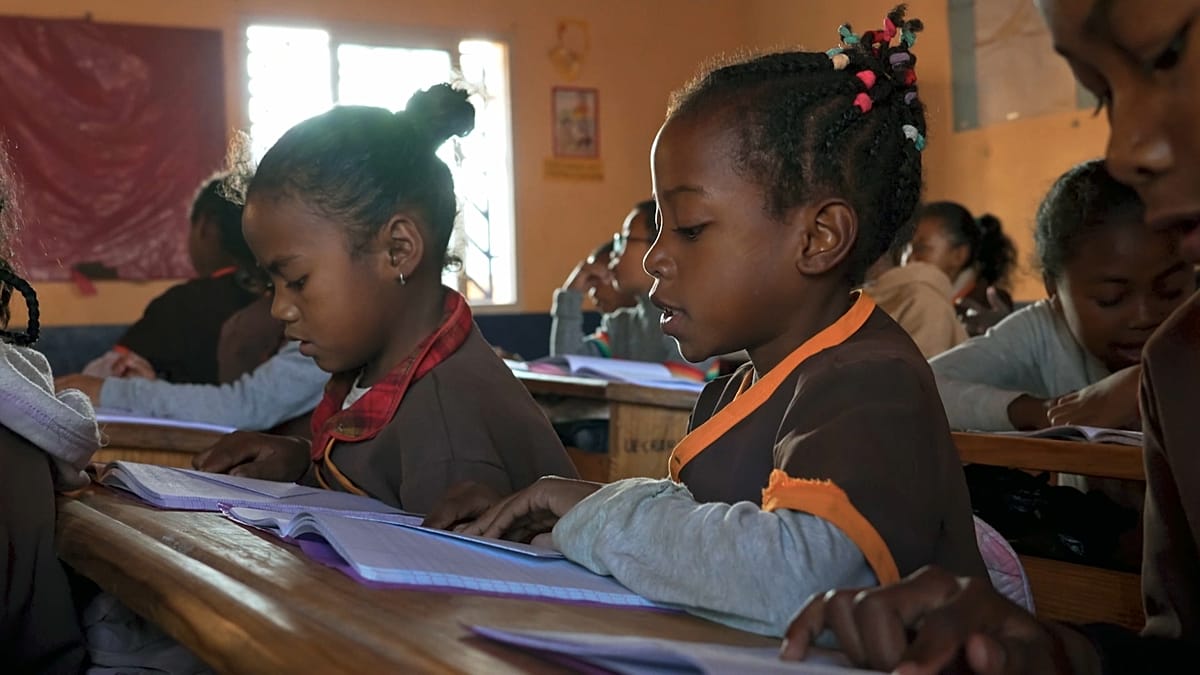
On the outskirts of Antananarivo, a quiet revolution is taking place in education. Parents, teachers, and local residents gather in a modest classroom to discuss budgets, priorities, and the future of their children's schooling. This is the School Management Committee, a cornerstone of School for All, a programme developed by the Japan International Cooperation Agency (JICA) that is now reshaping how education is delivered in Madagascar.
“The benefit of having the School Management Committee is first of all the transparency in the management and in the committee,” says Marie Harivola Malala Razanadrasoa, President of the committee. For her, the committee is more than a talking shop—it is a mechanism for accountability, ensuring that funds are used wisely and that the community's voice is heard.
Community-led education
The School for All approach is built on the idea that sustainable educational development cannot be imposed from above. Instead, it empowers local stakeholders to take ownership. In Madagascar, where literacy rates remain low and dropout rates are high, this participatory model is showing tangible results.
“We witnessed a big improvement in reading,” says Tinasoa Helimalala Rabezandry, a primary school director. The programme also includes community-organised meals and pre-school lessons inspired by Japanese storytelling methods, which have proven effective in engaging young learners.
Launched in Niger in 2004, School for All has since expanded to 11 African countries, adapting to local contexts while maintaining its core principle: that when all stakeholders work together, even limited resources can yield significant educational gains.
“The School for All approach is different: when all stakeholders work and create together, educational development can be sustainable and effective even with limited resources,” says Masahiro Hara, Chief Advisor at the JICA School for All project.
Lessons for Europe?
While the programme is focused on Africa, its principles resonate far beyond. In Europe, debates about school governance and parental involvement are ongoing, from student protests in France to broader questions about education funding. The idea of giving communities a direct say in how schools are run could offer a model for addressing educational inequality in European countries as well.
For Madagascar, the immediate benefits are clear. The committees have improved transparency, reduced corruption, and fostered a sense of shared responsibility. As one local official put it, “When parents see their involvement making a difference, they become champions of education.”
The programme's success has not gone unnoticed. Other countries in the region are looking to replicate the model, and JICA is exploring ways to scale it further. For now, in the classrooms of Antananarivo, the sound of children reading aloud is the most compelling evidence that the approach works.
As Europe grapples with its own educational challenges, from teacher shortages to digital divides, the lessons from Madagascar—where community engagement and simple, low-cost interventions are transforming outcomes—are worth heeding. The School for All model may not be a panacea, but it offers a reminder that sometimes the most effective solutions are the ones that start at the grassroots.