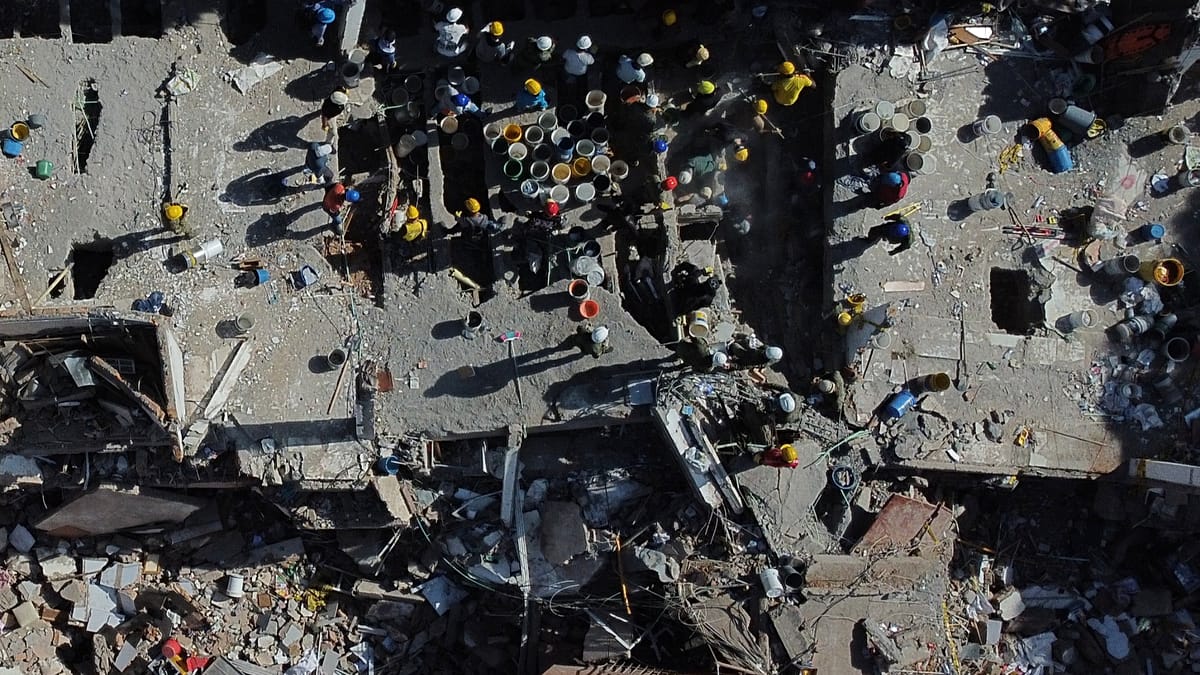
Colombia has entered three days of national mourning following a devastating earthquake that struck the country's west on Monday, killing more than 200 people and flattening entire neighbourhoods. The 7.4-magnitude tremor, the strongest to hit Colombia in a century, has triggered one of the largest disaster responses in recent years.
President Abelardo de la Espriella ordered flags to be lowered to half-staff on official buildings and at Colombian embassies worldwide, "in honour of all the dead." The death toll was revised to 216 after local officials in Cali corrected earlier figures, but rescue teams continue to search for survivors.
Rescue efforts under pressure
In Pereira and Cali, emergency crews are using cranes, dogs and heavy machinery to sift through the rubble of collapsed buildings. Volunteers have formed human chains to clear debris by hand, hoping to reach people still trapped. Experts say the first 72 hours after an earthquake are critical for finding survivors, and that window is closing.
There was a moment of relief on Tuesday when rescuers pulled 32-year-old Daniela Largo from the wreckage in Pereira. Her mother, Sandra Milena Perez, described the anguish: "We were losing hope and then we received a call." A local resident had heard cries for help and rallied neighbours to dig before professional teams arrived.
The quake overwhelmed parts of the health system. In Cali, part of the Hospital Universitario del Valle collapsed, forcing doctors to move patients into a parking lot and treat some in the open air. Many survivors spent the night outdoors, either because their homes were damaged or for fear of aftershocks. A park in Pereira has been transformed into a makeshift shelter with tents and mattresses.
"We lost everything, but we're alive," said 23-year-old John Tabasco, camped there with his wife and seven-month-old son. Thousands of residents have brought water, food and supplies to affected neighbourhoods, and long lines have formed outside blood donation centres. "It's about wanting to help your community, your city and your country," said donor Ferney Cabrera.
European solidarity
European Commission President Ursula von der Leyen announced on Wednesday that the EU would provide €2.1 million to support Colombia's most affected areas. "As search and rescue operations continue, the EU is supporting Colombia wherever possible," she said in a statement on X. The funding will cover health, water, sanitation and hygiene materials, as well as shelter, food, protection and cash assistance.
Colombia has activated the EU's civil protection mechanism, which pools resources from the 27 member states to deliver coordinated aid. Von der Leyen also confirmed that the bloc's Copernicus satellite service has been mobilised to assist with rescue operations. On the ground, the German Red Cross, an EU humanitarian partner, has reallocated €100,000 from an existing project to meet the immediate needs of 2,500 families in Chocó and Valle del Cauca.
President de la Espriella declared a state of emergency and promised rent subsidies for affected families during a visit to Pereira on Tuesday. The full scale of the destruction is still emerging, but the response has already become a test of both national resilience and international solidarity.