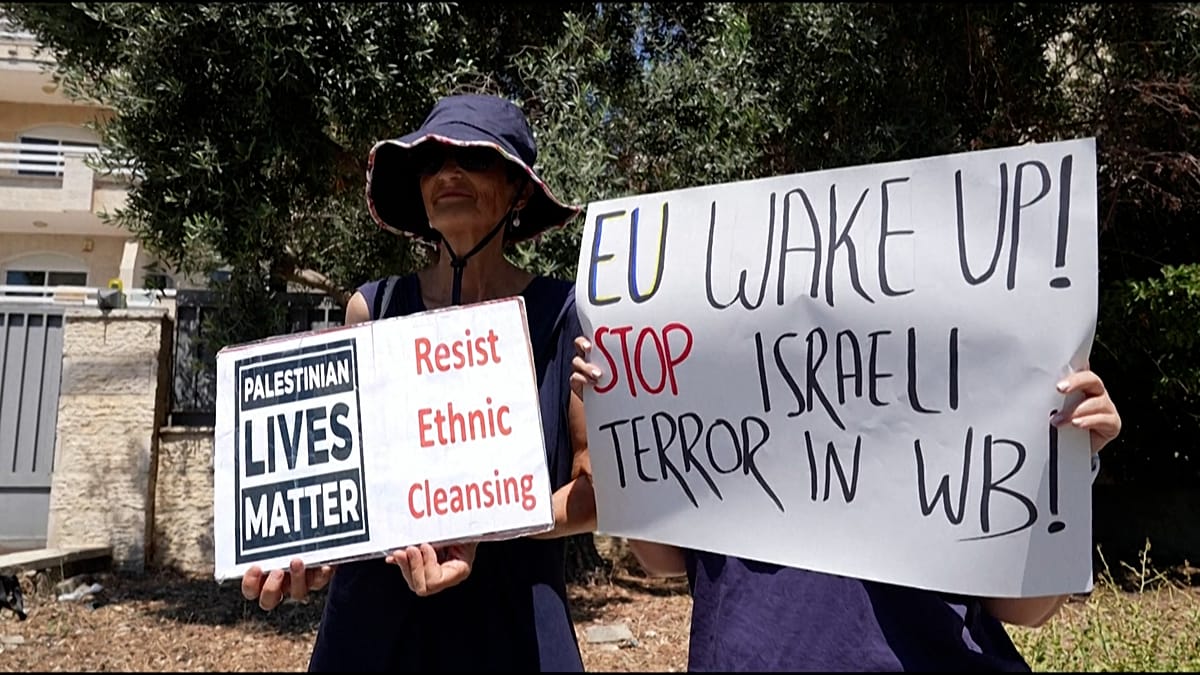
On 28 August, a small but determined group of Israeli activists gathered outside the European Union's representative offices in east Jerusalem, delivering a pointed message to the bloc: silence on Gaza is complicity. The protest, which drew around a dozen participants, aimed to pressure the EU to adopt a more assertive position on the war in Gaza, which has now entered its eleventh month.
A moral appeal from within
The demonstrators, many of whom are part of grassroots peace movements, held signs and chanted slogans in Hebrew and English, urging EU diplomats to move beyond statements of concern and take concrete actions. Among their demands were a formal suspension of the EU-Israel Association Agreement, which grants preferential trade terms, and a clear commitment to recognizing Palestinian statehood as a step toward a two-state solution.
One protester, a Tel Aviv-based teacher who asked to remain anonymous, told European Pulse: "We are here because we believe that the EU's quiet diplomacy has failed. Every day that the bloc remains silent, it becomes complicit in the suffering of Palestinians and in the erosion of our own democracy."
The timing of the protest is significant. It comes as EU foreign policy chief Josep Borrell has repeatedly called for a ceasefire, but member states remain divided on how to respond to the escalating humanitarian crisis in Gaza. The EU's inability to speak with one voice has frustrated many civil society groups across the continent, as well as within Israel.
EU's balancing act
The EU has long sought to position itself as a neutral mediator in the Israeli-Palestinian conflict, but critics argue that its economic and political ties with Israel undermine that role. The bloc is Israel's largest trading partner, and the Association Agreement, in force since 2000, remains a cornerstone of bilateral relations. However, human rights organizations have repeatedly called for its suspension, citing violations of international law in the occupied territories.
In recent months, several European governments, including Spain, Ireland, and Norway, have recognized Palestinian statehood, a move that has strained relations with Israel. Meanwhile, other member states, such as Germany and Hungary, have maintained strong support for Israel, reflecting the deep divisions within the EU on this issue.
The protest in Jerusalem also highlighted the growing frustration among Israeli citizens who oppose the government's military campaign. "We are not anti-Israel," said another activist, a student from Haifa. "We are pro-peace. We want our government to stop the war, and we want the EU to help us achieve that."
Broader European implications
The demonstration comes against a backdrop of rising tensions across Europe over the Gaza conflict. In recent weeks, anti-migrant protests in Ceuta and antisemitic incidents in the Alps have underscored how the war is reverberating in European societies. The EU's response to the conflict is being closely watched by both pro-Palestinian and pro-Israeli communities, and any perceived bias could fuel further polarization.
Analysts say the EU's credibility as a global actor is at stake. "The EU has always claimed to champion international law and human rights," said Dr. Elena Fischer, a political scientist at the Free University of Berlin. "If it fails to act decisively on Gaza, it risks being seen as hypocritical, not just by the Global South but by its own citizens."
For the activists in Jerusalem, the message is clear: the EU must choose between being a bystander or a peacemaker. As one banner read, "Your silence is our complicity."