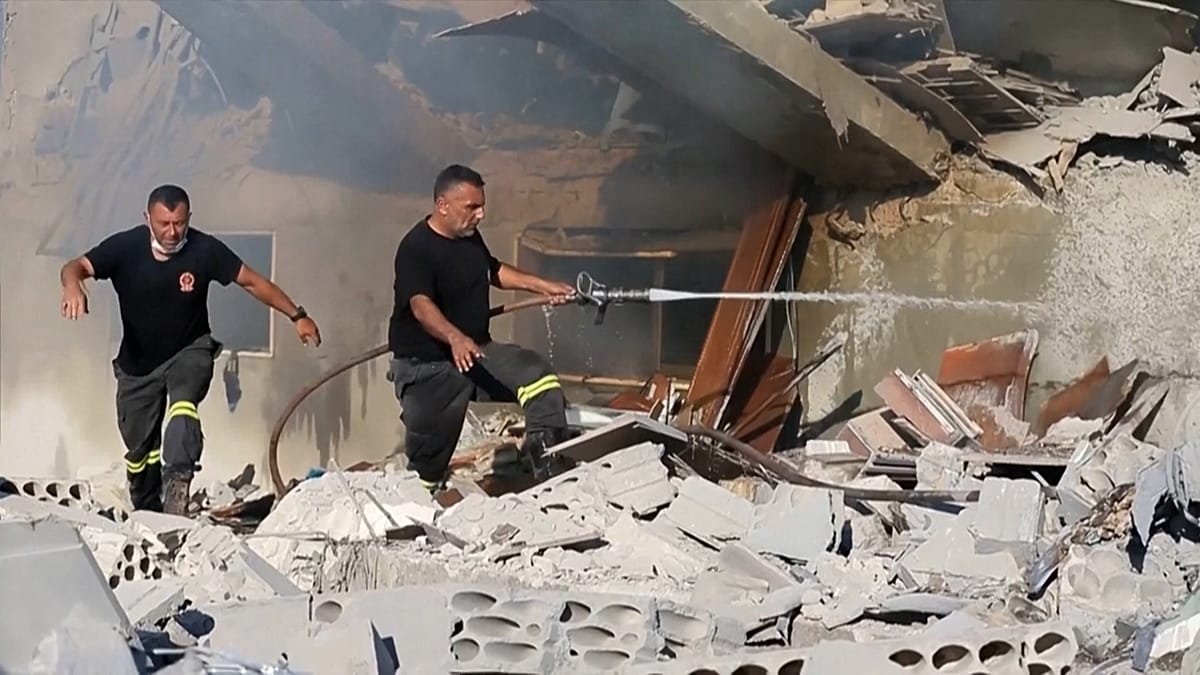
An Israeli airstrike hit a house in the southern Lebanese village of Saksakieh on [date], killing at least four people and wounding 33 others, according to Lebanese authorities. The attack comes despite a fragile ceasefire agreement that had raised hopes for de-escalation along the border.
The strike targeted a residential building in the predominantly Shia village, located about 15 kilometres north of the Israeli border. Local media reported that the victims included civilians, though the Israeli military claimed the site was used by Hezbollah operatives. The Lebanese Red Cross confirmed the casualty figures and said rescue operations were ongoing.
Ceasefire Under Strain
The ceasefire, brokered by the United States and France in late 2024, had largely held for several weeks, reducing cross-border exchanges that had escalated into the deadliest confrontation since the 2006 war. However, recent weeks have seen a series of violations. In a separate incident, Israeli strikes killed seven people in southern Lebanon earlier this month, drawing condemnation from the United Nations Interim Force in Lebanon (UNIFIL).
The latest attack has heightened tensions in a region already on edge. Hezbollah, the Iran-backed militant group, has vowed to retaliate, raising fears of a renewed cycle of violence. European diplomats have urged restraint, with France calling for an emergency meeting of the UN Security Council.
“This is a dangerous breach that undermines the fragile stability we have worked so hard to achieve,” said a spokesperson for the French Foreign Ministry. “We call on all parties to respect the ceasefire and avoid further escalation.”
The European Union has consistently supported the ceasefire framework, which includes provisions for the Lebanese army to deploy in southern Lebanon and for Hezbollah to withdraw north of the Litani River. However, implementation has been slow, and the Israeli military has conducted periodic strikes targeting what it describes as Hezbollah infrastructure.
For residents of southern Lebanon, the airstrike is a grim reminder of the region’s volatility. “We thought the ceasefire would bring peace, but now we are back to living in fear,” said a local shopkeeper in Saksakieh, who asked not to be named. “Every explosion makes us wonder if this will ever end.”
The attack also has broader implications for European security. The conflict has already displaced tens of thousands of people on both sides of the border and has strained EU diplomatic efforts to stabilise the Middle East. In a related development, an Israeli airstrike killed a Hezbollah commander in the Beirut suburbs last month, further eroding trust in the ceasefire.
European capitals, particularly Paris and Berlin, have been active in trying to mediate. Germany, which has seen a surge in applications for citizenship from Israeli and American Jews amid regional instability, has also voiced concern. The trend reflects growing unease about the long-term security situation in the Middle East.
Meanwhile, the Israeli military has launched an investigation into the conduct of its soldiers, including a recent incident where a soldier was filmed desecrating a statue of the Virgin Mary in a Lebanese church. The probe has drawn international criticism and added to the diplomatic fallout.
As the situation remains fluid, the European Pulse will continue to monitor developments. The coming days will be critical in determining whether the ceasefire can be salvaged or whether the region slides back into full-scale conflict.