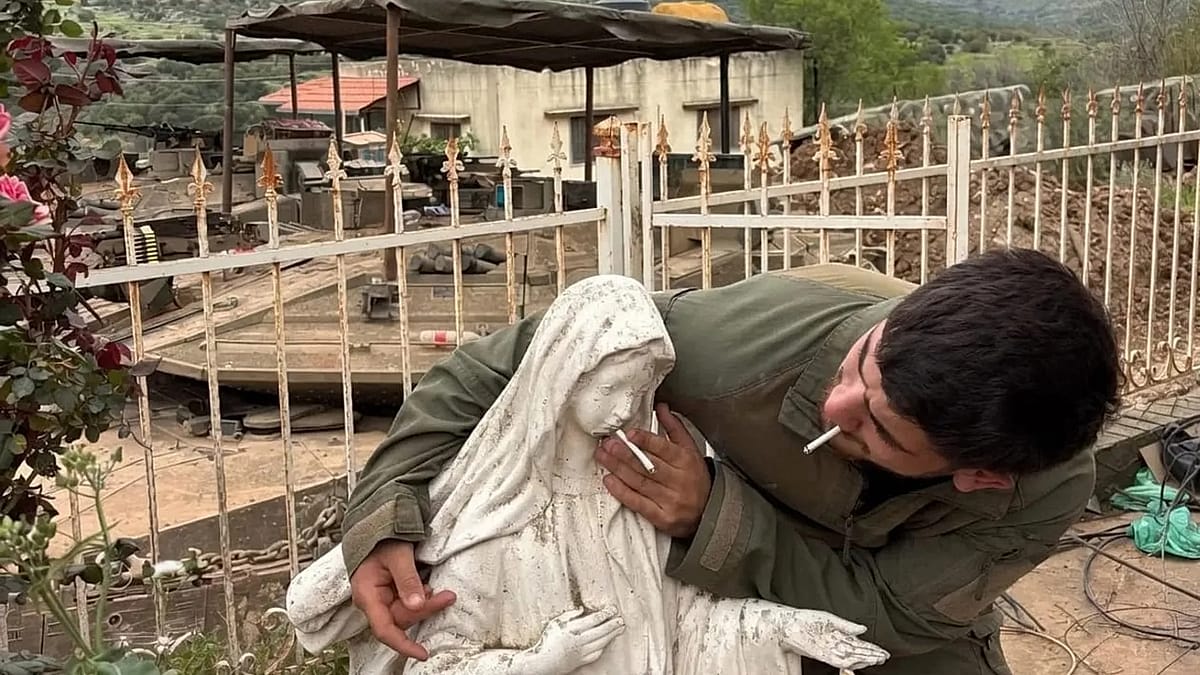
The Israeli military has announced an investigation after a soldier was photographed placing a cigarette in the mouth of a statue of the Virgin Mary in southern Lebanon. The image, which circulated widely on social media on Wednesday, shows the soldier with his arm around the revered Christian figure, holding a cigarette to her lips.
In a statement, the Israel Defense Forces (IDF) said it “views the incident with utmost severity and emphasises that the conduct of the soldier completely deviates from the values expected of its personnel.” The military added that “the incident will be investigated and command measures will be taken against the soldier in accordance with the findings.” An initial review indicated the photograph was taken several weeks ago.
Pattern of Desecration
This is not the first time Israeli forces have faced scrutiny over their treatment of Christian religious symbols in southern Lebanon. In late April, the IDF confirmed that two soldiers would serve 30 days of military detention and be removed from combat duty after a photo showed one of them using a sledgehammer to strike the head of a statue of a crucified Jesus in the village of Debel. That statue had already fallen from its cross.
The latest incident has drawn condemnation from Christian communities across the region. The Vatican has not yet commented, but local church leaders in Lebanon have expressed outrage. The Maronite Patriarchate in Bkerké called for respect of all religious sites, noting that such acts fuel sectarian tensions in a country already grappling with political and economic crises.
The IDF reiterated on Thursday that it “respects freedom of religion and worship, as well as holy sites and religious symbols of all religions and communities.” It also stated it had “no intention of harming civilian infrastructure, including religious buildings or religious symbols.”
These incidents occur against the backdrop of ongoing Israeli military operations in southern Lebanon, despite a fragile ceasefire. In a separate development, Israeli strikes killed seven people in the region earlier this month, raising further concerns about civilian safety and the protection of cultural heritage.
The desecration of religious symbols has broader implications for European diplomacy. The European Union has repeatedly called for the protection of minority communities in the Middle East, including Christians. Several EU member states, such as France and Italy, have strong historical ties to Lebanon’s Christian population. The Italian government recently sent a new crucifix to replace the one damaged in Debel, a gesture underscoring the importance of these symbols to European publics.
Human rights groups have also weighed in. Amnesty International’s regional office urged the Israeli military to ensure accountability and to implement measures preventing future violations. “Such acts not only offend believers but also violate international humanitarian law, which protects cultural and religious property,” the organization said in a statement.
The incident has also sparked debate within Israel. Some Israeli politicians and commentators have criticized the soldiers’ behavior, arguing it damages the country’s image and undermines its claims to respect religious freedom. Others have downplayed the significance, framing it as isolated misconduct.
For European readers, the story resonates beyond the immediate region. It highlights the fragility of interfaith relations in conflict zones and the challenges of maintaining respect for religious sites amid military operations. As European governments continue to engage with both Israel and Lebanon on issues of security and human rights, incidents like these test the credibility of commitments to protect cultural heritage.