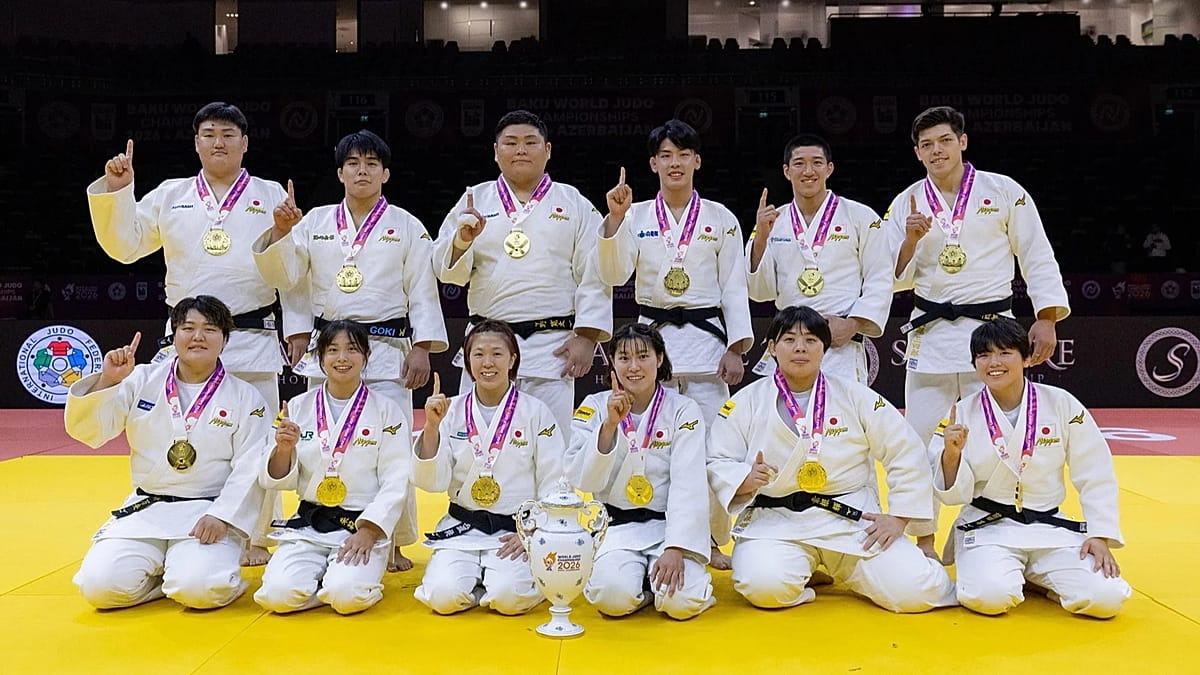
Japan restored their dominance in the mixed team event at the World Judo Championships in Baku on Sunday, defeating Russia in the final to claim their eighth team gold. The victory came after a bronze medal in last year's competition, marking a return to the top of a discipline that rewards collective depth as much as individual brilliance.
The Japanese squad had little trouble in the semi-final against China. Uchimura gave Japan an early lead, double world champion Murao added a second ippon, and Arai sealed the tie with a controlled turnover and hold-down. The result sent Japan into the final with momentum and without conceding a single contest.
A first final for Russia after a golden-score thriller
The other semi-final produced one of the most dramatic ties of the tournament. Uzbekistan took an early lead through Ahadov's ippon, but Russia levelled with a yuko from Lishchenko. Murtazoev restored Uzbekistan's advantage, only for Rechkalova to force a submission and make it 2-2. Tasoev then scored big to put Russia ahead, but Aminova equalised at 3-3, sending the tie to a golden-score contest at +90kg. Tasoev held his nerve, throwing for ippon a second time to send Russia into their first-ever mixed team final.
In the final, Japan left nothing to chance. Tanaka Shiho opened with a yuko to give her team the lead, Murao Sanshiro doubled the advantage, and Mao Arai made it 3-0. Tamerlan Bashaev briefly halted the Japanese run with a win for Russia, but Akari Omori closed out the tie, securing Japan's eighth team gold. The trophy was presented by International Judo Federation President Marius Vizer, while Almaz Alsenov, CEO of the Harvest Group, awarded the silver. IJF vice-presidents Laszlo Toth and Obaid Al Anzi handed out the bronze trophies.
The mixed team format, introduced to the World Championships in 2018, has become a fixture of the international calendar and a preview of the Olympic programme. It requires nations to field men and women across seven weight categories, turning individual specialists into a single unit. For Japan, the win in Baku underlines a structural strength that goes beyond a handful of stars. The country's depth was already visible in the individual competition, where Tsunoda and Murao shone across their respective categories.
Russia's run to the final, meanwhile, signals a growing threat in a format where team tactics and weight-class balance can neutralise individual favourites. Their semi-final against Uzbekistan was a case study in composure under pressure, with Tasoev's double ippon the decisive contribution. The result will give the Russian federation confidence ahead of future team events, even as questions over neutral status and eligibility continue to shadow the sport.
For the wider judo world, Baku delivered a championships rich in storylines. Lee and Tasoev triumphed in their respective individual categories, while Grigalashvili won a fourth world title and Kaju extended an unbeaten run. Japan also doubled up with two new world champions, reinforcing the sense that the sport's centre of gravity remains firmly in East Asia even as Europe produces a steady stream of medallists.
The mixed team title is more than a medal for Japan. It is a statement about the breadth of their talent pool and their ability to perform when the pressure is shared. After last year's bronze, the return to gold in Baku will be remembered as a correction rather than a surprise. For Russia, the silver represents progress and a platform to build on. For everyone else, the message is clear: in the mixed team event, depth wins, and Japan still have the deepest bench in the sport.