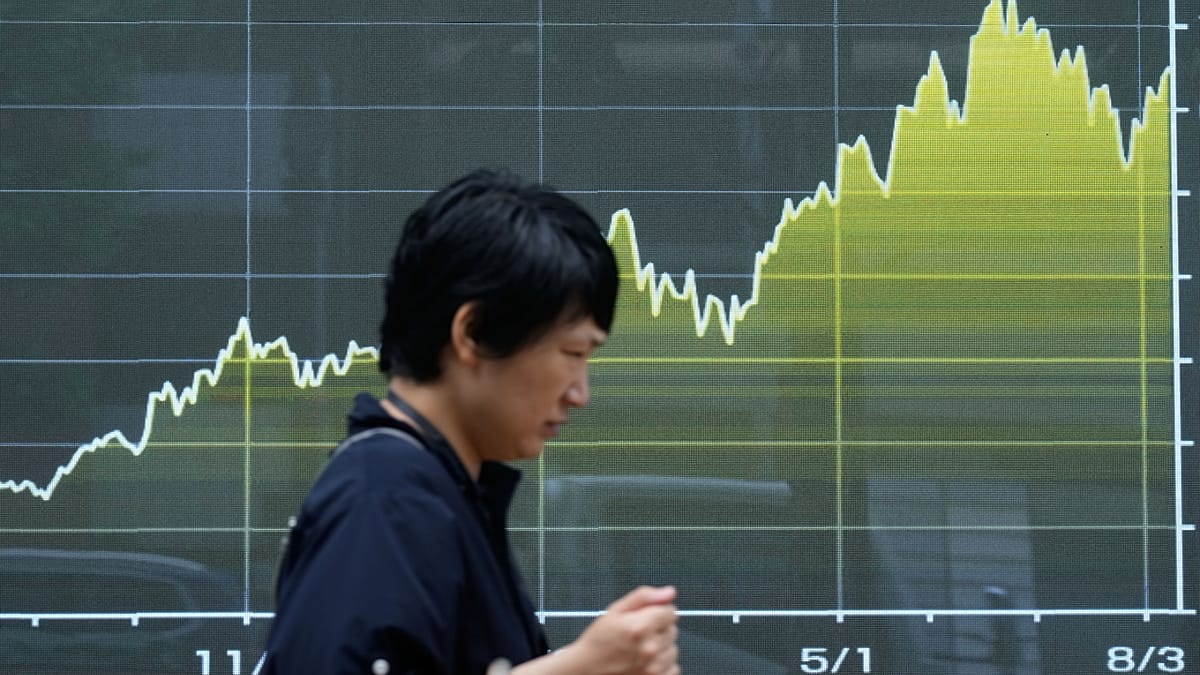
In Tokyo, two pieces of data collided within hours on Monday, sending a clear signal about the forces now driving Japan's financial markets.
Bond investors pushed the 10-year Japanese government bond (JGB) yield to a three-decade high before the government reported that economic growth had come in at barely half the pace economists had forecast. The pairing says a great deal about what is really moving Japan's markets right now: not growth, but inflation and the currency.
Growth disappoints, but yields climb
The Cabinet Office reported that the economy expanded at an annualised rate of 1.1% in the second quarter, well below the 2.0% forecast and down from a downwardly revised 1.9% pace in the first quarter. Quarter on quarter, GDP rose just 0.3% against a forecast of 0.5%, marking a third consecutive expansion.
Private consumption was flat, and capital expenditure fell 1.2%, while net exports, helped by the weak yen, added 0.5 percentage points to growth. The GDP deflator rose 2.6% year on year, underscoring persistent price pressures.
The 10-year JGB yield touched 2.93% earlier in the day, its highest level since September 1996, before easing slightly once the GDP figures landed. Traders are increasingly betting that the Bank of Japan (BoJ) will raise its policy rate, currently at 1% and already a three-decade high, as soon as September to contain inflation and support the yen.
The yen and the carry trade
The yen slid to 163.73 per US dollar in late July, its weakest level in roughly four decades, prompting Japan and the US to carry out their first joint currency intervention since 2011. Japan deployed an estimated $85 billion (€73.3bn) in the first two days alone, while the US intervention was much smaller, according to Goldman Sachs. The operation pushed the yen back to around 159 per US dollar.
There is currently a wide gap between Japanese and US interest rates, with the Federal Reserve's benchmark rate still at 3.50% to 3.75%. The BoJ's September meeting is being watched as the next test of whether the currency's recovery can hold.
Japan's bond market matters well beyond Tokyo because of the yen carry trade, in which investors borrow cheaply in yen to fund purchases of higher-yielding assets abroad, from US Treasuries to emerging-market debt. Rising Japanese yields erode that trade's profitability and can force rapid unwinding, as happened in August 2024, when a BoJ rate rise combined with weak US jobs data sent the Nikkei down more than 12% in a single session and knocked roughly 3% off the S&P 500.
With JGB yields at three-decade highs and further tightening still expected, analysts say the conditions for a similar shock have not disappeared. For European investors, the ripple effects are familiar: a sharp unwinding of the carry trade can hit global equity markets, including those in Frankfurt, Paris, and London.
The situation also resonates with Europe's own fiscal debates, as governments across the continent grapple with rising bond yields and inflation. In Sweden, for instance, the incoming government is set to harden its EU budget stance, a reminder that fiscal discipline remains a contentious issue across the bloc. Meanwhile, Spain's inflation hit 3.6% in July, the highest in over a year, showing that price pressures are far from vanquished in the eurozone.
For now, all eyes are on the BoJ's September meeting. The decision will not only determine the yen's trajectory but also test the resilience of global markets that have grown accustomed to cheap Japanese funding.