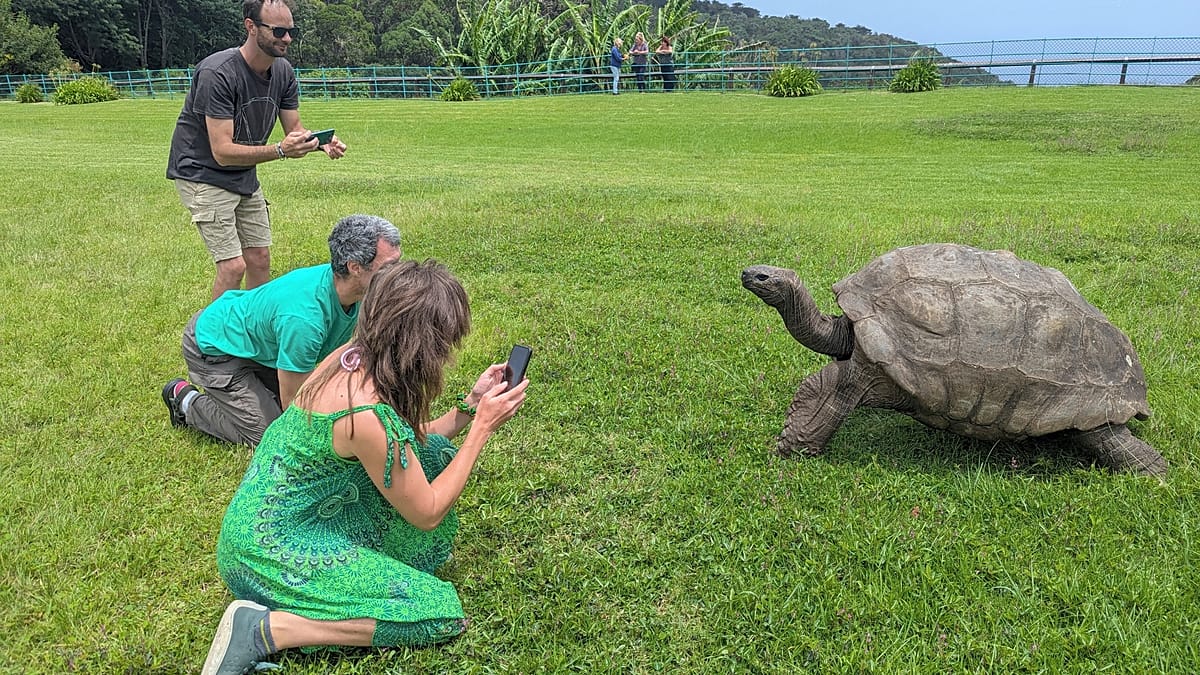
On the remote South Atlantic island of St Helena, a slow-moving resident has just marked another milestone. Jonathan, a Seychelles giant tortoise, is now 192 years old, cementing his status as the world's oldest living land animal. His birthday, celebrated this week, draws attention not just to his remarkable longevity, but to the island's unique place in natural history.
A living witness to centuries of change
Jonathan hatched around 1832, during the reign of King William IV, and has lived through the reigns of seven British monarchs, two world wars, and the birth of the European Union. He arrived on St Helena in 1882, when he was already a mature adult, and has been a fixture of the island's governor's residence, Plantation House, ever since. His age is verified by historical records and photographs, making him the oldest known chelonian—the group that includes turtles and tortoises—in recorded history.
Veterinarian Joe Hollins, who has cared for Jonathan for over a decade, notes that the tortoise remains in good health despite his age. "He's blind, has no sense of smell, but he still enjoys his food and has a very gentle disposition," Hollins told the BBC. "He's a symbol of resilience." Jonathan's diet consists of a mix of fruits, vegetables, and a specially formulated supplement to ensure he gets the nutrients he needs.
His longevity has made him a beloved figure on St Helena, a British Overseas Territory with a population of around 4,500. Visitors often make the pilgrimage to Plantation House to catch a glimpse of the ancient reptile, who spends his days basking in the sun, grazing on grass, and occasionally interacting with his younger companions—David, Emma, and Fred, also giant tortoises.
Jonathan's story resonates far beyond the island. In an era of rapid environmental change, his survival offers a poignant reminder of the fragility and endurance of life. Scientists have studied his genetics and biology to understand what enables such extreme longevity, with implications for aging research. His shell, marked by the wear of nearly two centuries, is a living archive of a world that has transformed dramatically.
For Europeans, Jonathan's life intersects with colonial history and the expansion of global trade. St Helena was a key stop for ships traveling between Europe and Asia, and the island's role in the Napoleonic Wars—Napoleon was exiled there in 1815—adds another layer to its historical significance. Jonathan's birth predates the unification of Italy and Germany, and he has outlived the empires that shaped the modern continent.
As the world grapples with biodiversity loss and climate change, Jonathan's continued existence is a testament to the importance of conservation. His care at Plantation House, supported by the St Helena government and the UK's Foreign, Commonwealth & Development Office, underscores the commitment to preserving such iconic species.
While Jonathan's age is extraordinary, he is not alone in his longevity. Other giant tortoises have lived over a century, but none have been documented as long. His record is a reminder that some of the planet's most ancient creatures still walk among us, offering a bridge to a past that often feels distant.
For now, Jonathan continues his slow, deliberate pace, a gentle giant whose life story is far from over. As Hollins puts it, "He's not just a tortoise; he's a piece of history that we are privileged to share."