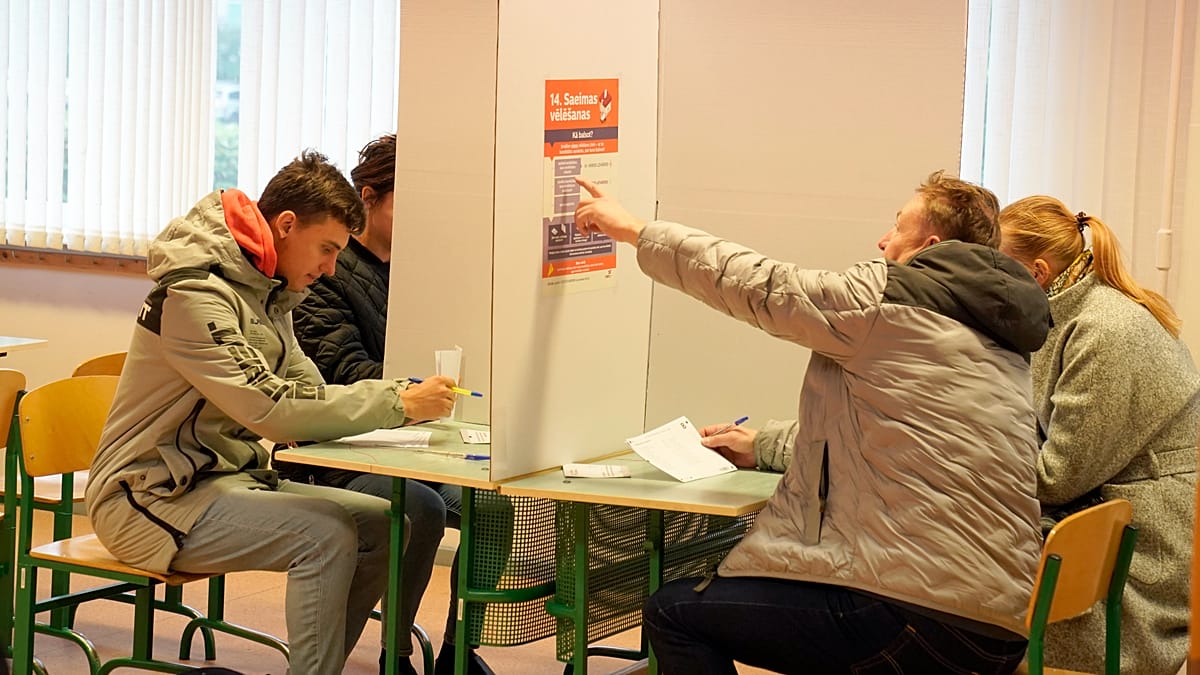
Voters across Latvia went to the polls on Saturday in a parliamentary election defined by two pressing issues: the threat posed by neighbouring Russia and the rising cost of living. The Baltic state, a crucial part of NATO's eastern flank, has seen broad public support for Ukraine in its war against Moscow, and analysts say that stance is unlikely to shift dramatically.
“The attitude towards Russia is the main reason for Latvians' Western, NATO and European anchoring,” a Western diplomat in Riga told reporters, adding that major political changes would be hard to imagine. Polls suggest the centre-right United List, led by Prime Minister Andris Kulbergs, will emerge as the largest party in the Saeima, the country's parliament.
However, the current governing coalition—comprising United List, New Unity, the nationalist National Alliance, and the Union of Greens and Farmers—is expected to lose seats, and its future in its present form looks uncertain. Partial results are due on Saturday evening, with preliminary official results expected on Sunday.
Security dominates the agenda
For many Latvians, security is the top concern in a country that was annexed by the Soviet Union and ruled from Moscow for much of the 20th century. Roberts Kits, an analyst at the Riga-based think tank LaSER, said that “defence and security will be the priority.” Apart from a few dissenting voices, he noted, there is broad consensus on maintaining military spending at nearly five percent of GDP and on continuing support for Ukraine.
The economy, however, is equally pressing. Latvia remains the least affluent of the three Baltic states in terms of living standards, despite significant progress since joining the EU in 2004. Growth is sluggish, and voters frequently cite the cost of living, the state of the healthcare system, and strained public finances as major grievances. Regional disparities compound these problems: around Riga, GDP per capita reached 101 percent of the European average in 2024, according to a Brussels report, but in other regions it falls below 50 percent.
The eastern region of Latgale, home to a large Russian-speaking minority and suffering from severe depopulation, is particularly affected. “The most important thing is the lack of young people, the lack of good jobs,” said Aigars Soikants, a 30-year-old resident of Daugavpils, the country's second-largest city. “There isn't enough work… People are leaving,” he added, noting that 90 percent of the city's population is Russian-speaking. Soikants said he plans to vote for “a centrist or right-wing party, which acts in the interest of the country.”
Populist surge
As in other European nations, economic discontent has boosted populist parties ahead of the vote. Sovereign Power (Suverena vara, SV), which is critical of aid to Ukraine and increased military spending, is polling at nine percent and could become the second-largest force in parliament. Critics label the party pro-Russian; its leader, Julija Stepanenko, focuses on Latvia's economic difficulties. The party remains politically isolated and, barring a major upset, has little chance of joining a future government.
Vjaceslavs Stepanenko, head of SV's local list in Latgale and husband of the party's chairwoman, carefully avoids the word “Ukraine” and advocates “stopping all aid to any foreign state.” He told AFP: “We are the ones who need help, not the other way around.” Another populist force, Latvia First (LPV), also polls at nine percent. Its businessman leader, Ainars Slesers, is often compared to US President Donald Trump. LPV combines a conservative message with promises of economic revival, and unlike SV, it could become a viable coalition partner. “The big question is whether the United List will cooperate with Slesers' party,” said political analyst Sigita Struberga.
The Russian-speaking vote
Russian-speakers, who make up about 35 percent of Latvia's population, have long supported the Harmony party, but that bloc has fractured. Harmony, which won several elections without ever entering government, lost all its seats in 2022 and has little chance of returning. “We should not look at Russian-speaking voters as a single bloc with a uniform electoral behaviour,” analyst Kits said. While identity issues remain, a growing share of this electorate now votes based on economic and social concerns.
Valentin Trofimov, a 62-year-old watch repairman from Daugavpils, told AFP he would vote for Slesers' party. In his view, the country “lacks money for everything,” including transport, education, and medicine. “Wages are too low,” he said.
As the results come in, the shape of Latvia's next government will hinge on whether the United List can forge a coalition that addresses both security and economic anxieties. The outcome will be closely watched across Europe, given Latvia's frontline role in NATO's eastern defence and its firm support for Ukraine amid ongoing Russian aggression.