Lausanne's Vaudoise Arena became the heart of European judo this weekend as the Grand Slam opened with a blend of elite competition, institutional milestones, and a renewed commitment to inclusivity. For Swiss judo, the day carried particular weight: the country formally secured the right to host the 2028 World Championships, a decision that underscores its growing influence in the sport.
A contract signed, a decade of judo ahead
Before the first contest, International Judo Federation president Marius Vizer and Swiss Judo Federation president Sergei Aschwanden signed the agreement bringing the 2028 Worlds to Switzerland. The announcement was met with applause from a crowd that included local dignitaries and international sports officials. Vizer then officially declared the Grand Slam open, with speeches from Emilie Moëschler, Lausanne's director of sports and social cohesion, Christelle Luisier Brodard, president of the Council of State of Vaud, Aschwanden, and Damien Antoine, president of the Deaf International Judo Federation.
The ceremony also honoured Kazuhiro Mikami Sensei, who received his 10th dan, the highest rank in judo. The recognition, rare and prestigious, highlighted the sport's deep roots in tradition even as it evolves.
Adaptive judo on the same tatami
Continuing a theme that has defined this event, deaf judoka competed alongside their world tour counterparts, sharing the same mats and the same intensity. The integration, which began on the opening day, reflects a broader push within the IJF to unify all disciplines of the sport. For the athletes, it was a chance to test themselves against a different level of competition; for the spectators, a reminder that judo's appeal transcends physical differences.
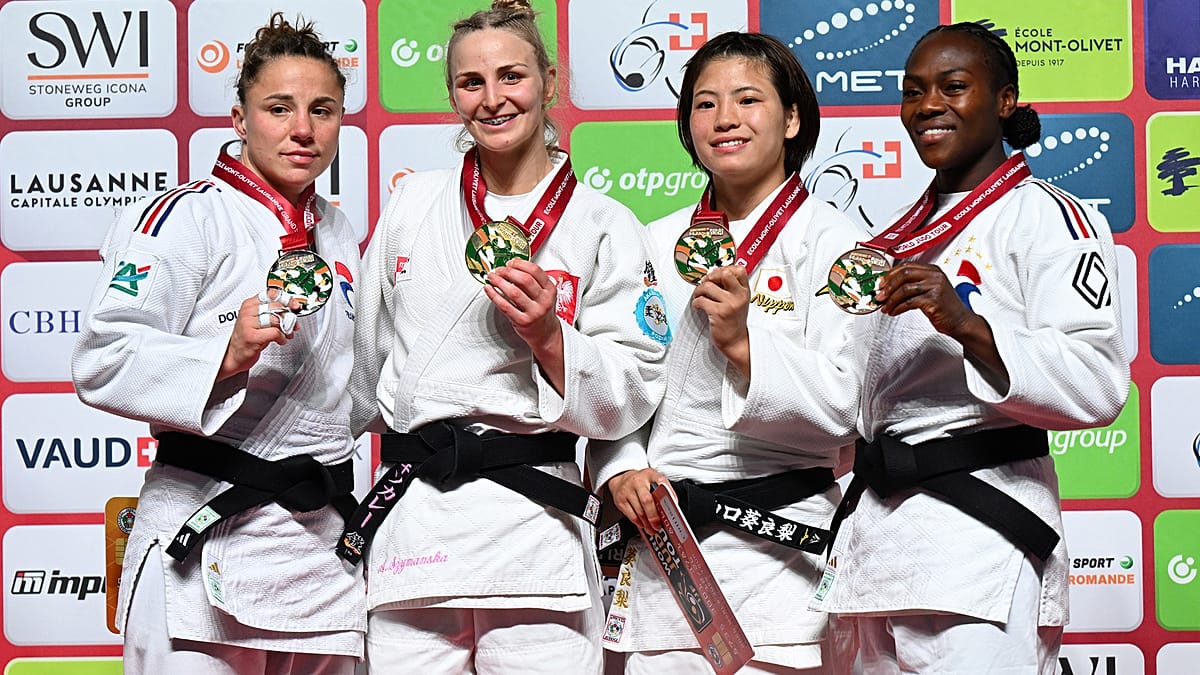
On the mat, the action delivered. In the women's -63 kg final, Poland's Angelika Szymanska capitalised on a failed attack from Manon Deketer, locking in her trademark arm lock for the win. IOC Olympic Games executive director Christoph Dubi presented the medals.
The -73 kg final saw Daniel Cargnin of Brazil stage a remarkable comeback. With Swiss world champion Nils Stump watching from the stands, Cargnin produced a huge counter to take gold, earning his medal from ASOIF president Ingmar De Vos.
Germany's Miriam Butkereit and Giovanna Scoccimarro met in the -70 kg final, with Butkereit judged the victor in a closely contested bout. Simon Benhamou, CEO of CBH Bank, awarded the medals.
In the -81 kg category, Kazakhstan's Abylaikhan Zhubanazar showcased his speed with a lightning-fast foot sweep for a yuko, enough to secure the title. IOC member Mustapha Berraf handled the medal ceremony.
For the host nation, the highlight came from Aurélien Bonferroni, whose bronze medal in the -73 kg category sparked celebrations among the Swiss supporters. His performance capped a strong second day for the Swiss team, which had shown promise across several weight classes.
The event also carried a broader significance for Lausanne, already known as the Olympic capital. The city's ability to stage a Grand Slam while hosting the signing of a future World Championships contract reinforces its status as a hub for international sport. As the final day approaches, the focus shifts to the remaining categories and the chance for more home success.
For those following the sport, the weekend in Lausanne has been a reminder of judo's capacity to bring together nations, disciplines, and generations. The 2028 Worlds will give Switzerland another opportunity to showcase that spirit on the global stage.