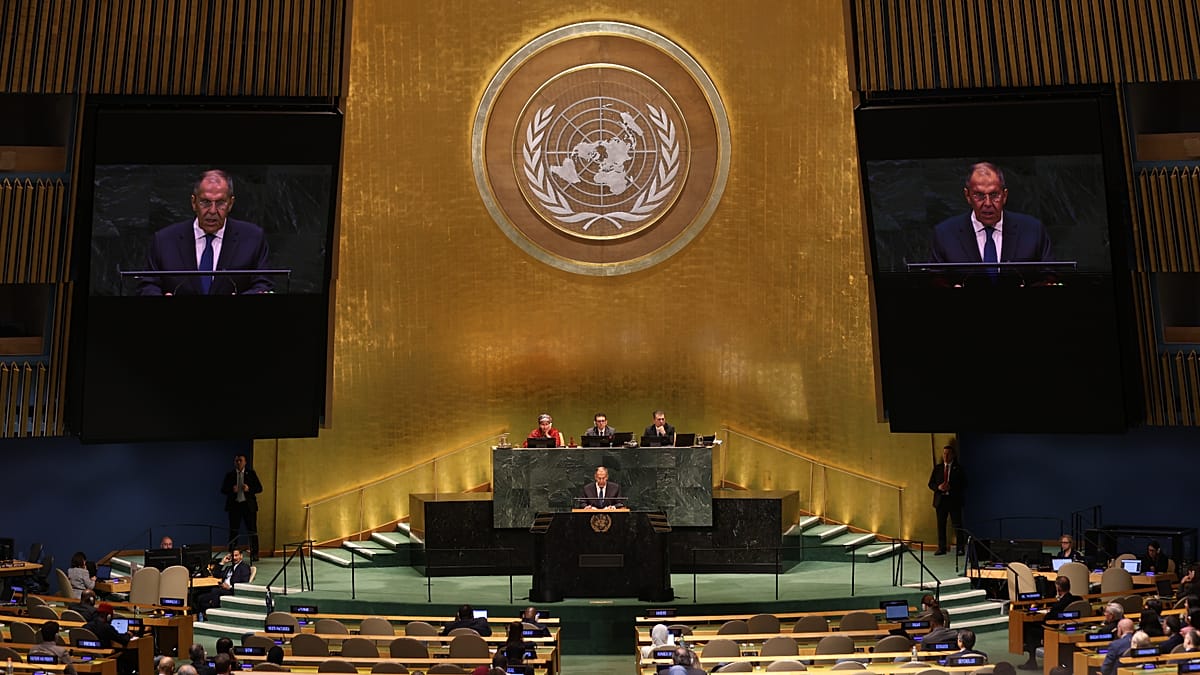
Russian Foreign Minister Sergey Lavrov has brushed aside Germany's appeal to step back from what Berlin calls a dangerous path of escalation, using a meeting on the sidelines of the United Nations General Assembly in New York to accuse the German government of being Ukraine's principal backer.
Lavrov met German Foreign Minister Johann Wadephul on Saturday, shortly before delivering his address to world leaders. According to a German delegation official cited by the Associated Press, Wadephul urged Moscow to abandon its "dangerous path of escalation" toward Europe, while signalling that Berlin remained open to improving ties with Russia if the Kremlin showed genuine willingness to end its war in Ukraine.
Speaking at the General Assembly, Lavrov turned his attention to German Chancellor Friedrich Merz, who has spoken of making Germany a leading military power in Europe once again. "Does Berlin understand what this could lead to? Did they not learn the lessons of World War II?" Lavrov asked.
In a press conference after his speech, the Russian diplomat was asked about his exchange with Wadephul and the state of Russian-German relations. "Nothing new came from that initiative of the foreign minister," he told reporters. "He simply reiterated his official public position condemning Russia. Can you judge for yourself whether that counts as dialogue or not?"
Leipzig drone dispute deepens rift
The friction between Berlin and Moscow reached a new peak in early September, when Germany accused Russia of orchestrating a drone attack at Leipzig/Halle airport earlier this year. Wadephul announced retaliatory measures, including the closure of Russia's consulate in Bonn and its cultural centre in Berlin, along with tighter border controls for Russian nationals and increased pressure on Russia's so-called shadow fleet.
The Russian embassy in Germany rejected the allegations as "unsubstantiated, absurd, and contrary to common sense," and warned of consequences. Ambassador Sergey Nechayev said the German measures represented "an unprecedented escalation in Russian-German relations" that would not go unanswered, with the German government bearing full responsibility.
Lavrov, for his part, dismissed the incident as an "unclaimed drone" and accused Germany of jumping to conclusions. The episode has further poisoned an already fraught relationship, one that many European diplomats had hoped might stabilise after the initial shock of Russia's full-scale invasion of Ukraine.
The dispute comes as European security concerns mount, with recent incidents such as Finnish and Swedish jets intercepting Russian aircraft over the Gulf of Finland and a Russian helicopter briefly violating Polish airspace near Kaliningrad underscoring the volatility of the region.
In his UN speech, Lavrov accused the United States of having "destroyed the European security system and created a Russophobic regime in Kyiv," and said the West's aspiration to inflict a strategic defeat on Russia would lead "war mongers" into a "strategic dead end."
Ukrainian President Volodymyr Zelenskyy, responding to Lavrov's remarks, said it was clear the Kremlin was not preparing to end the war. "Putin always finds some lame excuse – not to meet, not to hold a trilateral, not to talk, not to end it, not to stop the killing," Zelenskyy said in a video address. "He is looking for excuses to keep waging the war."
The exchange at the UN highlights the widening gulf between Moscow and European capitals, with Germany now firmly aligned with Ukraine's defence efforts. Berlin's recent push to expand EU procurement rules, which has already risked a rift with Paris, is part of a broader effort to bolster European defence capabilities in the face of Russian aggression.
As the war grinds on, European leaders are also weighing intelligence warnings about potential Russian drone strikes on southern Europe via merchant ships, a scenario that the CIA has reportedly flagged. For now, Lavrov's dismissive tone suggests that dialogue with Moscow remains a distant prospect, and that the continent must brace for continued tension.