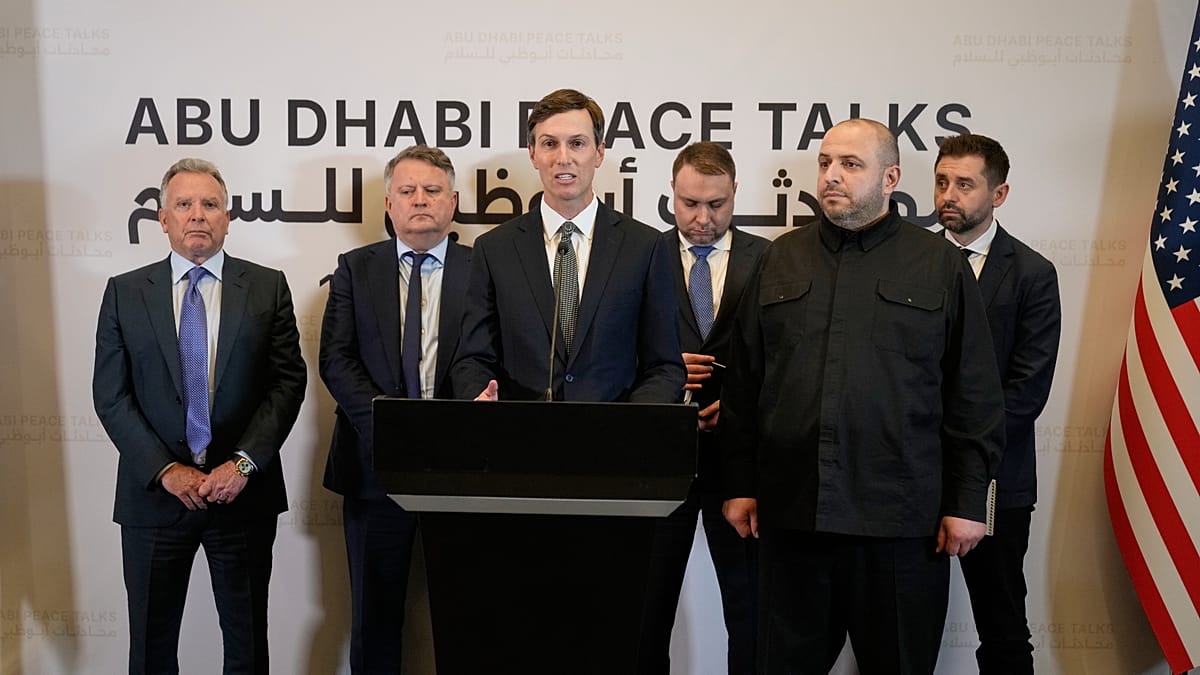
After two days of intensive negotiations in Abu Dhabi, Ukrainian and Russian delegations have agreed in principle to a large-scale prisoner exchange, the first tangible outcome of direct talks between the two sides in nine months. However, the discussions, mediated by the United States, failed to produce any progress on the core issues of a ceasefire or territorial disputes.
US envoy Jared Kushner announced the agreement on Wednesday, stating that the final numbers would be confirmed the following day. "One of the positives is we agreed that we're going to have the biggest humanitarian release of prisoners, which we're going to finalise the numbers tomorrow," Kushner said in Abu Dhabi.
Ukraine's chief negotiator, Rustem Umerov, and his Russian counterpart, Vladimir Medinsky, both confirmed the planned exchange, though neither provided details on its timing or scale. Ukrainian President Volodymyr Zelenskyy indicated on Tuesday that negotiators were discussing an exchange of 1,000 prisoners from each side, potentially rising to 1,500 each.
Limited progress on core issues
The prisoner swap marks the most concrete outcome of the first direct negotiations between Kyiv and Moscow since a round in Geneva in February that ended without a breakthrough. A similar agreement to exchange 1,000 prisoners each was reached during talks in Istanbul in May 2025, but no ceasefire was achieved then either.
Russia continues to demand that Ukraine withdraw from territory in the eastern Donbas region still under Kyiv's control, while Zelenskyy has insisted that territorial decisions must be addressed at the leaders' level. Moscow has also rejected calls for an immediate ceasefire, insisting on broader security arrangements before agreeing to halt hostilities.
US envoys Jared Kushner and Steve Witkoff are scheduled to travel to Moscow on Thursday to meet Russian President Vladimir Putin, before heading to Dublin for talks with Zelenskyy. The move underscores Washington's direct engagement in the peace process, even as European representatives remain on the sidelines.
Europe's role questioned
European officials were present in Abu Dhabi for separate consultations with Ukrainian and US representatives but did not participate directly in the trilateral negotiations. Russia's chief negotiator Vladimir Medinsky said his delegation had not held talks with European representatives and questioned their presence.
"No, we did not communicate with them. We don't really understand in what capacity they are here," Medinsky told reporters. "We don't really understand what there is to discuss with them."
Umerov said Kyiv's delegation would hold further discussions with European partners on Wednesday, but the lack of a direct role for European officials has raised concerns about the continent's influence in shaping the outcome of the conflict. As a former NATO chief recently argued, Europe must earn its place at the table, a sentiment echoed by several EU capitals.
The talks in Abu Dhabi have also highlighted divisions within Europe over how to engage with the peace process. Rome's coalition rift over Ukraine aid surfaced as the talks began, reflecting broader disagreements among EU member states on the appropriate level of support for Kyiv and the terms of any potential settlement.
Despite the lack of a ceasefire, the prisoner exchange agreement offers a rare humanitarian bright spot. US officials noted slight flexibility on territorial issues during the talks, but no concrete proposals were put forward. The coming days will be crucial as US envoys meet with Putin and Zelenskyy, and as European leaders seek to carve out a more meaningful role in the negotiations.