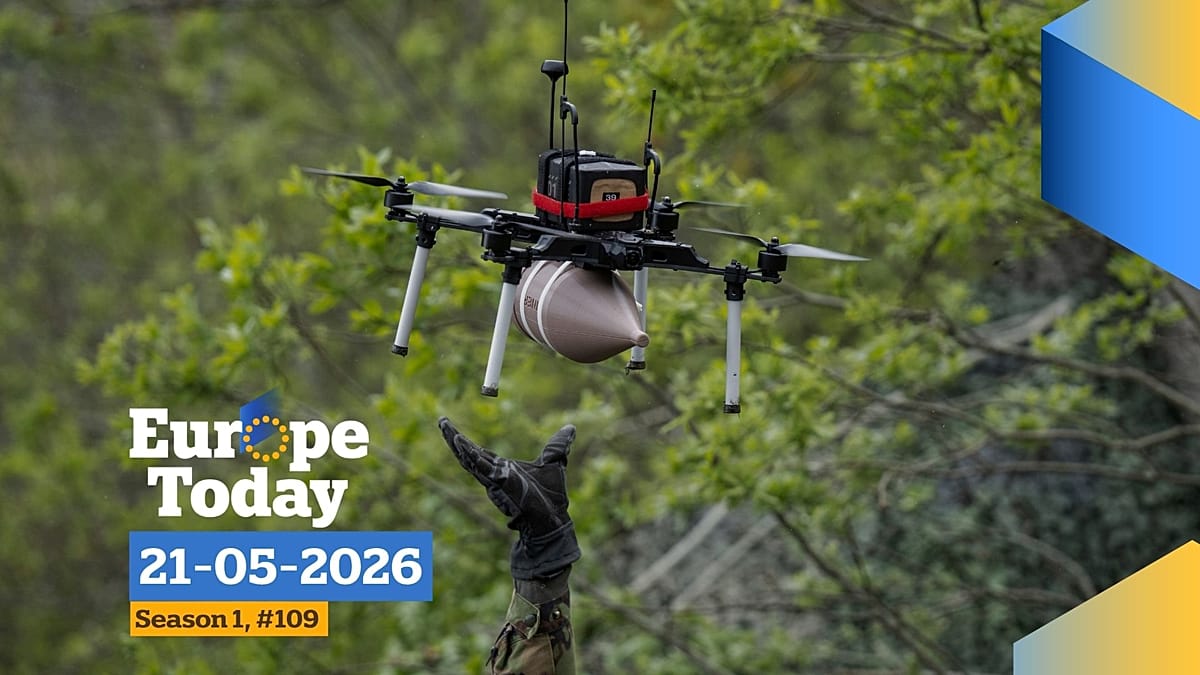
On Wednesday, a drone incursion over Vilnius brought the Lithuanian capital to a standstill, forcing President Gitanas Nausėda and other top officials to take shelter in an underground bunker. The incident, which occurred near the Belarusian border, prompted the temporary closure of Vilnius Airport and the scrambling of NATO fighter jets. It marks the most serious aerial breach in the Baltic region since the start of Russia's full-scale war in Ukraine.
European Commission President Ursula von der Leyen responded swiftly, stating that Europe would react with “unity and strength.” In a statement from Brussels, she emphasised that the security of EU member states is indivisible and that any violation of airspace will be met with a coordinated response. The incident has reignited concerns about the vulnerability of the Baltic states, which share borders with Russia and Belarus.
Political Fallout and Defence Minister Interview
In an exclusive interview with European Pulse, Lithuania’s Defence Minister Robertas Kaunas described the incursion as a “deliberate test of our readiness and NATO’s resolve.” He confirmed that the drone, believed to be of Russian origin, entered Lithuanian airspace from Belarus and flew over the capital before being intercepted. “We are working closely with our allies to identify the exact type and origin of the drone,” Kaunas said. “This is not an isolated event; it is part of a pattern of hybrid aggression.”
The incident has also sparked political turmoil in Vilnius, with opposition parties criticising the government’s response as too slow. Prime Minister Ingrida Šimonytė defended her administration, arguing that the country’s air defence systems are being upgraded but that full coverage remains a challenge. The debate echoes broader discussions across Europe about military spending and readiness, as MEPs clash over Europe's military spending.
NATO Meeting in Sweden and US Role
Meanwhile, NATO foreign ministers gathered in Stockholm, Sweden, for a two-day meeting focused on Baltic security and the alliance’s eastern flank. US Secretary of State Marco Rubio is expected to attend, signalling Washington’s continued commitment to the region. The meeting comes amid heightened tensions following the drone incursion and a series of Russian drone attacks on Ukrainian infrastructure, including a barrage that hit a residential area in Kharkiv.
Sweden, which recently joined NATO, has also ramped up its own drone capabilities, as reported in Switzerland ramps up drone capabilities amid European security shift. The Nordic country’s integration into the alliance is seen as a strategic boost for the Baltic region.
Broader European Security Landscape
The drone incident in Lithuania is not an isolated event. Across Europe, governments are grappling with the implications of drone warfare and the need for robust air defence systems. The European Union has been pushing for greater coordination on security and defence, with Commissioner for Tech Sovereignty, Security and Democracy Henna Virkkunen stressing the importance of technological resilience. In a separate interview, Virkkunen told European Pulse that “the race for critical raw materials and advanced drone technology is fundamentally about geopolitical power,” echoing the findings of a recent EU official statement on the critical raw materials race.
In Germany, Chancellor Friedrich Merz faces growing unpopularity at home, as explained by analyst Jakub Janas. Merz’s handling of defence policy and his reluctance to increase military aid to Ukraine have drawn criticism from both the left and the right. The Lithuanian drone crisis may further pressure Berlin to take a more assertive stance on European security.
Global Reactions and Other News
Beyond Europe, the incident has drawn international attention. In the Middle East, a video released by Israel’s National Security Minister Itamar Ben-Gvir showing him taunting handcuffed activists from a Gaza-bound aid flotilla has sparked condemnation. The flotilla, organised by pro-Palestinian groups, was intercepted by Israeli naval forces. The video has been widely shared on social media, prompting calls for an investigation.
In the United States, the Soros Foundation has committed $300 million to support democratic institutions amid political pressure, a move that has been both praised and criticised. Meanwhile, the Venice Biennale 2026 has opened with a spectacular display of naked bell ringers and drone carpets, showcasing the intersection of art and technology.
As the situation in Lithuania develops, European Pulse will continue to provide in-depth analysis and reporting. The drone incursion serves as a stark reminder that the continent’s security is fragile and that unity among member states is more critical than ever.