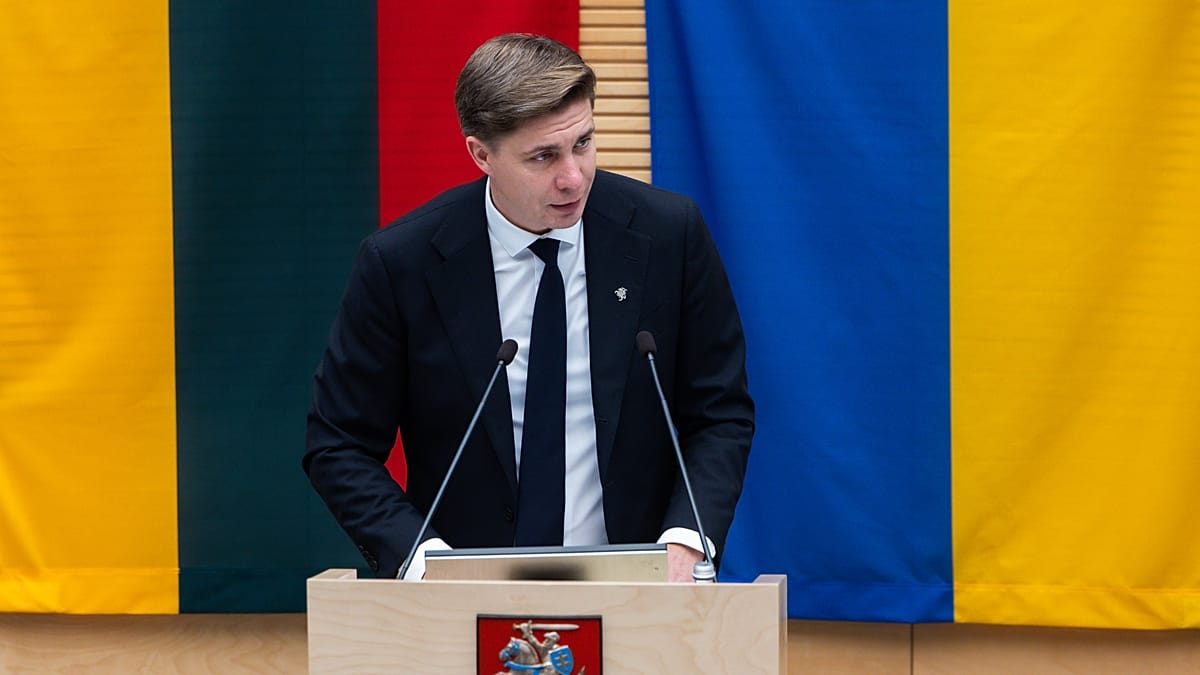
Lithuania's incoming government, led by Prime Minister Mindaugas Sinkevičius, has presented a policy agenda that marks a significant recalibration of foreign policy toward China while keeping a firm stance on Russia. In a speech to the Lithuanian parliament on Tuesday, Sinkevičius outlined a programme focused on defense, civil resilience, and economic pragmatism, reflecting the Baltic state's response to a deteriorating security environment on NATO's eastern flank.
Bordering both Russia and Belarus, Lithuania—a nation of fewer than three million people—has faced a growing number of hybrid threats in recent years, including drone incursions, airspace violations, cyber-attacks, and cross-border smuggling. These challenges have accelerated the country's defense preparations, which are now central to the new government's agenda.
Defense Spending and Innovation
The government has committed to spending no less than 5% of GDP on defense, accelerating investment in air defense and counter-drone capabilities, strengthening cybersecurity, and expanding the domestic defense industry. Sinkevičius argued that future conflicts will be determined by technological adaptation rather than conventional military superiority alone. "Future conflicts will be won by the countries that integrate innovation into their military doctrine the fastest and can learn from modern warfare," he said, pointing to drones, artificial intelligence, and autonomous systems as increasingly decisive on the battlefield.
The agenda also pledges to complete preparations for hosting a German brigade by 2027 and to ensure Lithuania's national division reaches full operational capability by 2030. To achieve "real" preparedness, the government is eyeing funds from the European Union, pushing for additional financing to reinforce NATO's north-eastern flank under the EU's 2028–2034 long-term budget (MFF).
China Reset
The clearest shift in foreign policy comes on China. The programme states that Lithuania will "normalise diplomatic relations with China to the level maintained by other EU member states," signaling a more pragmatic approach after several years of strained ties. This marks a departure from the previous Conservative-led coalition, which allowed Taiwan to open a representative office in Vilnius in 2021, prompting China to downgrade diplomatic relations and impose economic restrictions.
During the agenda's presentation, Conservative MP Žygimantas Pavilionis questioned the prime minister about the perceived lack of concern over China's threat. Sinkevičius responded, "I don't feel either love or dislike toward China," adding that his two foreign policy priorities are security and economic cooperation. The shift was foreshadowed last month when Lithuania paused negotiations with Taiwan on an economic cooperation action plan, citing "changes in the domestic political environment," according to the foreign ministry.
At the EU level, Lithuania aligns with France, Italy, Spain, and the Netherlands—countries that recently called for broader use of tariffs and other defensive trade instruments to counter China's unfair trade practices. This pragmatic approach mirrors broader European efforts to balance economic interests with security concerns, as seen in debates over the EU-Mercosur trade deal and its implications for China's influence.
Stance on Russia
While the government rethinks its approach to China, its policy toward Russia remains unchanged. The programme commits Lithuania to taking "active measures" to preserve Russia's international isolation and to continue coordinating with allies to maintain pressure through sanctions and other measures. Vilnius sees no prospect of normal relations with Russia while it continues its war against Ukraine and will seek to ensure frozen Russian state assets are used for Ukraine's reconstruction, in line with EU and international law.
The government reiterates unwavering support for Ukraine, arguing that "the only path to restoring a stable and just peace in Europe" is a Ukrainian victory and the restoration of the country's territorial integrity. It also commits to supporting Ukraine's reconstruction and long-term economic recovery. Belarus is described as another key security challenge, with the programme pledging increased pressure on Minsk if it continues supporting Russia's war or carrying out hybrid attacks against the EU.
This hard line on Russia aligns with recent European actions, such as the UK sanctions on Russian scientists over chemical weapons use, and underscores the broader European security context.
Upcoming EU Presidency
As Lithuania will hold the rotating presidency of the Council of the EU from January 2027, the government aims to shape debates on competitiveness, defense, security, safeguarding democracy, food security, and Europe's global role. Vilnius plans to use negotiations on the EU's next long-term budget to push for higher defense spending, increased investment in military infrastructure, and stronger support for the bloc's defense industry, while protecting cohesion funding and agricultural payments. The programme also reiterates support for Ukraine and Moldova's EU accession and calls for a stronger Common Security and Defence Policy.