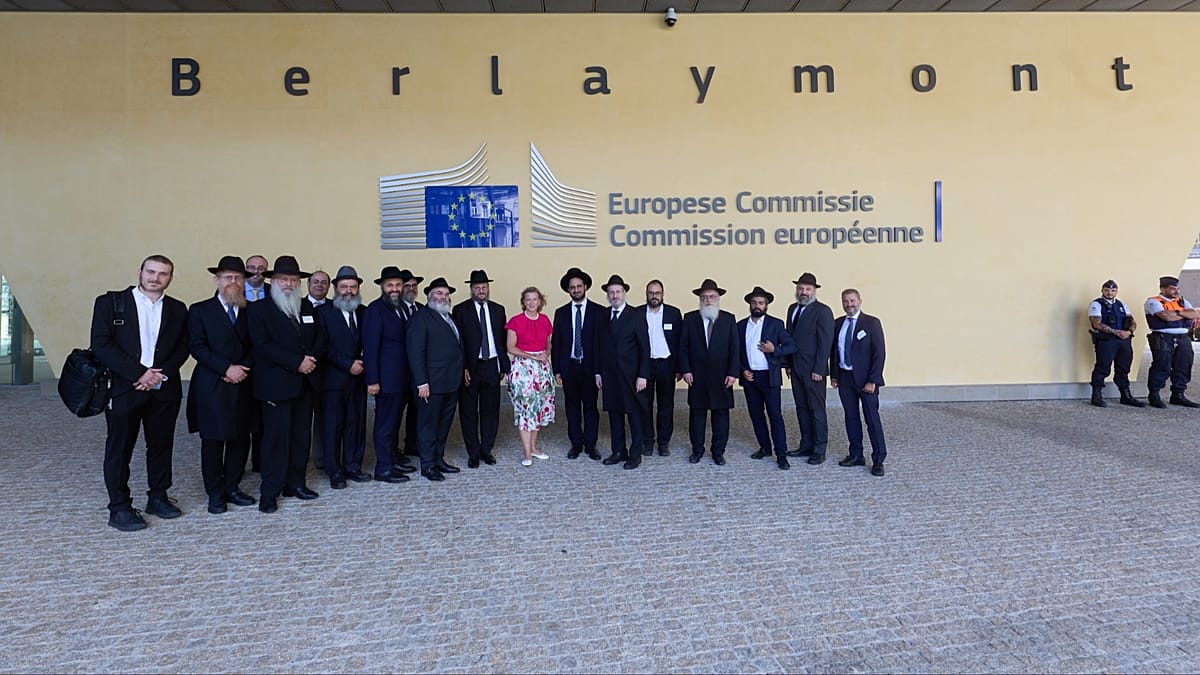
In a Brussels meeting room last week, an unusual tableau unfolded: the chief rabbi of Iran sat alongside rabbis from Morocco, Kazakhstan, and Nigeria, across from three European commissioners and ambassadors from Morocco, the United Arab Emirates, and Kazakhstan. For Rabbi Mendy Chitrik, founder of the Alliance of Rabbis in Islamic States (ARIS), the presence of envoys from three Muslim-majority governments was itself the point.
Chitrik argues that Europe, for all its diplomatic engagement with the Muslim world, systematically overlooks a crucial interlocutor: the Jewish communities that have lived there for centuries. “For many Europeans, Jewish life there belongs in a museum,” he says. “It should be part of the conversation.”
Experience Beyond Reports
The rabbis in that room carry something no policy paper can supply: lived experience. For generations, Jews in Muslim-majority societies have navigated life as visible minorities while maintaining working relationships with governments, clerics, and neighbours. Iran’s chief rabbi, Yehuda Gerami, told the commissioners his community has lived there for more than 2,500 years, numbers close to 20,000, and asks not for politics but for understanding and practical support. “We are loyal citizens, deeply rooted in the countries we call home,” he said.
It would be dishonest to romanticise this world. Across the region, ancient communities were devastated in the twentieth century; the 1941 Farhud pogrom foreshadowed the collapse of Iraqi Jewry, and hundreds of thousands left amid expulsion, persecution, and seizure of property. Their descendants form a large part of Jewish life in France today.
But collapse is not the whole story. Morocco has woven Jewish heritage into its national story more than any other Muslim-majority state; in Brussels, a rabbi from Casablanca recited a prayer for its king. Azerbaijan, one of Israel’s closest partners in the Muslim world, honours a fallen Jewish soldier as a national hero. In the Gulf, new communities have taken root since the 2020 Abraham Accords. Jewish life in the Muslim world is neither a tale of unbroken continuity nor of complete disappearance; it is loss, resilience, and renewal at once.
Renewal Under Strain
That renewal is now under strain. Since October 2023, public Jewish life has grown more discreet. In the UAE it retreated after the murder of Chabad’s Rabbi Zvi Kogan in late 2024; in Dagestan, a mob stormed Makhachkala airport hunting for arriving Jews; in Tunisia, a guardsman opened fire near the Ghriba synagogue on Djerba, killing five. And yet Djerba’s community — one of the last strongholds of indigenous Jewish life in the Arab world — keeps building, and ARIS has just rebuilt a mikvah in Tunis. None of these communities had any hand in the events that now endanger them.
Endurance is unglamorous work: kosher supervision, marriages, burials, and schooling in places with almost no Jews left. In 2021 it meant getting Zebulon Simentov, long called the last openly practising Jew in Afghanistan, safely out. It has meant welcoming more than a hundred Muslim theology students into an Istanbul synagogue and answering every question honestly. “They did not all leave agreeing with us — that was never the point,” Chitrik notes. “They left having met Jews, rather than ideas about Jews.” And it means answering the phone when governments stop speaking. Trust cannot be improvised once a crisis begins; it has to exist already.
What Europe Can Do
Europe can help sustain that trust with tools it already has. The requests ARIS brought to Brussels are modest: recognise synagogue registrations, grant visas so rabbis can reach communities too small to have their own, protect cemeteries, let religious articles cross borders safely. None of it requires new machinery. The EU already runs interfaith work in Syria and trains scholars in Egypt to counter extremism. Extend that same effort to the Jews of the Muslim world.
Then go further. Europe rightly teaches the Holocaust and funds the fight against antisemitism; it should also introduce young Europeans — including young Muslims — to the living Jewish communities of the Muslim world. Invite the rabbis of Istanbul, Casablanca, Baku, Almaty, Abuja — and yes, Tehran — into its universities and public forums. No syllabus can replace a conversation with someone who has spent decades as a Jewish minority in a Muslim-majority state.
There is a shared interest here, too. Jewish and Muslim communities increasingly defend the same freedoms: when kosher slaughter is challenged, halal is rarely far behind, and when circumcision is questioned, both families face the same doubt. Rabbis and imams need not agree on theology, or on the Middle East, to stand together for basic rights — not as ceremonial interfaith dialogue but as practical democratic cooperation.
Beyond the Nostalgia of al-Andalus
Europe reaches for medieval al-Andalus because it is a flattering precedent: proof that pluralism has European roots, and a golden age safely enough in the past to be admired without obliging anyone to act now. There is something real to admire — the Córdoba of the translators produced a genuine flourishing of philosophy, science, and poetry that Muslims, Christians, and Jews built together, much of it passing to the rest of Europe. But it was never quite the paradise the nostalgia describes — and Arab writers are often the first to say so. The longing for al-Andalus has always run deepest in the Arab world itself, yet its coexistence rested on hierarchy and was broken more than once by persecution. Maimonides himself, born in Córdoba, fled as a boy when the Almohads told the Jews to convert or leave.
Chitrik’s message is that coexistence is not a medieval memory to be admired from a distance. It is a living, fragile reality maintained by communities across the Muslim world today. Europe, he argues, should engage with them not as relics but as partners — because they offer something no report can supply: the experience of making pluralism work, every day, under pressure. For a continent that needs a shared story, that is a lesson worth learning.