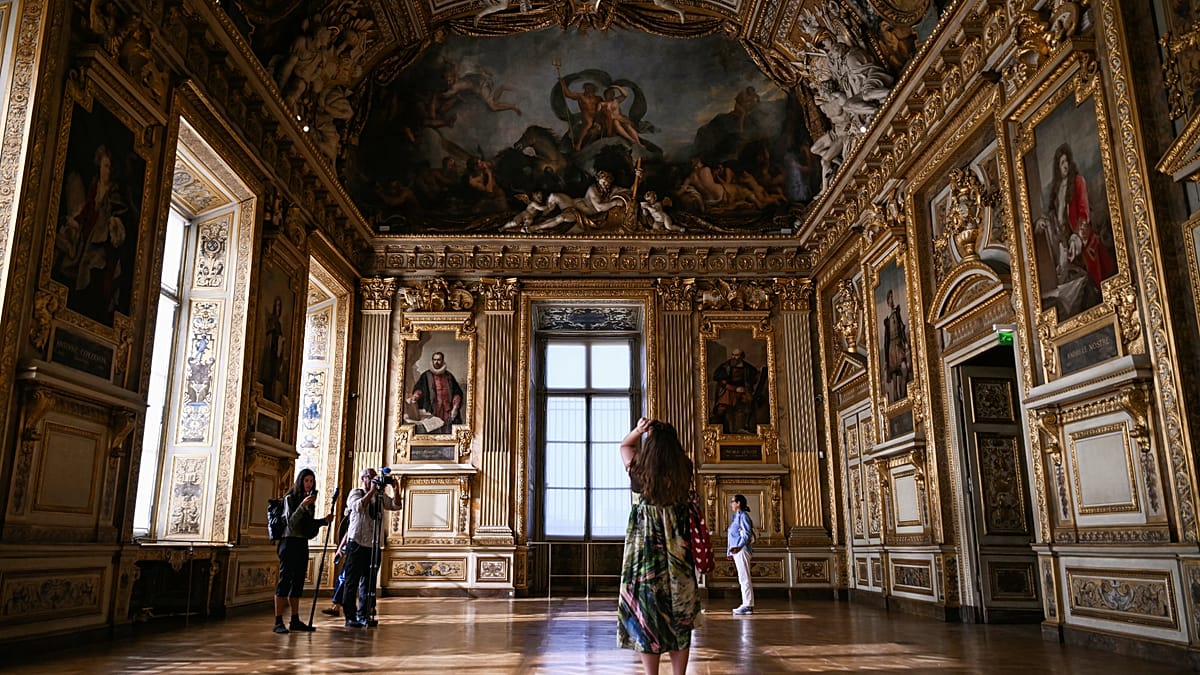
Nearly six months after a brazen daylight robbery shook the Louvre, the Apollo Gallery has reopened to the public — but not as a jewel box. The 17th-century ceremonial gallery, originally built for Louis XIV, now stands empty of display cases and treasures, returning to its historical role as a state passageway.
The decision to strip the gallery of its exhibition function follows the October 2025 theft of eight French Crown Jewels, estimated at €88 million. A four-man commando unit used a lorry-mounted lifting platform to break into the gallery in broad daylight, making off with pieces that included the legendary Régent diamond and the Sancy diamond.
The robbery exposed serious security vulnerabilities at the world's most-visited museum, which welcomed nearly 9 million visitors in 2024. Within weeks, Laurence des Cars, the Louvre's president, resigned amid criticism over the museum's preparedness. Her successor, Christophe Leribault, has since overseen a comprehensive security review.
A Gallery Restored to Its Original Purpose
The Apollo Gallery, with its gilded ceilings and allegorical paintings by Charles Le Brun, was inaugurated in 1663 as a ceremonial hall for the Sun King. It later housed the Crown Jewels from the 18th century until the French Revolution, and again from the 19th century until the 2025 theft. Now, Leribault says the space will be used for temporary exhibitions and official receptions, not permanent displays.
“The gallery is returning to its original vocation as a state gallery,” Leribault told journalists during a preview. “No display cases, no jewels. The survivors of the collection will be shown in a new, secure room designed as a windowless strongroom.”
The surviving jewels — those not stolen in the heist — will be relocated to a purpose-built vault within the museum, with reinforced walls, biometric access, and 24-hour surveillance. The design is expected to be completed by early 2027.
The theft itself remains under investigation. French police have made several arrests, and suspects revealed they were recruited just days before the heist, suggesting a highly organized operation. The jewels have not been recovered, and authorities believe they may have been smuggled out of the country.
The incident has prompted a broader reassessment of security at European museums. The Louvre's case is not isolated: in 2023, thieves stole a Van Gogh from a Dutch museum, and in 2024, a gang targeted the Green Vault in Dresden. The European Union has since proposed a directive on museum security standards, though it remains under debate.
For now, the Apollo Gallery's reopening marks a symbolic step forward. Visitors can once again admire the ceiling painted by Eugène Delacroix and the intricate woodwork, but the empty vitrines serve as a stark reminder of what was lost. The gallery's transformation from treasure house to ceremonial hall may be permanent, reflecting a broader shift in how museums balance public access with security.
“The Apollo Gallery is a masterpiece in itself,” said art historian Marie-Laure de Rochebrune. “It doesn't need jewels to be magnificent. But the theft has changed the way we think about heritage protection in Europe.”
The Louvre plans to announce a new exhibition program for the gallery later this year, focusing on 17th-century decorative arts. Meanwhile, the hunt for the stolen Crown Jewels continues, with Interpol and Europol coordinating efforts across multiple jurisdictions.