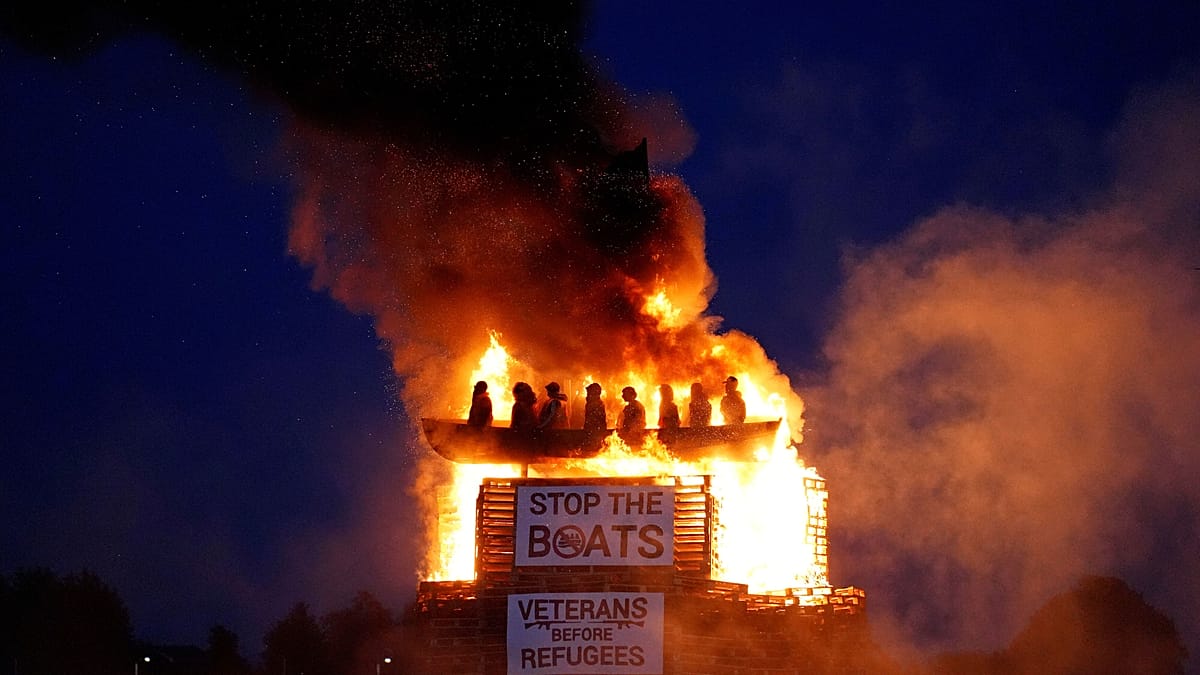
In the village of Moygashel, County Tyrone, a loyalist bonfire erected ahead of the annual Orange Order celebrations has ignited controversy. The structure, towering over the local landscape, features a replica mosque and signs bearing anti-immigration slogans, including messages such as “No to Islam” and “Stop the invasion.”
The bonfire, part of a tradition that marks the Twelfth of July festivities, has drawn sharp condemnation from across Northern Ireland’s political spectrum. Sinn Féin MP for Fermanagh and South Tyrone, Michelle Gildernew, described the display as “sectarian and racist,” calling on authorities to remove it. The Social Democratic and Labour Party (SDLP) also voiced concern, with councillor Malachy Quinn stating that such imagery “has no place in a modern, inclusive society.”
The Orange Order, a Protestant fraternal organization, has distanced itself from the bonfire. A spokesperson said the group “does not condone any form of hate speech or intimidation,” but noted that bonfires are often organized by local community groups rather than the Order itself. The Police Service of Northern Ireland (PSNI) confirmed it is monitoring the situation but has not intervened, citing the need to balance community tensions with freedom of expression.
This incident occurs against a backdrop of rising anti-immigrant sentiment in parts of the United Kingdom and Ireland. While Northern Ireland has seen relatively low levels of immigration compared to other regions, the issue has become a flashpoint in loyalist communities, where some feel their cultural identity is under threat. The bonfire’s symbolism echoes similar displays in recent years, including effigies of politicians and religious figures, which have often been condemned as divisive.
The timing is particularly sensitive, as Ireland currently holds the rotating presidency of the Council of the European Union. The Irish government has emphasized its commitment to inclusivity and human rights, a stance that contrasts sharply with the imagery in Moygashel. In a recent open consultation on its EU presidency, Dublin highlighted democratic engagement and social cohesion as priorities.
Local residents are divided. Some defend the bonfire as a legitimate expression of loyalist culture, while others express embarrassment. “It doesn’t represent me or my community,” said a Moygashel shopkeeper who asked not to be named. “We’re better than this.” Community leaders have called for dialogue to address underlying grievances, rather than allowing symbols to escalate tensions.
The controversy also raises questions about the role of the state in regulating such displays. Northern Ireland’s hate crime laws cover incitement to hatred on grounds of race, religion, or sexual orientation, but prosecutions are rare. Legal experts suggest that while the bonfire may be offensive, it likely falls short of criminal incitement unless it directly threatens violence.
Across the border, the Republic of Ireland has faced its own challenges with integration, as seen in debates over alumina exports to Russia during its EU presidency. However, the bonfire incident underscores the persistent cultural and political divides within Northern Ireland, two decades after the Good Friday Agreement.
As the Twelfth of July approaches, authorities are bracing for potential unrest. The PSNI has increased patrols in the area, while community mediators work to defuse tensions. For now, the bonfire stands as a stark reminder of the challenges facing a region still grappling with its identity in a changing Europe.