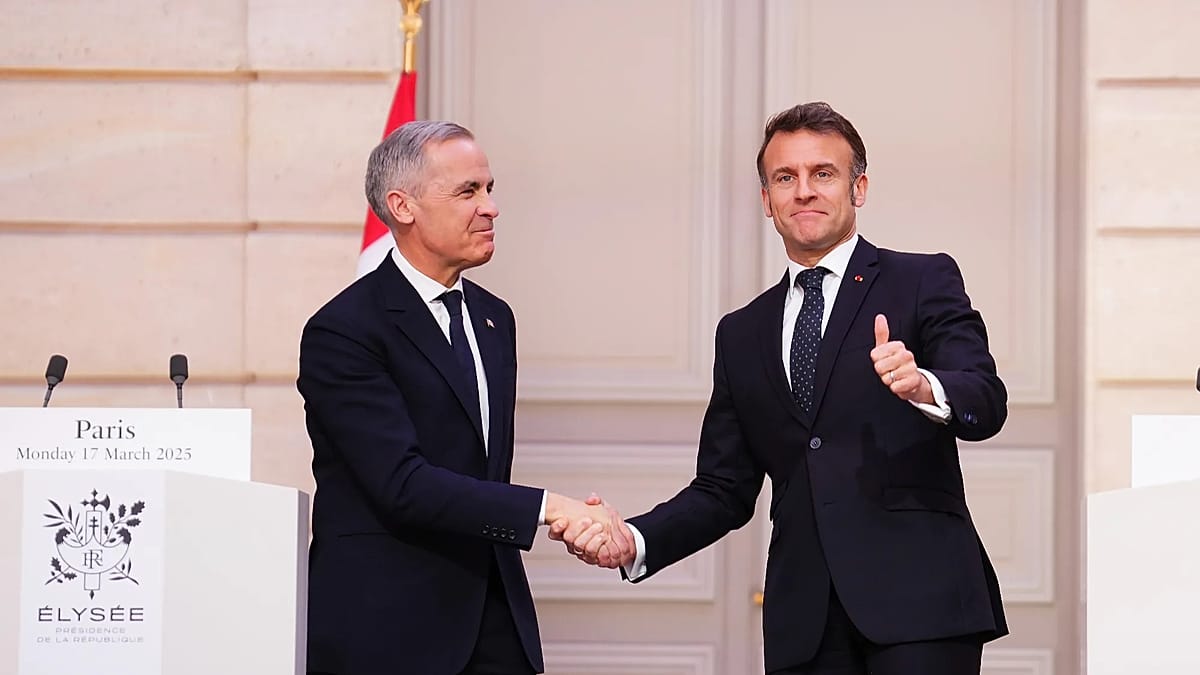
French President Emmanuel Macron spent the weekend in Saint Pierre and Miquelon, a small French archipelago off the coast of Newfoundland, in a visit aimed at reinforcing ties with Canada and charting a new course for the territory. Speaking to journalists, Macron framed the trip as a chance for the islands to "turn a new page," while downplaying any notion that the visit was intended as a provocative gesture.
"We shouldn't be so obsessed with sending messages," Macron said, adding that France has "close friends" in the region, including Canada. The French leader is due to meet Canadian Prime Minister Mark Carney on Sunday, a meeting he described as "a very strong gesture of friendship." Carney's office confirmed he would arrive around 12:30 pm local time, followed by a working lunch, a wreath-laying ceremony, and a joint statement before his return to Ottawa.
The encounter comes at a time when Canada and the European Union are drawing closer, as transatlantic relations shift under US pressure. Macron pointed to Carney's growing rapport with Brussels, noting that Canada's vast reserves of critical raw materials, rare earth elements, and liquefied natural gas (LNG) present significant opportunities for European supply security. He indicated that France and the EU would pursue contracts and arrangements to secure these strategic resources.
A strategic partnership in the making
The visit unfolds against a backdrop of heightened geopolitical maneuvering. Earlier this month, European Commission President Ursula von der Leyen announced that Canada could become the EU's first "associate member," a proposal that drew sharp criticism from US President Donald Trump. Trump called the idea "laughable" but warned that if the move were seen as "at all a hostile act," he would impose "very serious tariffs or stop trading with Europe on many things."
Trump has also stoked tensions by posting a map on his Truth Social account showing Saint Pierre and Miquelon and Greenland marked with the US flag. On Friday, the US and Denmark announced an agreement over Greenland, with Trump claiming the deal would give Washington "permanent control" of the island's security. That agreement is expected to be signed during Macron's upcoming visit to New York for the UN General Assembly.
Macron's stop in Saint Pierre and Miquelon is part of a broader European effort to deepen ties with Canada, a like-minded partner on trade, security, and climate. The EU and Canada have already forged a comprehensive trade agreement, and the prospect of associate membership would mark an unprecedented step in their relationship. Analysts see the move as a response to Washington's increasingly transactional approach to alliances.
For Saint Pierre and Miquelon, the visit carries local significance. The archipelago, with a population of around 6,000, relies heavily on fishing and tourism, and its economy has long been tied to both France and Canada. Macron's presence underscores France's commitment to the territory's development, even as its strategic importance grows in the context of Arctic and North Atlantic security.
On Saturday, Macron posted on X that he was "very proud and happy" to be in Saint Pierre and Miquelon. The sentiment reflects a broader French strategy of maintaining a presence in the region, balancing its European commitments with its overseas territories.
The meeting with Carney also comes as Canada moves to join the EU's €90bn loan package for Ukraine, a sign of converging interests on European security. Carney's recent address to the European Parliament, which drew applause, further signals a warming relationship between Ottawa and Brussels.
As Macron heads to New York for the UN General Assembly, the outcomes of his talks with Carney are likely to resonate beyond the small archipelago. The partnership being built between Canada and the EU—on minerals, energy, and security—could reshape the transatlantic landscape in the years to come.