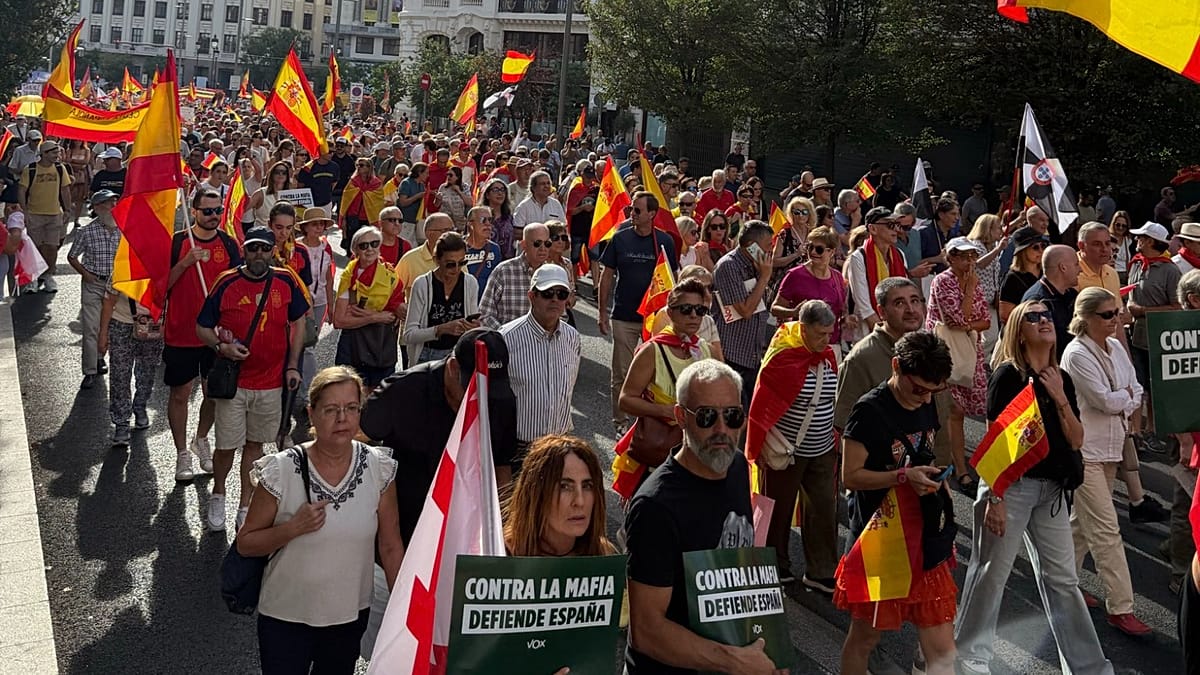
Thousands of demonstrators filled central Madrid on Saturday for the second edition of the "March for Dignity", turning the Spanish capital's streets into a stage for the country's unresolved dispute over the North African enclave of Ceuta. Organised by the civic group Sociedad Civil Española and supported by the conservative Partido Popular (PP) and the hard-right Vox, the procession set off shortly after 10am from the Plaza de Cibeles and wound its way towards the Arco del Triunfo in Moncloa, where it was due to conclude around 13:30 local time.
The marchers carried two central demands: a snap general election and visible solidarity with Ceuta, the Spanish autonomous city on Morocco's Mediterranean coast that has been at the centre of a migration standoff since late July, when tens of thousands of people crossed the border from Moroccan territory in a matter of days.
A political fault line running through Madrid
Among those at the front of the march was Vox leader Santiago Abascal, who used the occasion to attack the government of Prime Minister Pedro Sánchez in unusually blunt terms. Migrants who reached Ceuta, he argued, must be sent back to their countries of origin. "Ceuta remains invaded because Sánchez continues to be Morocco's servant; the migrant invasion is being encouraged," he said, framing the crisis as a failure of the Socialist-led coalition's foreign policy rather than a humanitarian emergency.
The first March for Dignity, staged before the mass arrivals at the end of July, drew a crowd that the Government Delegation estimated at around 40,000, while organisers claimed as many as 120,000. On 2 September, Ceuta's official day, protests were held in cities across Spain under the banner of the Spanish Federation of Municipalities and Provinces, underscoring how the issue has moved from a local border problem to a national political battleground.
The Ceuta standoff has also resonated beyond Spain's borders, with figures on the European right using it to argue that the EU's migration framework is failing at its southern edge. A French far-right MEP has already warned that the Ceuta migrant crisis remains unresolved, while senior centre-right figures in Brussels have pressed Morocco over its role in the episode.
Two months on, the situation on the ground is unchanged
Nearly two months after the influx, conditions in Ceuta remain precarious. Roughly 8,300 migrants are being housed in reception facilities set up across the city, according to official figures, while more than 4,000 are believed to be sleeping on the streets. Spanish Foreign Minister José Manuel Albares met his Moroccan counterpart, Nasser Bourita, in New York in recent days to try to unlock the impasse. Bourita pointed to "obstacles" and "controversies" that he said were being stoked in part by Spain's political class and were blocking a resolution.
Morocco has accused Madrid of obstructing the return of migrants still in Ceuta, a charge Spanish officials reject. The diplomatic friction adds another layer to a relationship already strained by broader questions of trade, security cooperation and the Western Sahara file. Rabat's own political calendar, with Morocco heading to the polls amid cost-of-living pressures, gives the dispute an added domestic dimension on the Moroccan side.
Meanwhile, Spanish authorities are continuing surveillance and assistance operations across the enclave. On Friday, the National Police arrested three Moroccan nationals living in a makeshift camp on Trampolín beach, alleging their involvement in the detention of two migrant minors. The two minors were taken to Ceuta University Hospital for treatment. That same day, 63 women who were either alone or accompanied by young children were relocated to a facility at the Hípica, part of an ongoing effort to move people off the streets.
Firefighters have also uncovered a makeshift settlement in underground tunnels in recent days, where an estimated 30 to 50 migrants are thought to have been staying — a reminder of how improvised and precarious the living arrangements have become for those who remain in limbo.
What happens next
The Madrid march is unlikely to change the arithmetic in the Spanish parliament, where Sánchez retains enough support to govern. But it signals that Ceuta has become a durable mobilising theme for the opposition, one that links migration, national sovereignty and the government's handling of relations with Rabat. For the thousands still sleeping rough in the enclave, the political argument in Madrid is a distant noise; the practical question — whether they will be returned, relocated or regularised — remains unanswered.