Marcos Rodríguez Pantoja, the Andalusian man who spent twelve years of his youth living alone in the mountains and gained fame as Spain's 'wolf boy', has died. He passed away on Saturday 15 August at the age of 80 in Rante, a hamlet belonging to the municipality of San Cibrao das Viñas in the north-western province of Ourense, where he had made his home since 2001.
Born in 1946 in Añora, a village in Córdoba province, Rodríguez grew up in a Spain still scarred by civil war and the wider conflict that had engulfed Europe. His early years were marked by extreme poverty, hunger, and abuse. His father could barely provide for the family, and his stepmother treated him with cruelty. At the age of six, his father sold him to a goatherd who took him to a remote valley in the Sierra Morena, where he was to tend livestock alongside an old shepherd. That man taught him the rudiments of survival in the wild.
When the shepherd died shortly afterwards, the boy was left entirely alone. Over the following years, he turned the wilderness into his home and found companionship among the animals around him. For twelve years, Rodríguez had no human contact at all. He learned to imitate the calls of birds, the cries of deer, and other sounds of the forest, and became convinced he could communicate with foxes, wolves, and even snakes. Whenever he heard human voices in the distance, he would hide or flee.
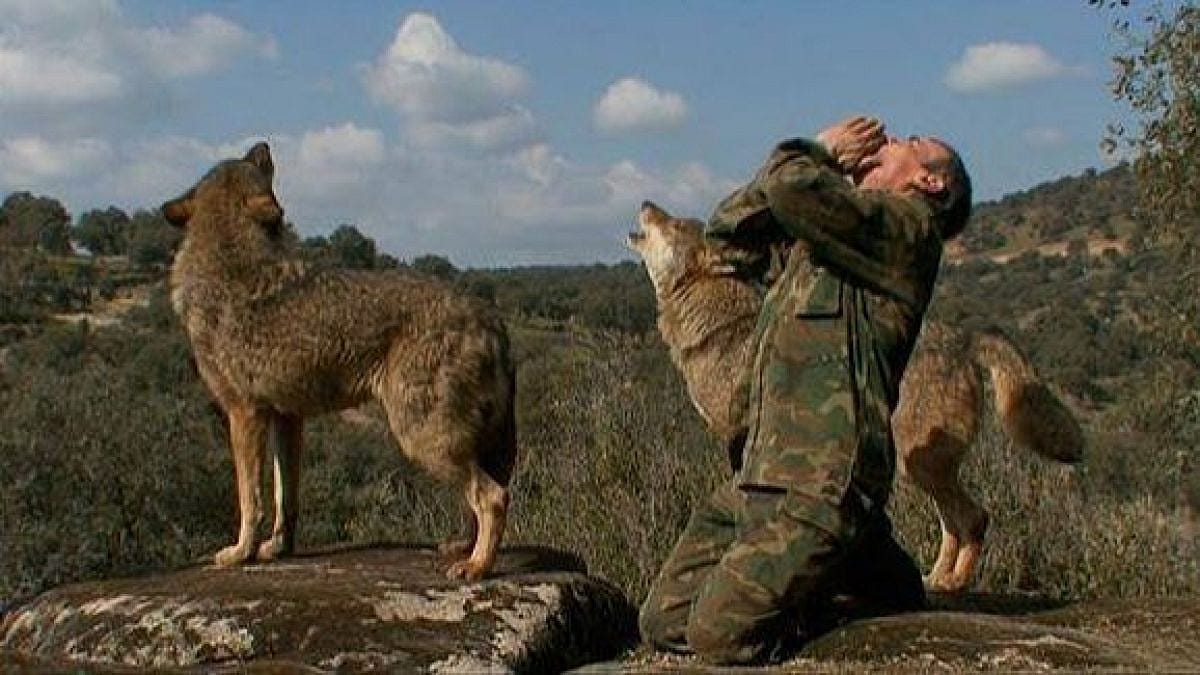
His most remarkable bond was with a pack of wolves. He gained their trust by feeding the cubs and howling to warn of danger. In an interview with anthropologist Gabriel Janer Manila, he described how the wolves accepted him: 'I cried and they jumped up onto me... then they showed me the way to their cave, the wolves' den.' Over time, a kind of symbiosis developed. 'If I wanted fish, I went to the river and fished; if I wanted a rabbit, I caught one; if I wanted a deer, I called my parents, the wolves, let out a howl, hid in the river and the wolves drove the animals down to me,' he recounted.
Janer Manila, a professor at the University of Palma de Mallorca, conducted extensive interviews with Rodríguez between November 1975 and April 1976 as part of a doctoral thesis. He later published the study as a book titled He jugado con lobos ('I Have Played with Wolves'). Janer became a friend and argued that Rodríguez survived thanks to his intelligence and imagination, gradually learning the rules and language of his non-human community.
When the Guardia Civil discovered him in 1965, he was 19 years old and had to relearn how to live in society. The adaptation was slow and painful. Rodríguez often said that he had been happy in the mountains; his real suffering began only when he was forced back into civilisation. People who knew him noted that he retained a childlike naivety and never spoke entirely fluent Spanish.
After his reintegration, Rodríguez lived in Jaén with a priest, then in Madrid with nuns, completed military service, and eventually settled in Mallorca, where he worked in hotels and restaurants. In later years, he decided to share his story to promote a better understanding of nature, which he felt people had become dangerously distanced from. He urged children to 'show more affection to your pets, because devices only need to be plugged in, but pets need love.'
His life story reached a wider audience through the 2010 Spanish film Entrelobos (released in Germany as Wolfsbrüder), directed by Gerardo Olivares. The film dramatised his years in the wild and brought his tale to international attention.
In 2010, Rodríguez returned to Añora for the first time in 60 years, where he spoke to the TVE programme Informe Semanal. Reflecting on his time in the mountains, he said: 'I was very well. I didn't know what money was, but I always had enough to eat.'
The municipality of San Cibrao das Viñas, where he had lived for over two decades, paid tribute to him on social media: 'Marcos came to Rante with a story the whole world knew. He leaves behind a story that has become ours too.'
Rodríguez's death marks the end of an extraordinary life that bridged the human and natural worlds. His story remains a powerful reminder of the resilience of the human spirit and the deep connections that can form between people and the wild.