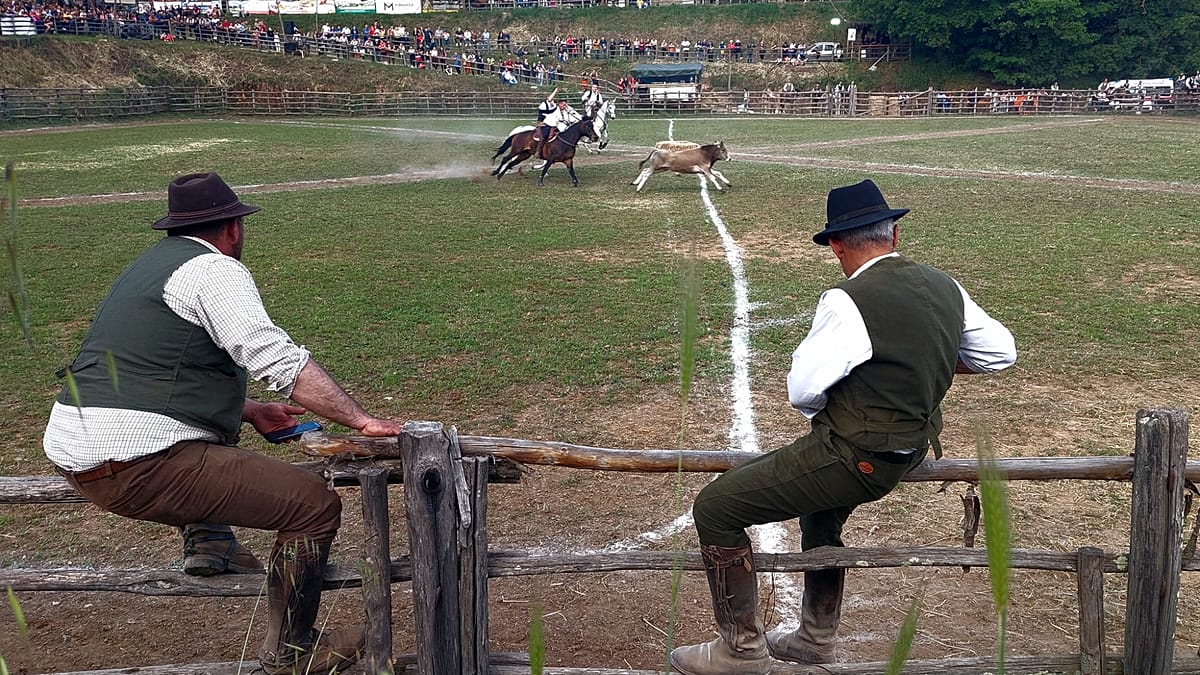
At first glance, the scene could be lifted from a Western: a rider on horseback moving cattle across open pasture. But this is not Texas; it is Canale Monterano, a town in the hills of northern Lazio, where the buttero — the Maremma cowboy — embodies a heritage far older than the American myth.
The buttero tradition traces its roots to the Etruscans, and its name comes from the Greek boutoros, meaning ox-goad. For centuries, these mounted herders were central to free-range cattle farming and rural life across the Maremma, a coastal and hilly region straddling Lazio and Tuscany. Today, the trade is fading, but a dedicated community — including the Associazione Butteri di Canale Monterano — works to keep it alive.
From Etruscan Roots to Modern Challenges
Rinaldo Camilletti, a buttero who runs a cattle and sheep farm with his son Cesare, explains that the tradition never fully died in his family. “I had uncles, my mother’s cousins. To keep the memory alive and keep the tradition going, we never abandoned it, even in our own small way,” he says.
For 27-year-old veterinarian Marta Papa, becoming a buttera was a natural choice. “Our horses and our cows were born and raised here, so all I can do is ride alongside them and accompany them,” she says. Her brother Alessandro, 21, also works as a buttero. Marta emphasises that “living in this environment is something I absolutely love; for me it really is a breath of fresh air.”
The buttero’s daily work once involved rounding up herds, weaning calves, and driving them into enclosures made of chestnut stakes, known as rimessini. Trained dogs helped navigate the hilly terrain. Branding with a hot iron — the merca — was a communal ritual, a celebration for the farm and all who took part.
Today, technology has transformed the role. Tractors and farm machinery have replaced horses for many tasks, and microchips have made branding obsolete. “Legislation has long since banned it,” Marta notes. The changes have made work more efficient, but they have also marginalised the buttero. “A lot of people no longer do this job, or at least it is no longer their main source of income,” she says. “Small everyday attentions that the buttero might have had 50 or 70 years ago have been lost.”
The Riarto: Reimagining a Festival of the Past
Every May, the Associazione Butteri di Canale Monterano organises the Riarto, a festival that recreates the pre-transhumance gatherings of the past. Twice a year, butteri would meet to exchange goods and compete in skill contests. The highlight is calf roping, using a lacciara — a non-rigid rope that makes the catch harder than in US rodeos. Once caught, the calf is symbolically branded with chalk.
The festival also includes horse-breaking demonstrations, a key skill for the buttero. The event draws locals and visitors alike, offering a glimpse into a way of life that is both resilient and evolving.
For the younger generation, the buttero’s future lies in adaptation. Marta sees her role as less about driving cattle and more about working alongside them. “We have to reinterpret tradition,” she says. “The work we do with animals today is different from a few decades ago.”
The butteri of Canale Monterano are a living link to a deep past, but they are not frozen in time. As Europe grapples with questions of rural identity and sustainability, their story — part of a broader tapestry of regional traditions — offers a model of how heritage can adapt without being lost. For more on how European communities preserve their cultural roots, see our coverage of the Bavarian Lake Procession.