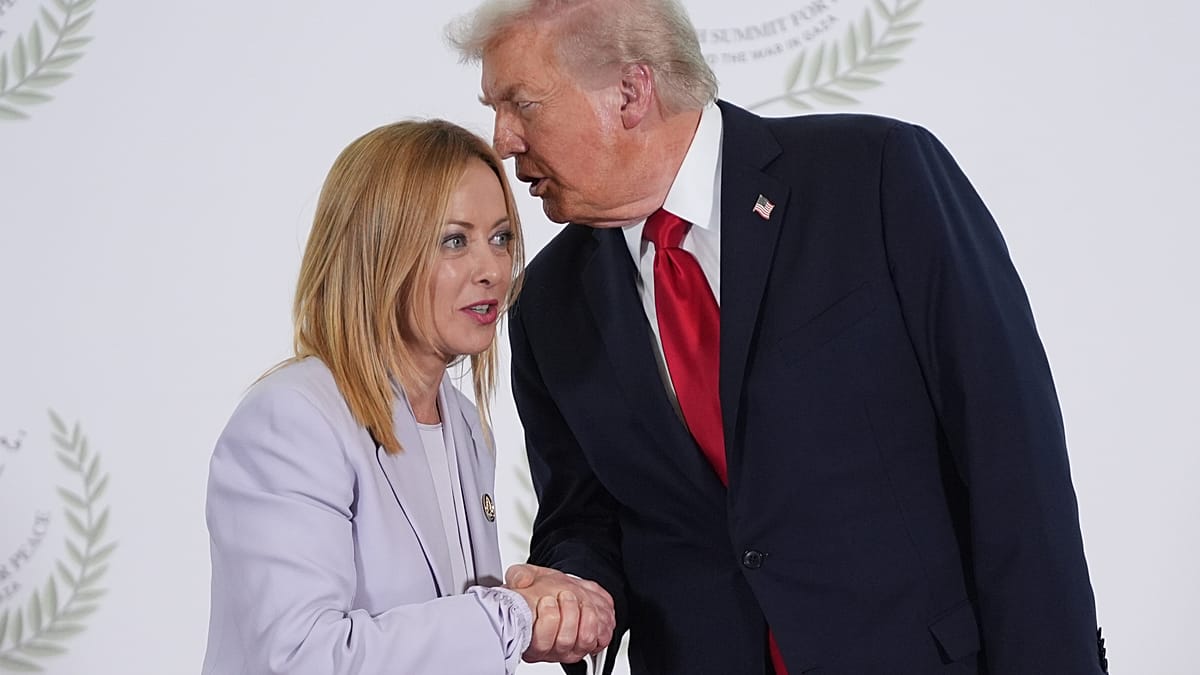
Italian Prime Minister Giorgia Meloni has acknowledged that her relationship with US President Donald Trump has been more challenging than she anticipated, despite their apparent ideological alignment. In an interview with the New York Times, Meloni said, "It is clear that, with Donald Trump, I thought things would be easier, given our convergence on immigration and woke culture. But things turned out differently."
The remarks come after a summer of visible friction between Rome and Washington. Tensions peaked in July, just before the NATO summit in Ankara, when Trump posted on his Truth Social network an image of himself with Meloni, captioned "Needs a restraining order" – a phrase typically used in legal contexts to keep stalkers at a distance. The post was widely interpreted as a signal that the US president wanted to keep the Italian leader at arm's length.
In the interview, Meloni revealed that she had not spoken with Trump for several weeks. When asked whether a meeting was planned after the summer break, she gave a cautious response: "We will see." She added, "I continue to believe that Western unity is very important," while stressing that she does not "decide Italy's strategy on the basis" of her "personal relationships."
Italy's pride and independence
Meloni used the interview to reiterate her vision of a more assertive Italy on the world stage. "I do not like," she said, "the idea of a subservient Italy that sees itself as inferior to others." She framed her mission as "the greatest possible revolution in this nation: a revolution of pride."
This stance has resonated with parts of the Italian electorate, but it also reflects the delicate balancing act her government faces between maintaining strong transatlantic ties and asserting national sovereignty. Her comments come as European leaders are increasingly navigating a more unpredictable US foreign policy, from trade disputes to security commitments. The strain on US alliances is not limited to Europe, as recent decisions have also unsettled allies in Asia.
Meloni also addressed her preference for being called "presidente" in the masculine form, a choice that has sparked debate in Italy. She dismissed feminist campaigns for inclusive language as "wrong," arguing that true equality lies in the freedom to hold high office, not in linguistic changes. "What matters to me is whether I am free to become president of the Council of Ministers. That is equality, not being called 'la presidente'," she said.
The prime minister returned to the famous rally line that made headlines worldwide: "I am a woman, I am a mother, I am Italian, I am Christian." She told the New York Times that those words "struck a chord that millions of people felt – the sense of being under threat in their most authentic and fundamental identity."
The New York Times profile traces Meloni's roots in the Garbatella district of Rome, her family background, and her political rise from the Youth Front, an organisation linked to the neo-fascist Italian Social Movement. Her journey from activist to prime minister has been marked by a blend of nationalist rhetoric and pragmatic governance, a combination that has both attracted and alarmed observers across Europe.
Meloni's relationship with Trump is being watched closely in European capitals, especially as migration policy becomes a flashpoint. Her hardline stance on immigration has found some resonance beyond Italy, as seen in the alignment of Denmark's prime minister with Meloni on migration issues, which has caused friction within the European socialist family.
Despite the difficulties, Meloni remains committed to Western unity, a theme she has consistently emphasised. Her balancing act between loyalty to the transatlantic alliance and her own nationalist agenda will be tested in the coming months, particularly as the US election cycle intensifies and European leaders seek to define their own strategic autonomy.