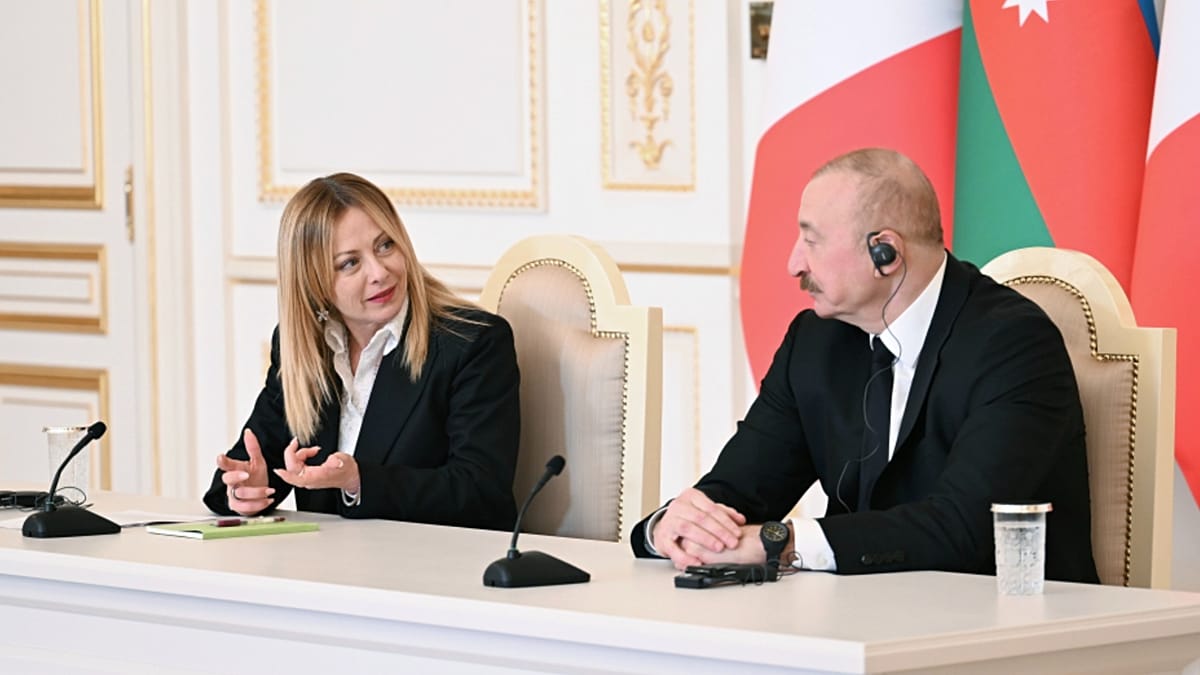
Italian Prime Minister Giorgia Meloni travelled to Baku on Monday for the first visit by an Italian premier to Azerbaijan in thirteen years, underscoring Rome's determination to lock in alternative energy supplies as turmoil spreads across the Middle East.
“The more instability grows around us, the more important it is to strengthen the certainties we have — and the relationship between Italy and Azerbaijan is certainly one of those certainties,” Meloni said at a joint press conference with President Ilham Aliyev.
The visit comes as the closure of the Strait of Hormuz has forced Italy to accelerate efforts to secure energy sources beyond the Middle East. Italy is the largest European Union importer of energy from Azerbaijan, and bilateral trade reached €10.2 billion last year, making Italy Azerbaijan’s top commercial partner.
Energy at the Core of Talks
Much of the discussion between Meloni and Aliyev centred on natural gas. Aliyev stated that Azerbaijan exported 25 billion cubic metres of gas in 2024, of which 7.5 billion went to Italy. Both sides discussed increasing that volume, which would require expanding the Trans-Adriatic Pipeline (TAP), the final segment of the Southern Gas Corridor that carries Azerbaijani gas through Turkey, Greece, and Albania into southern Italy.
“For us, the Italian market is of primary importance for both oil and gas,” Aliyev said. He confirmed that work on enlarging TAP, which he described as an “integral part” of the network, was already under way but needed to continue.
Meloni noted that Azerbaijani gas and oil supplies had been “decisive for the energy security” of Italy since Russia launched its full-scale invasion of Ukraine in 2022. She expressed her desire for Azerbaijan to strengthen its role as an energy hub between Europe and Asia, with Italy serving as “the privileged gateway to the European market.”
“Many Italian companies are extremely interested in participating in development plans and in 360-degree modernisation efforts, not only bilaterally but also in third countries,” Meloni added.
According to TAP managing director Luca Schieppati, the pipeline has delivered 47.5 billion cubic metres of gas to Italy since commercial operations began. In 2025, TAP covered around 16% of Italy’s total gas demand and roughly a quarter of its pipeline imports, excluding liquefied natural gas. Annual deliveries have remained stable in recent years: 9.69 bcm in 2022, 9.37 bcm in 2023, 9.76 bcm in 2024, and 9.46 bcm in 2025. The pipeline has maintained 100% system availability since launch. A recent upgrade to a compressor station in Greece added 1.2 bcm of annual capacity.
Around 30 Italian companies are currently operating in Azerbaijan, with 23 Italian projects under way in the Karabakh region. Both sides confirmed plans for a Business Forum in Baku in the second half of 2026 to develop further Italian investment.
Meloni also expressed support for the Armenia-Azerbaijan normalisation process, calling 2026 “a potentially crucial year” for unlocking the region’s potential. Her visit follows European Council President Antonio Costa’s trip to Baku, during which the top EU official said a new framework of cooperation with the 27-member bloc “sends a strong signal of our joint vision for the future,” underlining that energy security is a cornerstone of the EU’s cooperation with Azerbaijan.
Separately, Meloni confirmed that Italy has temporarily relocated its embassy in Iran from Tehran to Baku, thanking Azerbaijan for its support in evacuating Italian citizens from Iran after the war broke out in February. “I want to thank Azerbaijan and the president for how they ensured Italy could carry out the operations necessary to bring to safety so many Italian citizens who found themselves in danger in Iran,” she said.
Italy’s deepening ties with Baku reflect a broader European push to diversify energy sources amid geopolitical shocks. For more on EU efforts to strengthen strategic partnerships in the region, see our coverage of EU Foreign Policy Chief Kallas Visits Baku to Strengthen Strategic Ties with Azerbaijan. The European Union is also investing heavily in cross-border energy infrastructure, as detailed in Asian Development Bank Unveils €65 Billion Plan for Cross-Border Energy and Digital Links.