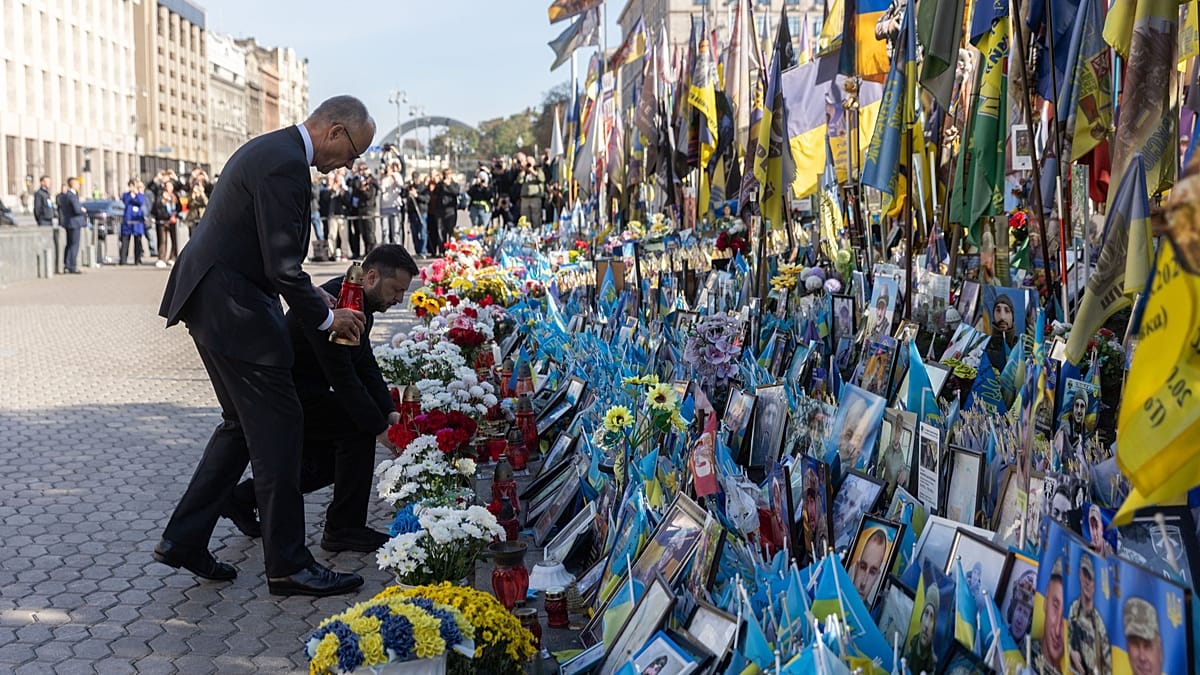
German Chancellor Friedrich Merz arrived in Kyiv on Sunday, a journey intended to underscore Berlin's unwavering support for Ukraine as Russian forces intensify their aerial bombardment of Ukrainian cities. This is Merz's second visit to the Ukrainian capital since taking office, and it comes with a tangible commitment: a newly announced €1.3 billion aid package aimed at bolstering Ukraine's defence and energy infrastructure.
“If Russia is not stopped, its war machine will sooner or later turn against us,” Merz said in a statement, adding that he had assured Ukrainian President Volodymyr Zelenskyy: “You can continue to count on our help.” The German leader's words were echoed by Zelenskyy, who took to social media to thank the chancellor and stress that Ukraine is not fighting alone. “Russia must be stopped together,” he wrote on X.
A show of resolve in the face of Russian threats
The visit unfolds against a backdrop of escalating violence. Moscow has been pounding cities across Ukraine with ballistic missiles and jet-powered drones, while Kyiv has retaliated by striking Russian oil facilities and businesses—a move that has drawn sharp criticism from US President Donald Trump amid rising energy prices. In a pointed response to Russian warnings that diplomats should leave Ukraine or risk their lives, the international community has stood firm. EU Ambassador to Ukraine Katarína Mathernová delivered a succinct and defiant message: “We are staying.”
Former European Council President Charles Michel, speaking to Europe Today, framed the German package as more than military aid. “It is for our common future,” he said, highlighting the broader stakes for European security and stability.
Some observers, however, see a subtext to Merz's journey. It comes shortly after a reportedly tense meeting between German Foreign Minister Johann Wadephul and his Russian counterpart Sergey Lavrov in New York. While Wadephul's message was clear—Russia must end its invasion and engage in negotiations—the very fact of the meeting has raised eyebrows in Brussels, with some fearing it could signal a thaw in the isolation of the Kremlin's leadership.
Energy crunch and diplomatic ambitions
The war in Ukraine has also exacerbated an energy crisis that is squeezing households and businesses across Europe. With refining capacity reduced and supply tight, prices have soared. US Treasury Secretary Scott Bessent has urged Europe to release strategic stocks “immediately” to ease costs, warning that American “farmers, truckers, and businesses should not be left carrying the burden.” A virtual G7 meeting on Friday, attended by IEA Executive Director Fatih Birol at the invitation of French President Emmanuel Macron, led to an announcement of 100 million barrels of diesel and crude oil being released from reserves, following Trump's threat to ban diesel exports.
Charles Michel used his Europe Today appearance to call for greater European ambition in Middle East diplomacy, particularly regarding Iran. “We are not seen as a decisive player, as a decisive actor,” he admitted. His remarks come as 20 senior international figures urge the EU to explore “new options” on Iran. “We have tried appeasement and diplomatic engagement,” Michel said, noting that while the US and Israel are pursuing military intervention, “other options should be developed with the ambition to put the people of Iran at the heart.”
Brazil's election and Europe's stakes
Beyond Europe's immediate neighbourhood, the continent is watching Brazil's presidential election closely. Nearly 159 million Brazilians voted on Sunday, with incumbent Luiz Inácio Lula da Silva and challenger Flávio Bolsonaro—son of former leader Jair Bolsonaro and an ally of Donald Trump—heading to a runoff on 25 October after neither secured a majority. A Bolsonaro victory would align Brazil with a wave of Trump-friendly governments in Latin America, including Argentina, Chile, Colombia, Costa Rica, and Peru.
João Albuquerque, a former Member of the European Parliament and former vice-chair of the EU-Brazil delegation, now at EuroCommerce, described the first-round result as a “sad morning” for Brazilian politics. He warned that Lula's legacy—including progress on the Mercosur trade agreement and closer EU-Brazil ties on cultural and democratic issues—could be at risk. “I think it was very important that the two sides managed to come together. I think this is at risk now,” he told Europe Today.
Election fever has also reached Paris, where Marine Le Pen, the National Rally's presidential candidate, has finally responded to media reports of alleged antisemitic remarks by party leader Jordan Bardella. In an interview with La Tribune Dimanche, Le Pen expressed “total confidence” in Bardella, who is tipped to become her prime minister if she wins the 2027 election. She had previously dismissed the allegations, first published by Mediapart, as “just madness.”
Meanwhile, elections in Bosnia and Herzegovina and Latvia over the weekend have drawn attention to the influence of Russia-backed parties across the continent. In Latvia, Prime Minister Andris Kulbergs' centre-right United List party emerged victorious in the Baltic state's parliamentary vote.