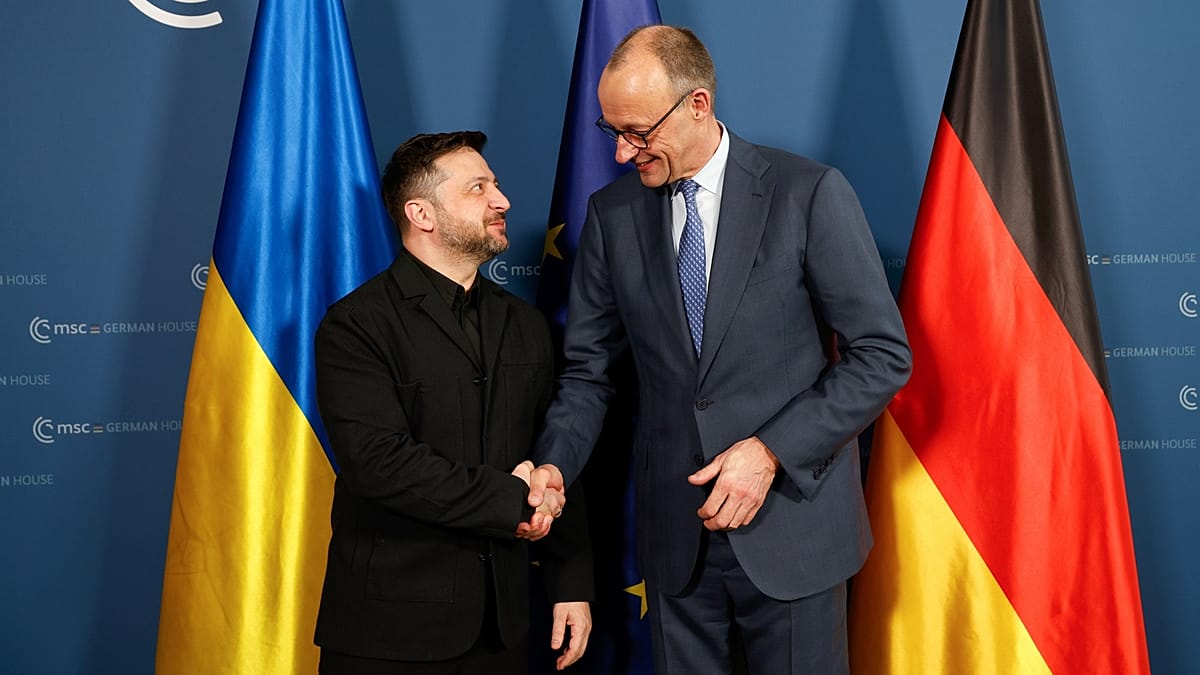
German Chancellor Friedrich Merz has put forward a proposal for Ukraine to become an 'associate member' of the European Union, a novel status designed to bypass the protracted full accession process while offering tangible security guarantees. In a letter to EU leaders, Merz argues that the traditional path to membership is too slow given the ongoing war and the political complexities of ratification across the bloc's twenty-seven member states.
'It is obvious that we will not be able to complete the accession process shortly, given the countless hurdles as well as the political complexities of ratification processes in various member states,' Merz writes. He calls for 'innovative solutions' to move Ukraine's integration forward immediately.
What Associate Membership Would Entail
Under Merz's plan, Ukraine would gain access to decision-making bodies such as the European Council, the European Commission, and the European Parliament, but without voting rights or a dedicated portfolio. Kyiv would also be able to participate in certain EU-funded programmes on a step-by-step basis. Crucially, the associate status would trigger Article 42.7 of the EU treaties, a mutual assistance clause that obliges member states to aid a fellow member under armed attack. This provision, which Brussels is currently working to operationalize, would allow Ukraine to request military, economic, medical, or diplomatic support from other EU countries, creating what Merz calls a 'substantial security guarantee.'
The proposal includes a 'snap-back mechanism' that would freeze associate membership if Ukraine backtracks on fundamental rights, rule of law, or structural reforms. Merz emphasizes that the regular accession procedure would continue in parallel, aiming for full membership as soon as possible.
'We would already now offer to Ukraine a substantial equivalent to membership that exceeds by far what we could deliver in the medium-term through our accession methodology, notably given the ratification process,' the chancellor writes.
Political Context and Reactions
The letter formalizes an idea Merz first floated during an informal EU summit in Cyprus last month. There, Ukrainian President Volodymyr Zelenskyy rejected any 'symbolic' membership, insisting on full membership with a clear start date. 'We seek the same full membership that every EU nation has, from Cyprus to Poland. The only thing we ask is speeding up the full membership,' he told leaders. His push was met with reservations from others who stressed the process must remain merit-based.
Merz acknowledges that associate membership has no precedent and will raise questions about its political, technical, and legal feasibility. However, he argues these can be resolved if leaders take a constructive approach. 'It will be a strong political signal that Ukraine and its citizens so urgently need in their continuous fight against the Russian aggression,' he says, adding that it could facilitate ongoing peace talks.
The proposal comes as Hungarian Prime Minister Viktor Orbán, a key opponent of Ukraine's accession, departs. His successor, Péter Magyar, has signaled a willingness to lift the veto on opening the first cluster of negotiations, known as 'fundamentals,' but wants to first discuss the Hungarian minority in Ukraine. Budapest and Kyiv have already launched formal consultations on the matter, as reported in Hungary and Ukraine Hold Expert Talks on Minority Rights, Easing EU Accession Path.
Merz reassures other candidate countries—such as Moldova and the Western Balkans—that his proposal will not derail their accession processes. He suggests they too should benefit from 'privileged access' to the single market and closer ties with Brussels. Austria, the Czech Republic, Italy, Slovakia, and Slovenia have circulated their own proposal for sectoral integration of all candidates.
'My aim would be to reach an agreement soon, and to set up a dedicated task force to work out the details,' Merz concludes. 'I am convinced that we will find a common way for Ukraine as well as for the other candidates!'
The proposal arrives amid broader debates about Europe's security architecture, as highlighted in Merkel Warns Europe's Security Assumptions Are Outdated After Ukraine Invasion. It also follows Merz's own political challenges at home, with his chancellorship hitting record low approval ratings, as noted in Friedrich Merz's Chancellorship Hits Record Low Approval After Self-Inflicted Wounds.