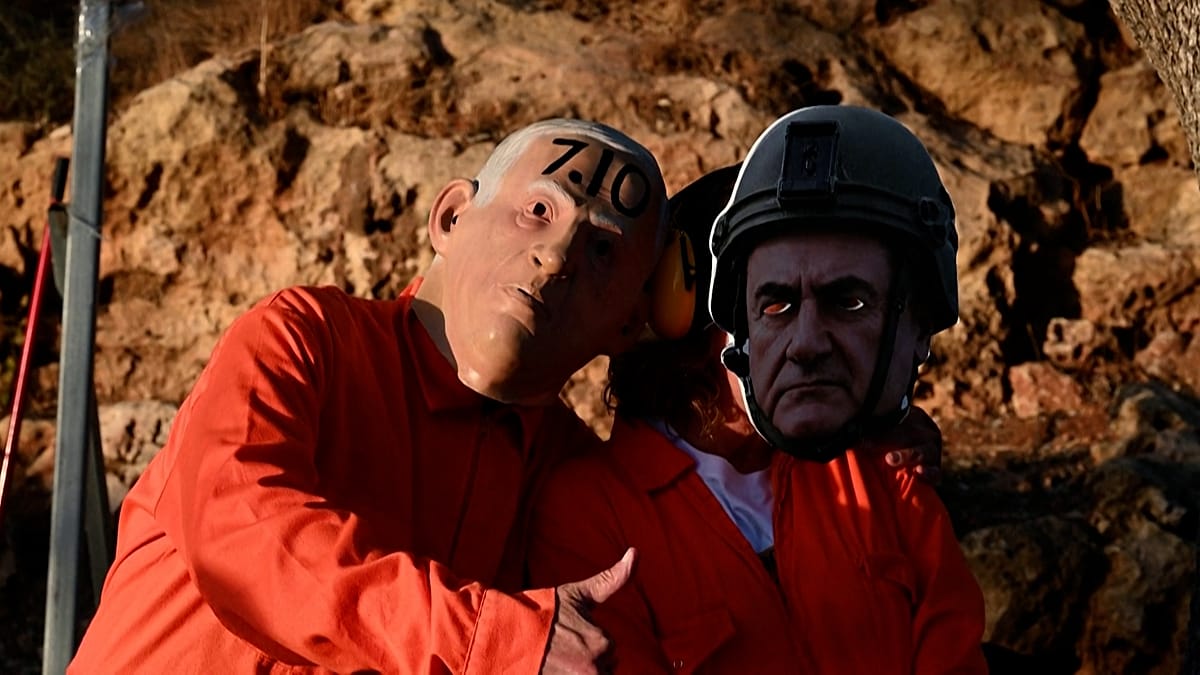
Dozens of Israelis gathered outside the Knesset in West Jerusalem on 17 September, in a protest that blended dark humour with serious political accusation. Demonstrators carried missile-shaped signs and wore masks of Prime Minister Benjamin Netanyahu, a visual shorthand for their claim that the government is using regional tensions to interfere with the parliamentary election scheduled for 27 October.
The protest, organised by civil society groups and opposition activists, aimed to draw attention to what they see as a deliberate strategy by the ruling coalition to postpone or manipulate the vote under the guise of security concerns. Chants and placards called for the election to proceed on time, with some signs reading “Don’t use the war to cancel our voice” and “The ballot box is our missile.”
Election under pressure
The 27 October vote was already contentious, with deep divisions over judicial reform, the role of the military in politics, and the ongoing conflict in Gaza. The protest came amid heightened regional instability, including recent exchanges of fire with Hezbollah and continued operations in the Palestinian territories. Critics argue that the government has used these events to justify emergency measures that could delay the election or alter its outcome.
“They are using the smoke of rockets to hide the fire of their own failures,” said one protester, a 34-year-old teacher from Tel Aviv who asked to be identified only as Noa. “We are here to say that no external threat will be allowed to silence our democracy.”
The demonstration remained peaceful, with police maintaining a visible presence but making no arrests. Organisers claimed that several opposition members of the Knesset attended in solidarity, though no official statements were made.
Regional context and European parallels
The protest takes place against a backdrop of regional volatility that has echoes across Europe. In recent weeks, US and Iranian confrontations in the Gulf have raised fears of a wider conflict, while European capitals have watched with concern as Israel’s internal political crisis deepens. The European Union has repeatedly called for restraint and for the preservation of democratic processes, but has stopped short of direct intervention.
For European observers, the scene outside the Knesset is a reminder of how quickly security crises can be weaponised in domestic politics. Similar dynamics have played out in EU member states, where governments have sometimes invoked emergency powers during the pandemic or migration surges. The difference, analysts note, is that Israel’s election is taking place under the shadow of an active war, making the stakes particularly high.
“The use of external threats to justify internal political manoeuvring is a classic tactic,” said Dr. Miriam Stein, a political scientist at the Hebrew University of Jerusalem. “But in a country with a proportional representation system and a fragile coalition, the risk of a constitutional crisis is real.”
International attention
The protest has drawn attention beyond Israel’s borders, with international media covering the event and social media amplifying images of the missile-shaped signs. Some commentators have drawn comparisons to protests in other democracies where leaders have been accused of using security pretexts to undermine electoral integrity.
In Europe, the story resonates with ongoing debates about the rule of law and democratic backsliding. The recent political turbulence in France, where far-right leader Marine Le Pen has struggled to maintain party unity, and protests in Paris over proposed legislation, show that European citizens are equally vigilant about threats to democratic norms.
As the 27 October date approaches, the question remains whether the Israeli government will heed the protesters’ call or continue to use the security situation to its advantage. The international community, including the EU, is likely to keep a close watch on developments, mindful that the outcome could have ripple effects across the Middle East and beyond.
For now, the missile-shaped signs and Netanyahu masks serve as a stark visual reminder that in Israel, as in Europe, the battle for democratic integrity is never fully won.