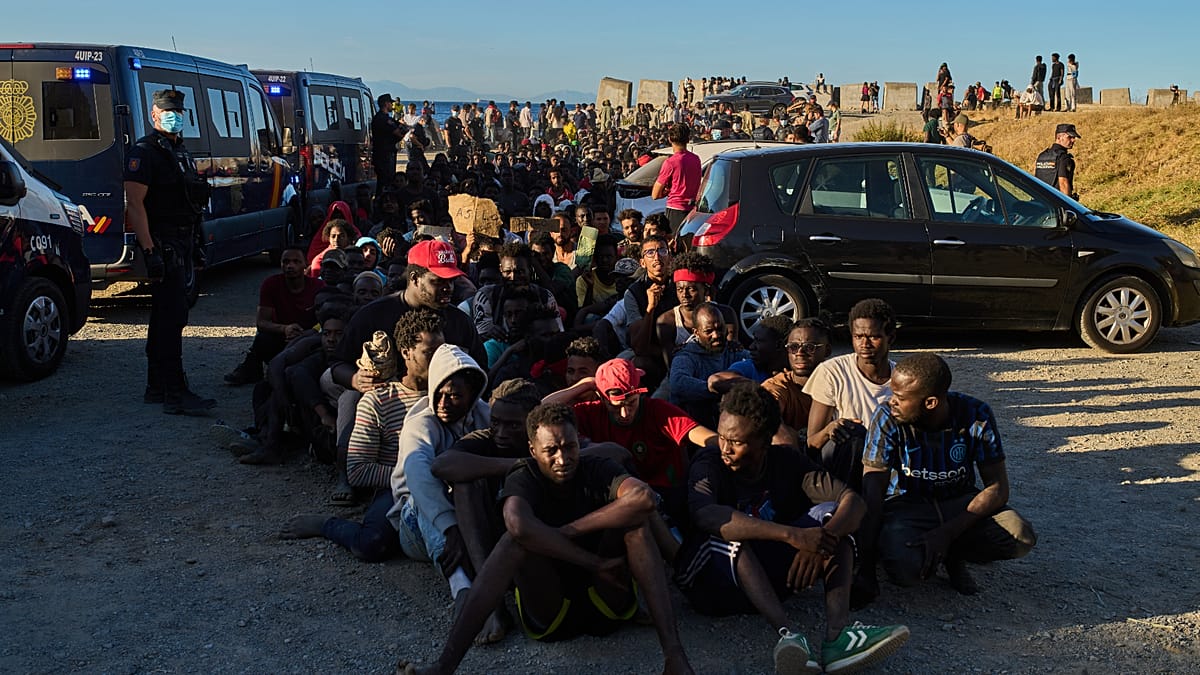
Morocco's National Human Rights Council (CNDH) has released a preliminary report accusing Spanish security forces of assaulting and ill-treating migrants during the mass crossing into Ceuta on 30 and 31 July, when an estimated 80,000 people entered the enclave in just 48 hours. The report, published on 8 August, is based on testimonies from migrants who had been returned to Morocco, all of whom described beatings and mistreatment by Spanish officers, particularly in areas not covered by surveillance cameras.
The CNDH also alleges that unaccompanied minors suffered insults and physical abuse from what it calls “extremist groups” while passing through Ceuta. It criticises the local authorities for failing to provide adequate care, especially for children and young people, and blames them for the closure of restaurants and shops in the city—though that decision was actually taken by business owners following a recommendation from the local employers' association.
In a separate development, Morocco's Justice Minister Abdellatif Ouahbi told the pan-Arab channel Asharq News that Rabat continues to assert its historic claim to the enclaves of Ceuta and Melilla. He described the issue as “remaining on the table” in bilateral talks and spoke of a “long-term” strategy to reclaim what he considers Moroccan territory through dialogue. He also pressed for the repatriation of unaccompanied Moroccan minors currently housed in Spanish centres, insisting that responsibility for their welfare lies with Madrid.
A recurring pattern of accusations
This is not the first time the CNDH has targeted Spain. In 2022, following the deadly storming of the Melilla border fence that left at least 23 people dead, the council blamed Spanish authorities for keeping the gates closed. Although Morocco's public prosecutor later closed the case citing “absence of evidence of a crime,” the decision was controversial, as reports suggested that Moroccan officers had relaxed border controls, allowing sub-Saharan migrants to cross.
The latest report also highlights the role of social media in fuelling the July influx. The CNDH says it had identified misleading content about migration as early as 8 July on pages with more than 90,000 followers, and has analysed 23 Facebook groups with a combined membership exceeding one million.
The diplomatic row comes at a time when Spain and Morocco have been working to improve relations, particularly after Madrid's shift on Western Sahara in 2022. However, the renewed sovereignty claim and the human rights report threaten to strain that rapprochement. The Spanish government has not yet issued an official response to the CNDH findings, but previous similar accusations have been firmly rejected.
For Ceuta, the immediate challenge remains managing the aftermath of the surge. Local authorities have called for additional resources, and the city's leader has previously advocated for a detention centre to handle such influxes. Meanwhile, the broader migration debate continues to divide the EU, as seen in recent clashes between Italy and Spain over how to share responsibility.
The CNDH's report is preliminary, and it remains to be seen whether it will lead to any formal action. But the timing—coinciding with the minister's remarks—suggests that Morocco is using both human rights and sovereignty as leverage in its dealings with Spain. As the two countries navigate their complex relationship, the fate of the enclaves and the treatment of migrants will likely remain contentious issues.