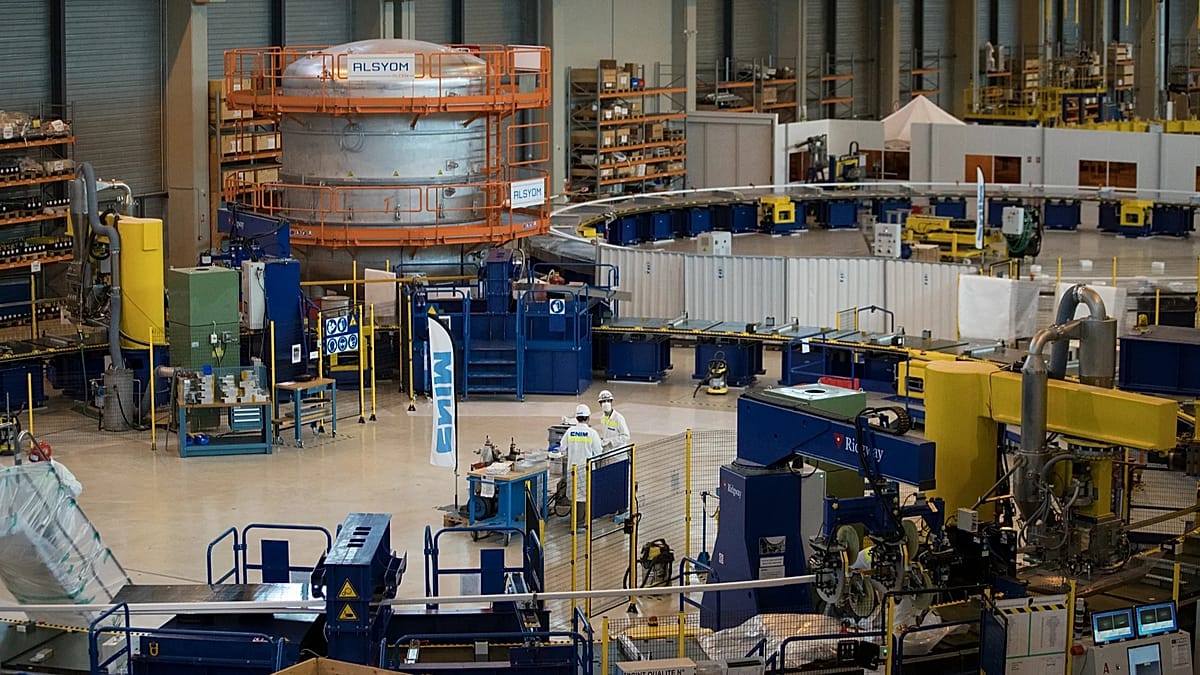
In the midst of sweeping EU sanctions and a broader freeze in scientific cooperation, one major international project remains an exception: ITER, the world's largest nuclear fusion experiment. Despite the geopolitical rupture caused by Russia's invasion of Ukraine, Moscow continues to play a significant role in the project, which is headquartered in Cadarache, France.
ITER, launched in 2007, is a collaboration among 33 nations, including Russia, China, the United States, and the European Union. The project aims to demonstrate the viability of nuclear fusion as a low-carbon energy source, a goal that aligns with the EU's ambition to achieve climate neutrality by 2050. Europe bears the largest share of construction costs, at 45.6 percent, according to ITER's website.
While Brussels has moved to exclude Russian institutions from EU research programs like Horizon Europe and Euratom, and has banned Russian funding to European research organizations, ITER's rules prevent the expulsion of any member. Russia remains a 9.1 percent contributor and provides essential components, including the PF1 poloidal field coil, used to shape and control plasma, and gyrotrons, which heat plasma in fusion reactors.
An ITER spokesperson told Euronews: "The Russian Federation is an ITER member and participates through its Domestic Agency, Project Center ITER. All ITER-related activities are conducted in accordance with the applicable legal and regulatory requirements."
The continued collaboration has drawn attention as nuclear fusion becomes a strategic EU priority. Brussels is set to unveil its own fusion strategy, after recently announcing €330 million to accelerate the sector. The strategy, delayed by a year, is expected to address governance, regulatory clarity, and international cooperation, with Europe's central role in ITER at its core.
A Council document assessing nuclear energy, dated 9 July and seen by Euronews, carefully avoided any reference to Russia, instead stating that the EU shall "continue collaboration with the ITER Organisation and partners on ITER-related activities." The European Commission has not responded to questions about whether Russia's participation has caused diplomatic delays among member states.
High-level contacts persist
Despite the broader freeze in scientific ties, ITER signed a cooperation agreement in June with Russia's Kurchatov Institute, covering scientific information exchange, research programs, and training. In July, Russian Science Minister Valery Falkov visited the ITER site in France with a large delegation, underscoring the persistence of high-level contacts.
Supporters of the collaboration argue that ITER is a decades-long endeavor requiring specialized knowledge and global supply chains. "The poloidal field coil system, for example, includes contributions from Europe, Russia and China, requiring components and technologies from different national supply chains to be integrated into a single machine system," the ITER spokesperson said.
However, critics question the wisdom of maintaining such reliance on Russia. As Berlin plans a digital shield against Russian hybrid sabotage, the EU's energy independence goals clash with the practicalities of scientific cooperation. The issue highlights a broader dilemma: can science remain insulated from geopolitics?
Recent research from the European Parliament suggests that technological progress since ITER's founding might pave the way for fusion to be ready for industrial use in the second half of the century. Yet, as long as Moscow remains a partner, the project will continue to be a point of tension between Brussels' strategic ambitions and its sanctions policy.