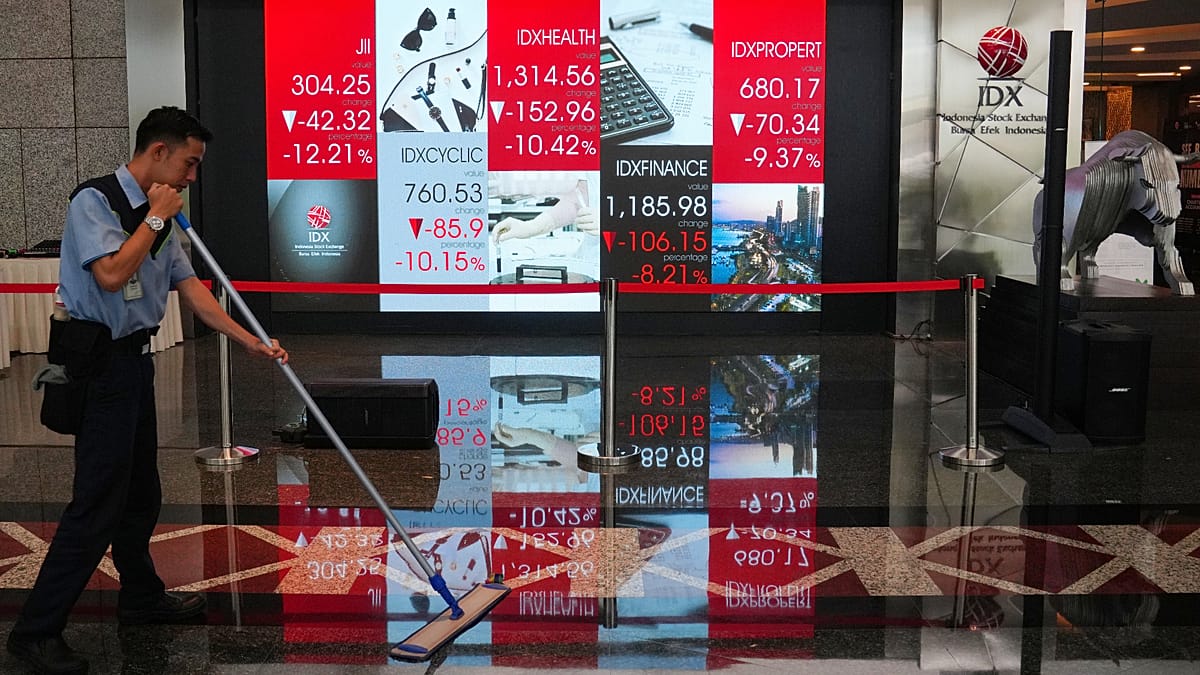
Jakarta's stock market suffered its worst session in nearly three decades on Friday, with the benchmark index plunging about 11% after MSCI, one of the world's most influential index providers, proposed reclassifying Indonesia from an emerging market to a standalone market. The move, if confirmed, would force funds that track MSCI's emerging market indexes to offload their Indonesian assets, potentially triggering billions of dollars in outflows.
MSCI said in a statement that "market participants had raised significant concerns regarding the investability of the Indonesian equity market," citing a lack of clarity in shareholding structures and suspected coordinated trading. The company added that Indonesia's continued emerging-market status was "no longer appropriate" and launched a consultation on the proposed reclassification.
Under MSCI's classification system, markets are grouped into developed, emerging, frontier, or standalone categories. A downgrade would place Southeast Asia's largest economy alongside Jamaica, Panama, and Palestine, bypassing frontier market status entirely. The consultation will run until June 2027, with a final decision expected by the end of that month.
Reforms fall short
Indonesian authorities had hoped to avoid this outcome. After MSCI first raised the possibility of a downgrade in January, officials in Jakarta announced a series of reforms in April, aiming to address investor concerns. However, MSCI noted that while reforms had been announced, "sufficient progress has not been made" and "significant concerns remain around market dysfunction."
The index provider said it expects to proceed with the reclassification "unless the consultation identifies clear evidence of material improvements in market governance and functioning to warrant reconsideration."
The news compounds a difficult year for Indonesian markets. According to Bloomberg, global funds have already pulled a net $4.9 billion from the country's stock market so far in 2026, putting it on track for its worst year on record. The Jakarta Composite Index has fallen roughly 39% since January, and the rupiah has weakened by about 8% against the dollar, despite Bank Indonesia's repeated pledges to maintain currency stability.
The sell-off underscores broader concerns about emerging market vulnerabilities, particularly in economies with weaker governance standards and opaque corporate structures. For European investors, the episode serves as a reminder of the risks inherent in frontier and emerging market exposure, even as many funds continue to seek higher yields in these regions.
While the immediate impact is felt in Jakarta, the ripple effects could extend to global portfolio strategies. European asset managers with significant emerging market allocations may need to reassess their exposure to Indonesia, especially if the downgrade is confirmed. Some may already be reducing positions ahead of the final decision.
The situation also highlights the growing influence of index providers like MSCI in shaping capital flows. Their classifications can make or break market access for countries, and their decisions are closely watched by investors worldwide. For Indonesia, the proposed downgrade is a stark reminder that market reforms must be credible and sustained to retain investor confidence.
As the consultation period unfolds, Indonesian authorities will have a chance to demonstrate tangible improvements. But with the clock ticking and investor sentiment already fragile, the path to avoiding a downgrade looks increasingly difficult.