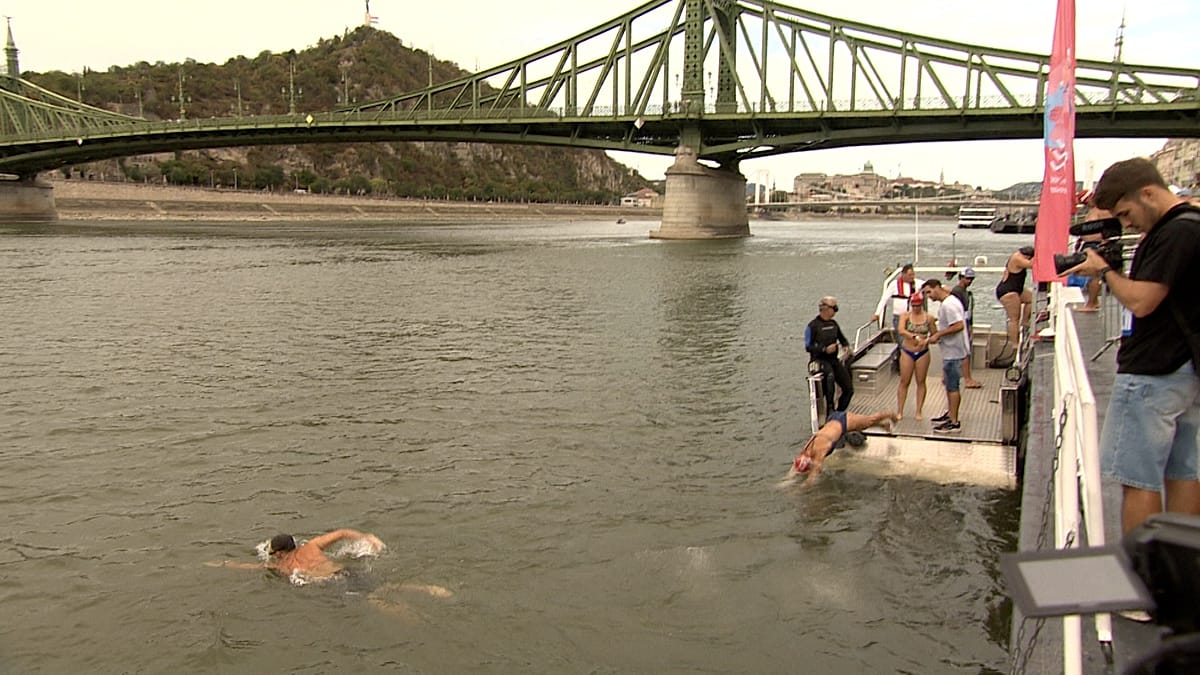
Budapest's Danube, usually a busy artery for cargo ships and river cruises, became a swimming lane on Saturday as nearly a thousand people took part in the Generali OWT Danube Crossing. The open-water event, held between Corvinus University and the University of Technology, marked the first time in six years that swimmers were allowed to tackle this iconic stretch of the river.
Organiser Balázs Mezős told European Pulse that the event requires meticulous planning. "This is a very big event: almost 40 paramedics watch over the swimmers, 12 motorboats look after them, and the entire Danube is closed for four hours, so no one can enter or leave. The larger ships have to be cleared from the start and finish areas and moved elsewhere," he explained.
For participants, the appeal lies in swimming where it is normally unthinkable. The river's strong currents and heavy boat traffic make it off-limits for most of the year. But on Saturday, the water was calm, and the city unfolded from a unique perspective.
One young woman, a university student, told European Pulse: "I used to come to university over Liberty Bridge every day. I would always look out from the tram, wondering what it would be like to swim across — whether you actually could. It never occurred to me that it was really possible. Then we found out this event existed, and we signed up as soon as registration opened."
The organisers stress that the water quality is good and that the stretch is free of dangerous eddies. Mezős acknowledged that many Hungarians are wary of the Danube, but he believes that fear is largely unfounded. "People are very wary of the Danube," he said. "That basically stems from the fact that they don't swim in it, because usually you're not allowed to. Fortunately, more and more open-water Danube beaches are being built here in Budapest and across the country, so people are slowly getting used to it. You can see that in our swimming races, where the number of participants keeps growing. So I think there's a kind of mistrust that has no real basis. People tend to mention whirlpools first, but there aren't any here — what little current there is wouldn't even be able to pull under a duck. You have to give it a try: the first time or two might feel a bit uncomfortable, or exciting, or even scary, but by the third time it's a real pleasure. Swimming while carried along by a current of about five kilometres an hour is heaven itself."
Among the finishers was a British man living in Budapest, whose wife and two young daughters waited for him near the University of Technology. "A fantastic experience," he said. "Every Budapest resident should try it once. The start is tough because of the current — you think you're swimming in a straight line, but you're not. But the organisation is excellent; it's a great event."
A river reborn
The Danube has long been a defining feature of Budapest, but its role as a recreational space has grown in recent years. The city has invested in new riverside beaches and promenades, and events like this swim are part of a broader effort to reconnect residents with the water. The river's record low levels last year, which exposed shipwrecks and wartime relics, also drew attention to the Danube's changing character.
For many participants, the swim was a personal challenge and a chance to see the Hungarian capital from a new angle. The route passed under the Liberty Bridge and the Elisabeth Bridge, offering views of the Gellért Hill and the Parliament building that are usually reserved for boat passengers.
The event also had a broader European dimension. Swimmers came from several countries, and the organisers hope to make it a regular fixture on the international open-water calendar. As Mezős noted, the Danube is not just a Hungarian river; it flows through ten countries, and its health and accessibility matter across the continent.
With the river closed to traffic for four hours, the event required coordination with Hungarian authorities and international shipping companies. The logistics are complex, but the payoff is a rare opportunity for ordinary people to experience one of Europe's great rivers in a completely new way.
As the last swimmers emerged from the water, exhausted but smiling, the message was clear: the Danube is not just for boats. It is a resource that belongs to everyone, and with careful planning, it can be enjoyed safely.