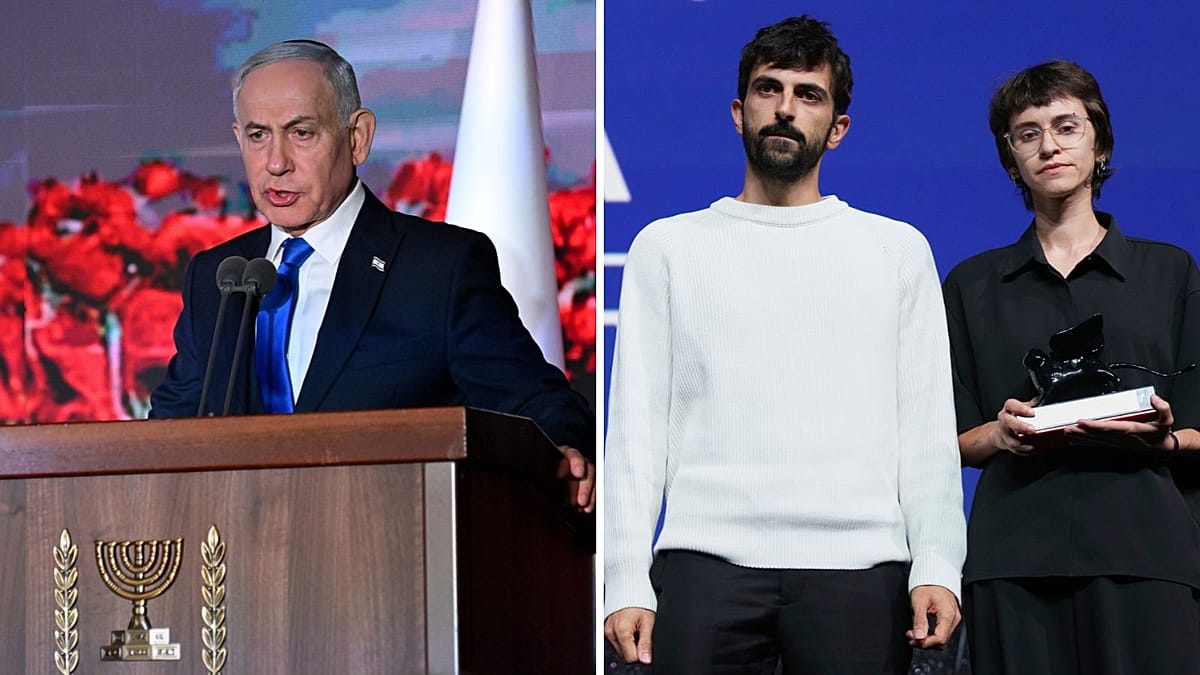
Israeli Prime Minister Benjamin Netanyahu has instructed the country's attorney general and the head of the Shin Bet security service to identify the military personnel who appear in the award-winning documentary NAZA, and to prosecute its filmmakers for allegedly damaging Israel's diplomatic and security interests.
In a directive issued this week, Netanyahu called on Attorney General Gali Baharav-Miara, IDF Chief of Staff Lt Gen Eyal Zamir, and Shin Bet chief David Zini to “act urgently to uncover the identity of all those who are involved or appear in the libel film.” The prime minister specifically named the film's directors, Yuval Abraham and Rachel Szor, both Israeli and winners of an Oscar for previous work, as targets for criminal investigation.
The 80-minute documentary, which premiered at the Venice Film Festival and took the Special Jury Prize, is currently screening in more than 50 countries. Its official synopsis states that it reveals “in detail the systems behind Israel's calculated mass killing of Palestinian civilians in Gaza.” Shot covertly at night on Tel Aviv rooftops during the ongoing war, the film features interviews with 24 Israeli military intelligence officers, soldiers, and whistleblowers. Their faces and voices are digitally altered to protect their identities.
Those interviewed describe how Palestinian targets are selected and how strikes are executed using AI-driven surveillance and automated targeting systems, even when Israeli forces are aware that civilians are present in the areas being hit. The documentary builds on reporting published between 2023 and 2025 by the Israeli-Palestinian outlet +972 Magazine, its Hebrew-language sister publication Local Call, and The Guardian.
European and international reaction
The Israeli government has previously attacked Abraham and Szor, threatening to strip them of their citizenship. The latest move has drawn sharp criticism from press freedom advocates across Europe. Ricardo Gutiérrez, general secretary of the European Federation of Journalists, told The Guardian: “These threats constitute a blatant act of intimidation against journalists who have simply been doing their job, in strict accordance with ethical standards and in the public interest.”
Gutiérrez added: “I am not surprised by this outburst, which confirms that this regime is prepared to do anything to cover up its crimes against humanity and the ongoing genocide in Gaza.”
The documentary has also made waves in European cinemas. In Italy, it outperformed a Marvel rerelease at the box office, a sign of the public appetite for critical reporting on the conflict. Its Venice screening reportedly drew a record-breaking 25-minute standing ovation, the longest in the festival's history.
Netanyahu's order comes amid broader international scrutiny of Israel's conduct in Gaza. The prime minister has faced fresh questions over warnings before the October 7 attacks and has continued to defy UN resolutions. His recent address to the UN General Assembly in New York was met with walkouts, protests, and arrests.
Legal experts in Europe have noted that the prosecution of journalists and whistleblowers for revealing information about military operations could set a dangerous precedent for press freedom worldwide. The European Federation of Journalists has called on EU institutions to intervene, arguing that the threats against Abraham and Szor are part of a wider pattern of intimidation against those documenting alleged war crimes.
As the film continues its international rollout, the question of whether Israel will follow through on Netanyahu's orders remains open. But the prime minister's directive signals an escalating effort to silence critical voices, even as the documentary gains traction with audiences across Europe and beyond.