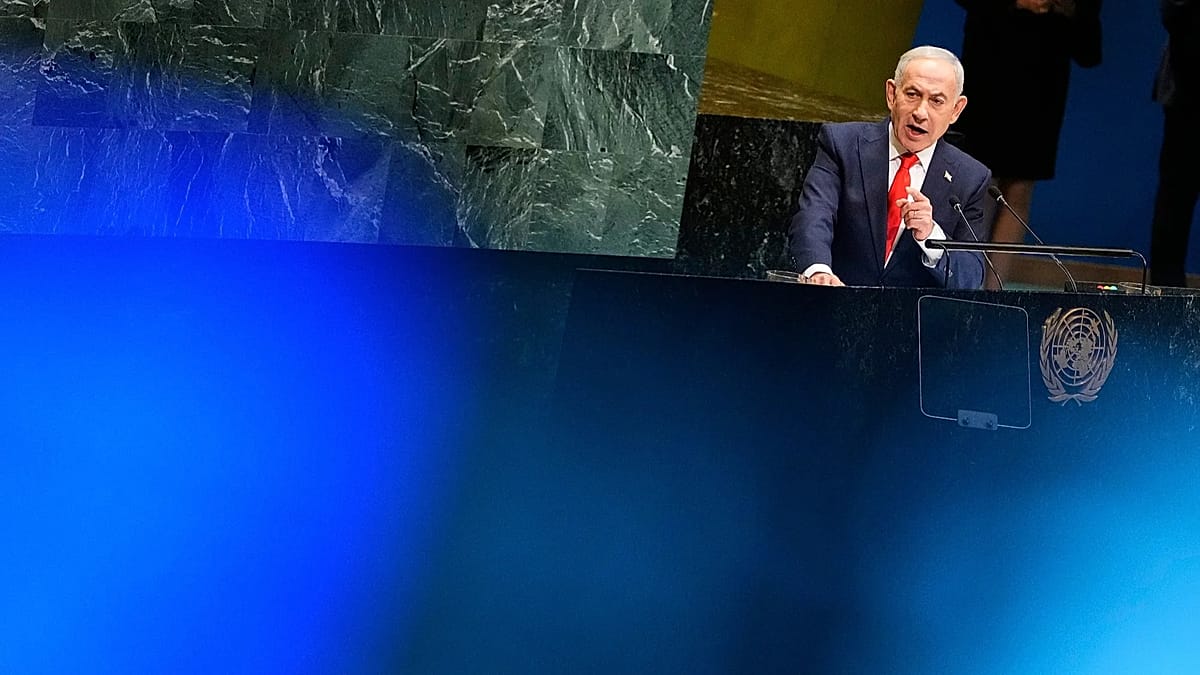
Israeli Prime Minister Benjamin Netanyahu delivered a combative address at the United Nations General Assembly in New York on Thursday, using the global stage to defend his government's actions in Gaza and to lash out at detractors, even as demonstrators gathered outside and dozens of delegates walked out in protest.
Netanyahu, who faces a legislative election in Israel next month, opened his speech by taunting those who had left the hall. "If there are any other moral cowards who haven't yet left this hall, please do so now," he said, before pivoting to the war with Iran, which began in late February after US and Israeli strikes. He argued that Iran posed an existential threat not just to Israel but to the world, and that Israel was "defending many of the countries whose delegates just left this hall."
Recalling his 2012 warning about Iran's nuclear ambitions, Netanyahu said: "14 years ago, I stood on this podium and I drew a red line. I vowed to prevent Iran's murderous dictatorship from developing atomic bombs. Devastating Iran's nuclear facilities was hard. It was very hard to do. But for me, it was one of the easiest decisions I've ever had to make as prime minister because if we hadn't done it, we'd all be dead."
Clash with New York's mayor
Netanyahu also took aim at New York City Mayor Zohran Mamdani, whom he labelled the "antisemitic mayor" of the city. "Mr. Mamdani, since you were elected mayor of this city, many Jews no longer feel safe," he said. Mamdani has previously urged US federal authorities to execute the International Criminal Court's (ICC) arrest warrant for Netanyahu whenever he visits the United States. The ICC issued the warrant in November 2024, alleging responsibility for war crimes including "starvation as a method of warfare" and "intentionally directing an attack against the civilian population," as well as crimes against humanity.
Mamdani responded sharply on social media, saying Netanyahu had "used his speech to repeat baseless lies meant to sanitize his genocide of Palestinians." He added: "Yet no lie can change the fact that he remains the subject of an International Criminal Court arrest warrant alleging war crimes and crimes against humanity."
In his speech, Netanyahu rejected accusations of genocide in Gaza, insisting "it's the opposite of genocide." He also turned his fire on European critics, singling out the UK and France for their mounting criticism of Israel's military campaign. "They accuse Israel, tiny Israel, of colonialism, some colonialism. And who's accusing us? Well, among them are people in Britain and in France. For God's sakes, they invented the term," he said, a remark that drew sharp reactions from European diplomats.
The address came as thousands of protesters gathered in New York, with police reporting around 100 detentions at an "unscheduled demonstration" that blocked an intersection. Among those detained was actress Susan Sarandon, who was seen in video footage being led away in handcuffs by officers. The protests were part of a broader wave of demonstrations against Netanyahu's policies, which have also taken place in European capitals, including protests in Jerusalem ahead of the October vote.
Netanyahu's UN appearance comes at a time of heightened tension between Israel and several European governments. The ICC warrant has created a diplomatic dilemma for EU member states, which are obliged to cooperate with the court. France and the UK have both expressed concern over the humanitarian situation in Gaza, while Germany has maintained a more cautious stance. The European Union's foreign policy chief has repeatedly called for a ceasefire, and the bloc has imposed sanctions on extremist Israeli settlers in the West Bank.
The walkout by delegates was a symbolic rebuke, but Netanyahu's speech was clearly aimed at a domestic audience as he campaigns for re-election. His defiant tone, however, may further strain relations with Western allies, many of whom have grown increasingly critical of the civilian toll in Gaza. The recent Israeli strikes on Gaza camps have drawn particular condemnation from European governments.
As the General Assembly session continues, European leaders are expected to press for a renewed ceasefire and a path toward a two-state solution. The contrast between Netanyahu's rhetoric and the measured diplomacy of EU officials was stark, underscoring the widening gap between Israel and its traditional European partners.