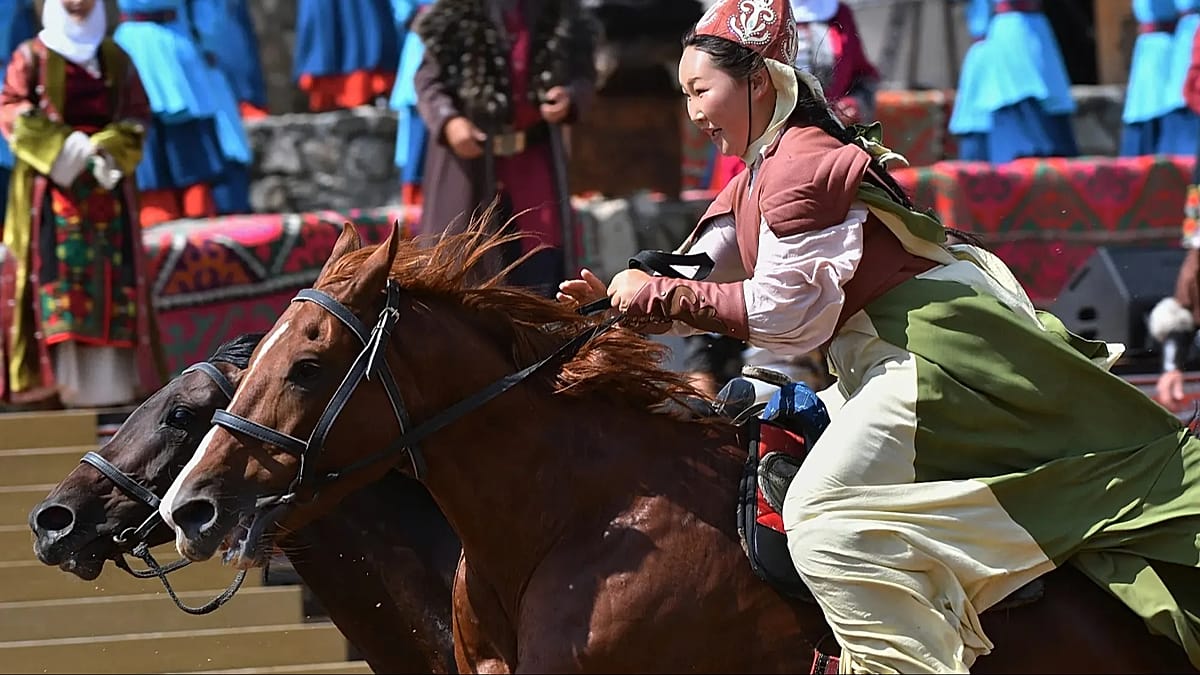
The sixth Nomad Games drew to a close on the shores of Lake Issyk-Kul in Cholpon Ata, Kyrgyzstan, with a grand ceremony at the local hippodrome. The event, which ran for six days, brought together more than 3,000 athletes from 109 countries competing in 42 traditional disciplines, making it the largest edition of the Games to date.
The highlight for many spectators was the finals of kokpar and kok boru, the equestrian sports that remain the most anticipated events of any Nomad Games. Kokpar is traditionally Kazakh, while kok boru is Kyrgyz, but both involve mounted teams of four players trying to carry a weighted dummy—representing a goat carcass—into the opponent's goal: a large pot in kok boru or a marked circle on the ground in kokpar.
As expected, the finals pitted the two powerhouses of these sports against each other: Kyrgyzstan and Kazakhstan. The hosts had the home advantage, and they used it to full effect. In front of a packed hippodrome, the Kyrgyz team defeated Kazakhstan 12:0 in kok boru and 7:2 in kokpar, avenging their losses in the previous two editions of the Games. The bronze in kokpar went to the Russian Federation, who edged Uzbekistan 5:4.
The demand for tickets was extraordinary. More than 30,000 were sold days in advance, and the hippodrome was filled to capacity, with additional spectators watching from the surrounding fields. Many fans travelled from across Kyrgyzstan, but a sizeable and vocal contingent also crossed the border from Kazakhstan to support their teams.
Beyond the sporting contests, the Games served as a platform to promote and revive nomadic traditions. More than 600 cultural events took place, including exhibitions, song contests, music festivals, culinary competitions, and handicraft workshops, drawing thousands of visitors. One of the key scientific gatherings was the conference “Nomadic Civilizations: Heritage, Paradigms, and Prospects,” which brought together researchers from 21 countries. They agreed to launch joint research projects, create a shared digital database, and seek cooperation with international institutions.
Medal table and political reactions
The final medal standings were a subject of intense interest. Initially, organisers announced that Kyrgyzstan had won the most medals with 71, followed by Kazakhstan with 65. However, after a re-evaluation of the counting method, the final table placed Kazakhstan at the top with 72 medals, including 32 golds, while Kyrgyzstan followed closely with 77 medals, 30 of them gold.
Kazakh President Kassym-Jomart Tokayev congratulated his country's team, praising their “commitment, hard work and iron will.” He expressed gratitude to the champions, prize winners, trainers, and all specialists whose efforts, he said, strengthen Kazakhstan's international authority as a nation that nurtures traditional sports.
Closing the Games, Kyrgyz Prime Minister Adylbek Kasymaliev drew comparisons between the Nomad Games and global sporting spectacles such as the Olympics and the football World Cup. He argued that the event is establishing itself as a major force in world culture, watched by people across the globe.
The Nomad Games have grown significantly since their inception in Cholpon Ata, and this year's edition attracted newcomers from every continent, including Afghanistan, Cape Verde, Algeria, Barbados, Brunei, Saudi Arabia, Bhutan, and Croatia. The event's ability to draw such a diverse field underscores its rising international profile.
For those interested in the broader cultural landscape, the Games are part of a wider revival of traditional practices across Central Asia. Similar efforts can be seen in the revival of ancient traditions that the Games champion. As the event continues to expand, it offers a unique window into the rich heritage of nomadic peoples, a heritage that resonates far beyond the steppes of Central Asia.



