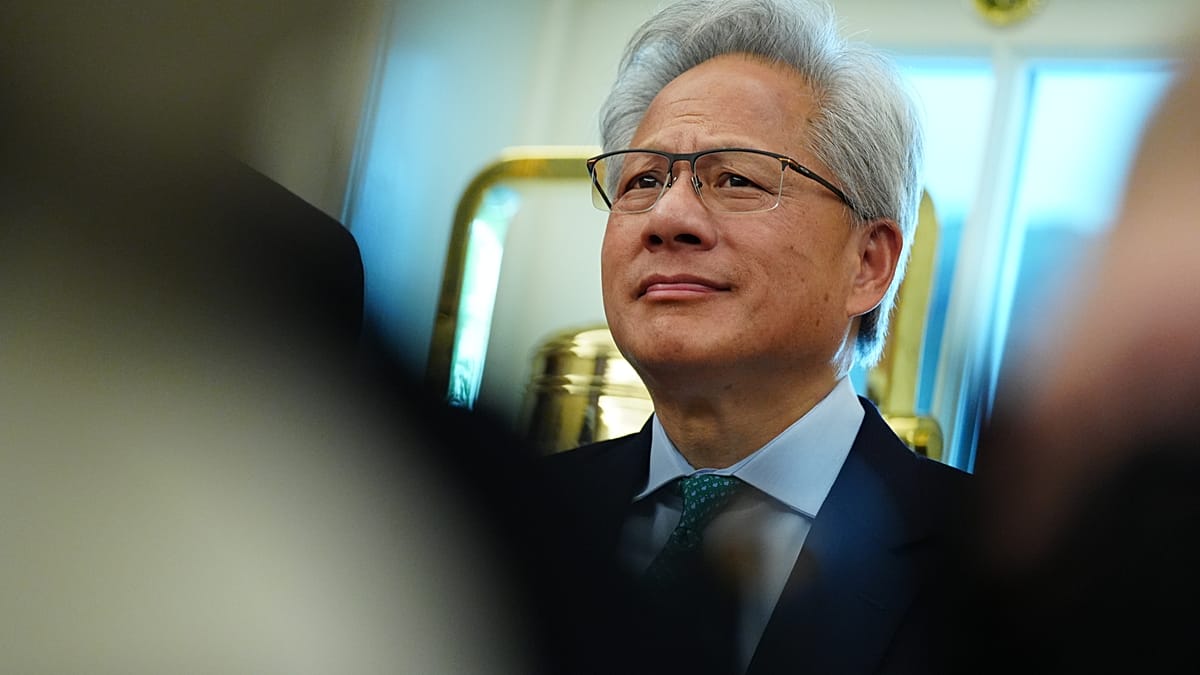
Nvidia has brought Wall Street into the heart of the artificial intelligence boom. Last week, the US chipmaker announced it had signed memorandums of understanding with six of the world's largest asset managers — Apollo Global Management, Blackstone, BlackRock, Brookfield Asset Management, Goldman Sachs and KKR — to raise more than $500 billion (€433 billion) for AI companies to borrow against. The money will be used to buy Nvidia's chips and build the servers, networking gear and power infrastructure that run them.
The six firms will create what Nvidia calls "compute financing platforms," drawing on institutional money, insurance funds and private credit. Borrowers can use the proceeds for chips, servers, networking equipment, buildings and power supply. Nvidia has the option to guarantee up to a quarter of any given deal, which lowers the interest rate its customers pay while leaving most of the credit risk with the lenders.
CEO Jensen Huang said he approached only these six companies and none refused. The structure is designed to keep massive spending off the balance sheets of tech giants, and the fact that such a structure is needed at all tells investors a great deal about where the constraints in the AI boom now lie.
From depreciating chips to long-lived infrastructure
The financial engineering rests on a single reclassification. Graphics processing units (GPUs) have always been treated as equipment that loses value quickly, superseded whenever a faster generation arrives. Nvidia is effectively asking lenders to treat them instead as long-lived infrastructure, closer to a toll road or a power plant, that can be borrowed against for years.
"These are revenue-generating assets now," Huang said, describing them as productive, long-lived and transferable between customers. That shift is central to the deal's appeal — and to the doubts it has raised.
The timing reflects a squeeze that has been building all year. Microsoft, Amazon, Alphabet, Meta and other hyperscalers whose cloud platforms host most of the world's AI workloads have together guided roughly $720 billion (€624bn) to $745 billion (€646bn) of capital spending in 2026, an increase of about 77% on last year. What analysts expect the hyperscalers to spend in 2027 alone has more than doubled in the space of a year, from a consensus of $480 billion (€416bn) in August 2025 to $1.08 trillion (€943bn) this month, a rise of about 127%, according to Bank of America.
The pattern has repeated at every stage. Analysts who already considered last year's investment unsustainable then watched the hyperscalers guide higher at the start of 2026, revise those figures upward again through the year, and pencil in larger sums still for next year and 2028.
Moody's has warned that spending on this scale is eating into free cash flow and pushing tech groups into heavier borrowing. Alphabet recorded negative free cash flow of $5.9 billion (€5.1bn) in a quarter when it spent $44.9 billion (€38.9bn) on projects.
What the deal means for Europe
For European companies, the implications are significant. Smaller operators such as CoreWeave and Nebius, which lack investment-grade ratings and pay dearly for credit, gain access to capital on terms previously reserved for the giants. Nebius, which has roots in Russia but now operates from Amsterdam, is one of the few European players in the AI infrastructure race. The deal could help European firms compete with US hyperscalers, though it also deepens their dependence on Nvidia's technology and on American financial markets.
The reaction was more ambivalent than the headline number suggests, and came weeks after a July selloff driven by doubts over whether AI spending will pay for itself. Essentially, equity investors saw a bottleneck being cleared while credit investors saw something else: the cost of insuring Nvidia's own debt against default rose after the news and has roughly doubled since late May.
Their doubt concentrates on the reclassification previously mentioned. "Chips depreciate fast and lose value the moment a newer generation arrives," warned Nigel Green of financial advisory firm deVere Group, noting that lending against them only works if the collateral holds its value. Critics also point out that Nvidia is helping finance purchases of its own products, deepening the circularity that already worries the sector.
Goldman Sachs CEO David Solomon called it "a pivotal moment of a historic AI investment cycle." Whether that cycle ends in a boom or a bust may depend on whether the chips really do hold their value as long as Nvidia hopes. For now, the deal marks a new chapter in how the AI boom is funded — and where the risks lie.