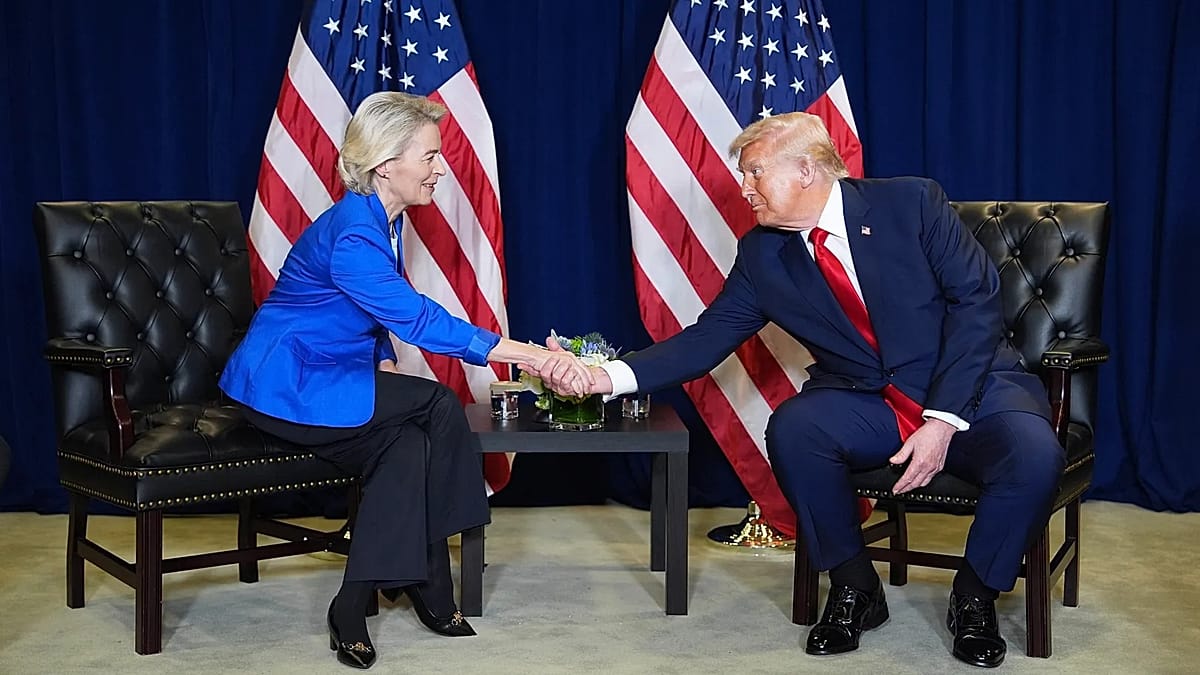
It has been exactly one year since European Commission President Ursula von der Leyen and US President Donald Trump shook hands on the Turnberry trade deal in Scotland. The anniversary, however, is far from celebratory. Transatlantic trade relations are once again under strain after the European Union fined Google €890 million for abusing its dominance in digital markets — a move that sent Washington into a fury.
US Trade Representative Jamieson Greer was quick to warn that the fine created “uncertainty” for the Turnberry agreement, jeopardising the ongoing dialogue over the EU's digital rules. Then came Trump's post on Truth Social: “The United States of America is not a ‘PIGGYBANK’ for Europe, nor will we allow it to be!” He announced a Section 301 investigation under the US Trade Act of 1974, a tool that allows the federal government to counter what it deems unfair trade practices by foreign countries. “The European Union will pay a very big price for this illegal and highly unethical conduct,” he wrote. “Stay tuned!”
How serious are Trump's threats?
Since the Turnberry deal was struck, Europeans have grown accustomed to receiving threats from Trump on social media. More often than not, they no longer react. In December 2025, Washington threatened a list of EU tech companies — including Accenture, Siemens, and Spotify — with restrictions or fees if the EU continued regulating US Big Tech through its digital rules. The Digital Services Act (DSA) and the Digital Markets Act (DMA), two landmark pieces of EU digital legislation, have been repeatedly criticised by the Trump administration as non-tariff barriers targeting mainly US firms.
German Socialist MEP Bernd Lange, the European Parliament's trade chief, told Euronews: “Let's see what time will bring.” He added that discussions with the US about EU digital regulations are underway, but he could not say for sure whether they would lead to “concrete” results. Nonetheless, Lange believes that if Trump's threats turn out to be serious, the US could impose restrictions on EU digital services.
The EU has already faced similar pressure before. In a related development, EU trade chief warned US retaliation likely after Google fine, underscoring the fragility of the deal.
What can the EU do if Trump follows through?
On 19 May, after hours of negotiations, the EU's member states and the European Parliament struck a deal to remove EU tariffs on US goods as of 1 July. However, in an effort to ensure stability for EU businesses, lawmakers pushed to include safeguards to shield the agreement from future threats. The Commission can now suspend the deal if the US does not respect the 15 percent tariff ceiling or if it “undermines access of Union economic operators to the United States’ market, discriminates against or targets Union economic operators aiming to operate, or already operating, in the United States.” The regulation removing EU duties adds that it can also be suspended if the US “disrupts the trade and investment relationship between the Union and the United States.”
Croatian conservative MEP Željana Zovko told Euronews that the “responsibility” for suspending the deal “has rightly been entrusted to the Commission.” She added: “I am confident it will act at the right time and on the basis of facts.”
Over recent weeks, the Commission has appeared to take the view that regardless of whether the US imposes new tariffs, it was prepared to accept them as long as they respected the 15 percent ceiling. That is what happened on Friday, when a new US tariff regime replaced the one imposed after a February ruling by the US Supreme Court. The EU executive was satisfied to see the new US tariffs set at 10 percent, even though they were imposed over alleged failures to ban imports made with forced labour — an accusation the EU rejects, saying it has strict rules in place to keep such products out of its market.
But what might happen if EU services were targeted? Lange said there was an agreement with the Commission that if it had to suspend the deal, it would take Parliament's views into account. “So if we are pushing for the suspension, then I guess they will do it as well,” he said, adding that there would be sufficient political will in Parliament for such a move. “We have much more self-confidence than a year ago.”
The broader context of EU trade policy also includes challenges beyond the US. For instance, the EU's €1bn daily trade deficit with China is unsustainable, according to a Parliament vice president, adding another layer of complexity to Brussels' trade strategy.