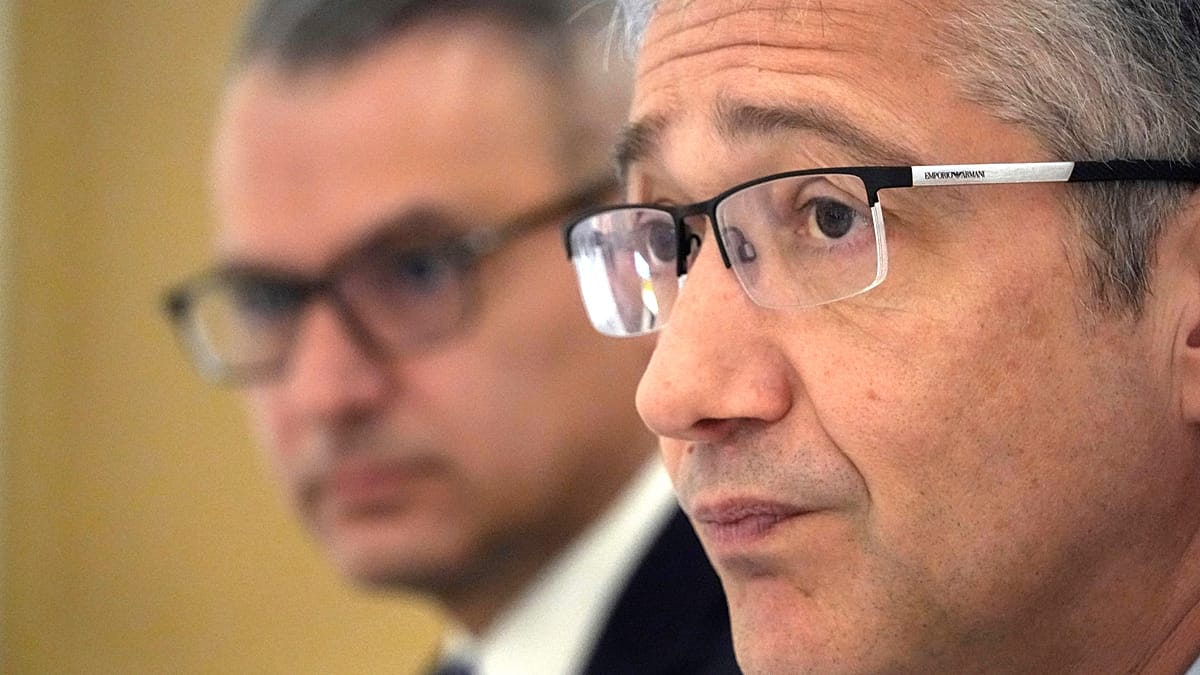
In a country where political polarization rivals that of Brazil or the United States, Pablo Hernández de Cos has achieved something remarkable: he has become a figure of consensus. The 55-year-old economist, who will soon become the first Spaniard to preside over the European Central Bank (ECB), has briefly interrupted the bitter rivalry between Spain's Socialists and the conservative Popular Party (PP), who are vying for power in this Sunday's general election.
Hernández de Cos is a familiar face in Spain's public life, and one of the few citizens—alongside King Felipe VI and Queen Letizia—to have been photographed by Annie Leibovitz, the celebrated portraitist of global elites. Unlike the controversial images she took of the monarchs, Leibovitz captured Hernández de Cos as approachable yet authoritative, seated at the head of the table in the Governing Council chamber of the Bank of Spain, an institution he led from 2018 to 2024.
A career intertwined with political change
His professional milestones have often coincided with pivotal moments in Spanish politics. He was proposed as governor of the Bank of Spain by Mariano Rajoy's outgoing administration on 28 May 2018, one of the former prime minister's last acts. Four days later, the first successful no-confidence motion in Spain's democratic era forced Rajoy out and brought Pedro Sánchez to power. Now, with the election on Sunday, it remains to be seen whether Hernández de Cos's imminent move to Frankfurt—confirmed this Thursday as ECB president—will again foreshadow a shift in Spain's political landscape.
The economist's family history is steeped in Spain's transition to democracy. His father, Inocencio Hernández Amores, began his career as a police officer but was assigned to La Moncloa in 1978, where he gained the trust of Prime Minister Adolfo Suárez and became his personal secretary. Growing up in a politicized, middle-class household, Hernández de Cos witnessed the country's profound transformation. Journalist John Müller noted in a 2022 report in ABC that the young economist was rebellious, participating in demonstrations in the 1980s—a stark contrast to the reserved, technocratic image he projects today. Those who know him describe him as approachable despite his discretion.
Married with two children, Hernández de Cos earned a degree in Economics and Business Administration from CUNEF, a private university, followed by a law degree from UNED, Spain's distance-learning institution, and a doctorate in Economics from the Complutense University of Madrid.
The model civil servant of the Transition
Fluent in English and French—a rarity among Spaniards of his generation—Hernández de Cos chose public service over academia or the private sector. He joined the Bank of Spain in 1997 at age 25 as a graduate in its Research Department, having also passed exams for commercial expert and state economist. Over nearly three decades at the institution, he rose to become director general for Economics, Statistics and Research, and served on the boards of the International Centre for Monetary and Banking Studies and the Foundation for Applied Economic Studies. His work has spanned macroeconomics, fiscal and monetary policy, and financial stability.
Specialists widely expect Hernández de Cos to maintain orthodox positions, aligning with the ECB's hawkish camp—contrary to stereotypes about southern Europeans—except on interest rates, which he argued for cutting in 2024. He took up the post of director general of the Bank for International Settlements on 1 July 2025, after completing his term at the Bank of Spain. He knows the ECB well: as head of Spain's central bank, he was a member of its Governing Council from 2019 to 2024, and he also chaired the Basel Committee on Banking Supervision and the Advisory Technical Committee of the European Systemic Risk Board.
His appointment comes at a time when Spain's economy is a bright spot in Europe, though growth has outpaced wages, leaving many households behind. The ECB's next leader will also have to navigate broader challenges, including hybrid threats and disinformation that have targeted European institutions. As Hernández de Cos prepares to take the helm in Frankfurt, his consensus-building skills may prove as valuable as his economic expertise.



