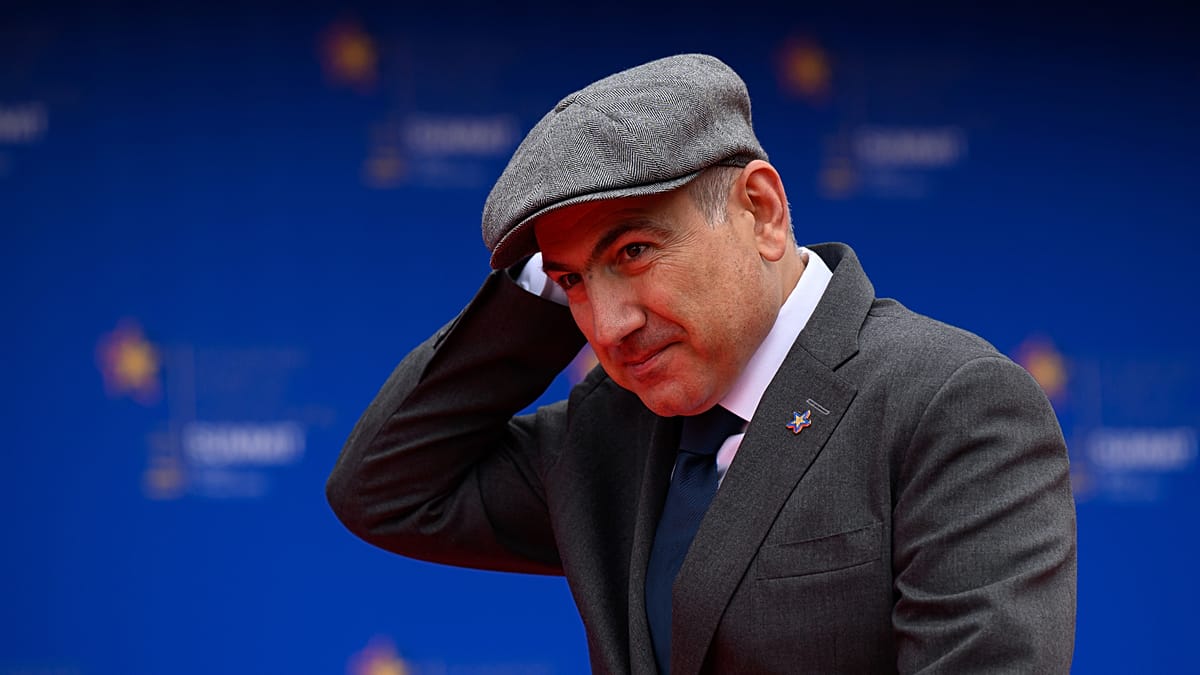
With parliamentary elections looming on Sunday, Armenian Prime Minister Nikol Pashinyan is attempting to recalibrate his country’s foreign policy without provoking an outright rupture with Moscow. Polls suggest his party is headed for a decisive victory, but the Kremlin has been steadily tightening economic screws in recent weeks.
Speaking on Monday, Pashinyan addressed the Russian-led Eurasian Economic Union’s (EAEU) demand for a referendum on Armenia’s pro-European trajectory. He dismissed the idea as premature, stating that “the moment for such a choice has not yet arrived.” Yerevan, he said, would “continue working in the Eurasian Economic Union until the moment when a choice between the EU and the EAEU becomes unavoidable.”
However, the prime minister was careful to underline that Armenia’s future direction remains a sovereign matter. “The decision must naturally be made by the people of Armenia in a referendum,” he added, but only once the country has formally applied for EU membership or is close to obtaining candidate status. “Putting a theoretical choice to a referendum is of course neither very sensible nor justified,” he explained.
Balancing Act with Moscow
Pashinyan described the current state of Armenia-Russia relations as being “in a transformational phase,” which he characterised as “positive.” He insisted that ties remain “open and sincere, and we have kept no dark corners in that relationship.” Yet the backdrop tells a different story. On Monday, Moscow banned imports of almost all Armenian fish products, following earlier restrictions on fruits, vegetables, wine, brandy, and Jermuk mineral water. The Kremlin has also threatened to cut critical oil and gas supplies.
These measures come despite a birthday greeting from Russian President Vladimir Putin to Pashinyan on Sunday, in which Putin noted that “relations between our countries and peoples have traditionally been friendly, and we are interested in their further progressive development.” The contrast between diplomatic niceties and economic coercion underscores the tension in the relationship.
Pashinyan’s government has been pushing to normalise ties with Turkey and Azerbaijan, a move that the pro-Russian opposition views as a betrayal of Moscow’s traditional orbit. “If we have no relations with Turkey, that scale is empty — and an empty scale creates serious risks and instability,” the prime minister argued, framing the outreach as a necessity rather than a whim.
Armenia’s EU membership bid remains, for now, “theoretical,” as Pashinyan put it. But the country’s growing alignment with European institutions has not gone unnoticed in Brussels. The European Union has increasingly engaged with Yerevan on trade and security issues, though full membership remains a distant prospect.
The election on Sunday will test whether Pashinyan’s balancing act resonates with voters. His opponents, backed by Moscow, have accused him of jeopardising Armenia’s security by alienating Russia. Yet the prime minister’s message of sovereignty and gradual European integration appears to have broad appeal, particularly among younger Armenians who see the EU as a path to modernisation.
Meanwhile, Russia’s shadow fleet continues to evade sanctions, as detailed in our recent analysis, and European navies have stepped up interceptions, such as the French operation in the Atlantic. These developments highlight the broader geopolitical context in which Armenia’s election takes place.
For now, Pashinyan is betting that a clear electoral mandate will strengthen his hand in negotiations with both Moscow and Brussels. Whether the Kremlin will accept that outcome remains an open question.



