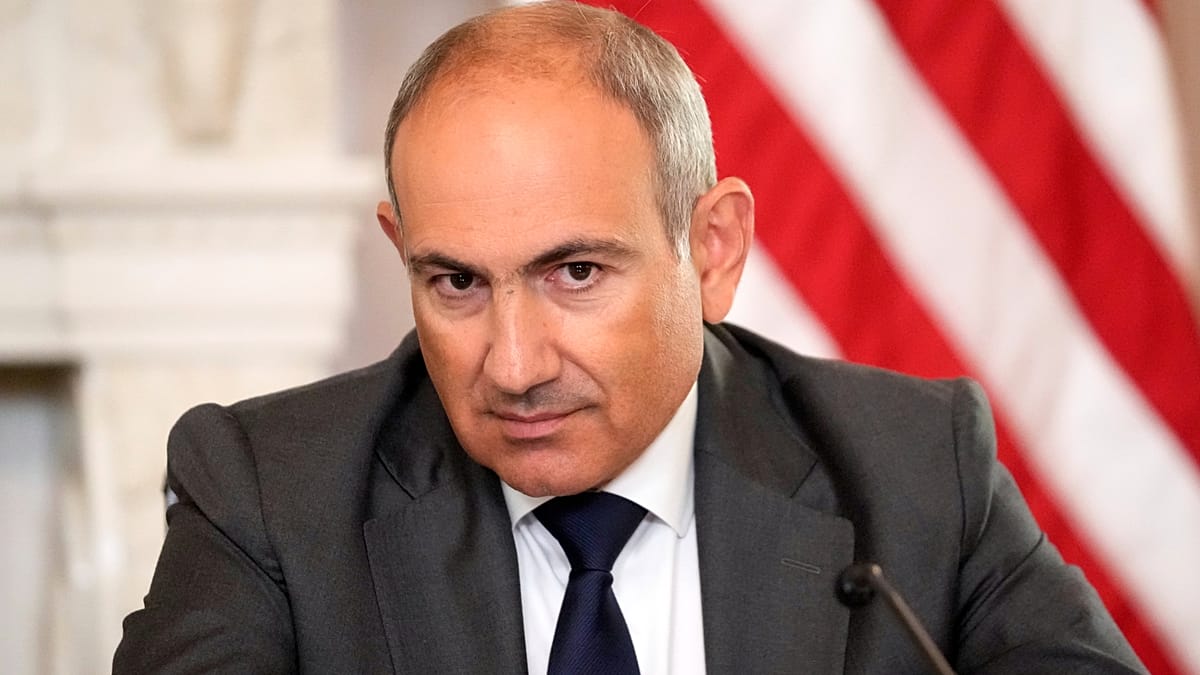
YEREVAN — A new opinion poll suggests that Prime Minister Nikol Pashinyan’s Civil Contract party is on track for a decisive victory in Armenia’s parliamentary elections on 7 June, potentially securing a strong pro-Western mandate that would deepen the country’s rift with the Kremlin.
The survey, conducted by Breavis between 5 and 11 May among 1,551 respondents, indicates that Civil Contract would capture nearly 65 percent of decided voters. No opposition party — some of which enjoy explicit backing from Moscow — is projected to exceed 12 percent. If confirmed at the ballot box, the result would give Pashinyan a comfortable majority in the National Assembly and a clear mandate to pursue his strategic realignment toward the European Union and the United States.
A Pivot Away from Moscow
Armenia, a landlocked country of roughly three million in the South Caucasus, has historically been one of Russia’s closest post-Soviet allies. But since coming to power in 2018, Pashinyan has steadily reoriented Yerevan’s foreign policy, culminating in a historic peace agreement with Azerbaijan over the Nagorno-Karabakh region, signed at the White House last year alongside Azerbaijani President Ilham Aliyev. That deal ended decades of conflict and opened the door to regional cooperation, but it also alienated Moscow, which had long acted as a security guarantor for Armenia.
The Breavis poll signals that Armenian voters are prepared to endorse this shift. A landslide victory would give Pashinyan the political capital to accelerate EU accession talks and deepen security cooperation with NATO, even as Russia intensifies its campaign to keep Yerevan in its orbit.
Russian Pressure Mounts
In recent weeks, Moscow has escalated its efforts to undermine Pashinyan. On 17 May, Russia recalled its ambassador to Armenia, Sergey Kopyrkin, for consultations — a diplomatic rebuke triggered by Yerevan’s decision to hasten its path to the European Union. “The Ambassador of the Russian Federation to the Republic of Armenia, S. P. Kopyrkin, has been recalled to Moscow for consultations in connection with steps taken by the Armenian leadership toward rapprochement with the European Union,” the Russian Foreign Ministry said in a statement.
The recall followed a series of economic measures designed to pressure Armenia. Russia has imposed temporary restrictions on Armenian exports of fruits and vegetables, adding to earlier bans on mineral water, wines, and brandy. Moscow has also threatened to cut off cheap natural gas and oil supplies — Armenia imported more than 80 percent of its gas from Russia last year — and warned of possible suspension from the Eurasian Economic Union (EAEU), the Moscow-led bloc of five former Soviet states that functions as a single integrated market.
On 16 May, the leaders of Russia, Belarus, Kazakhstan, and Kyrgyzstan issued a joint statement at an EAEU summit in Astana, calling on Armenia to hold a national referendum on whether to remain in the bloc or pursue EU membership. “The crisis in Ukraine began at one point with Ukraine’s attempts to join the EU,” Russian President Vladimir Putin told reporters at the summit, drawing a direct parallel between Armenia’s current trajectory and the events that preceded Russia’s full-scale invasion of Ukraine in 2022.
Western Support and Disinformation
Pashinyan has not been without external backing. On 15 May, former U.S. President Donald Trump gave Pashinyan his “complete and total endorsement” for re-election, describing him as “a great friend and leader” who is making Armenia “strong, wealthy and very secure.” The endorsement, reported by European Pulse, came as a boost to Pashinyan’s campaign, though Trump is no longer in office.
Meanwhile, Moscow has mounted an intensive disinformation campaign in Armenia, using state-controlled media and covert operations to support pro-Russian opposition candidates and undermine Pashinyan’s credibility. Analysts say the Kremlin views Armenia’s pivot as a direct threat to its influence in the South Caucasus, a region it considers part of its sphere of interest.
The EAEU leaders’ demand for a referendum, detailed in a separate report, underscores the stakes. For Armenia, the choice is existential: continued integration with Europe, with its promise of economic modernization and security guarantees, or a return to dependence on a Russia that has shown it is willing to use economic coercion and military force to maintain its grip.
As Armenians prepare to vote, the outcome will resonate far beyond the Caucasus. A decisive Pashinyan victory would mark a significant setback for the Kremlin’s post-Soviet ambitions and strengthen the hand of pro-Western forces across the region. It would also cement the peace with Azerbaijan, opening the door to new trade routes and energy partnerships that could reshape the geopolitical landscape of the South Caucasus.



