The Organisation for Economic Co-operation and Development (OECD) released its latest Programme for International Student Assessment (PISA) report this week, and the findings are sobering: 15-year-olds across much of the developed world are performing worse in mathematics and reading than they did three years ago. The decline is particularly pronounced in several European countries, including Germany, France, and the Netherlands, where scores have fallen to levels not seen in over a decade.
PISA, which tests around 600,000 students in 79 countries and economies every three years, is the most comprehensive international benchmark of educational achievement. The 2022 cycle, the first since the COVID-19 pandemic, shows that the average OECD score in mathematics dropped by 15 points compared to 2018, while reading fell by 10 points. Science scores remained relatively stable, but the overall trend is worrying for policymakers from Lisbon to Tallinn.
What the results mean for Europe
The decline is not uniform. Estonia, for instance, continues to punch above its weight, ranking among the top performers in Europe and globally, alongside Asian powerhouses like Singapore and Japan. Meanwhile, countries such as Iceland, Norway, and Sweden have seen significant drops, raising questions about the effectiveness of their education systems in the post-pandemic era.
Experts point to a combination of factors: prolonged school closures, increased reliance on remote learning, and a broader cultural shift towards digital distractions. "The pandemic was a shock, but the data suggests that some countries were already on a downward trajectory before 2020," says Andreas Schleicher, the OECD's director of education and skills. "We need to look beyond the immediate crisis and address systemic issues like teacher shortages and inequities in access to quality education."
In Germany, the results have reignited a long-running debate about digitalisation in schools. The country's federal structure means education policy is largely set by the 16 Länder, leading to uneven outcomes. The Kultusministerkonferenz (the standing conference of education ministers) has promised to invest more in teacher training and digital infrastructure, but critics argue that progress is too slow.
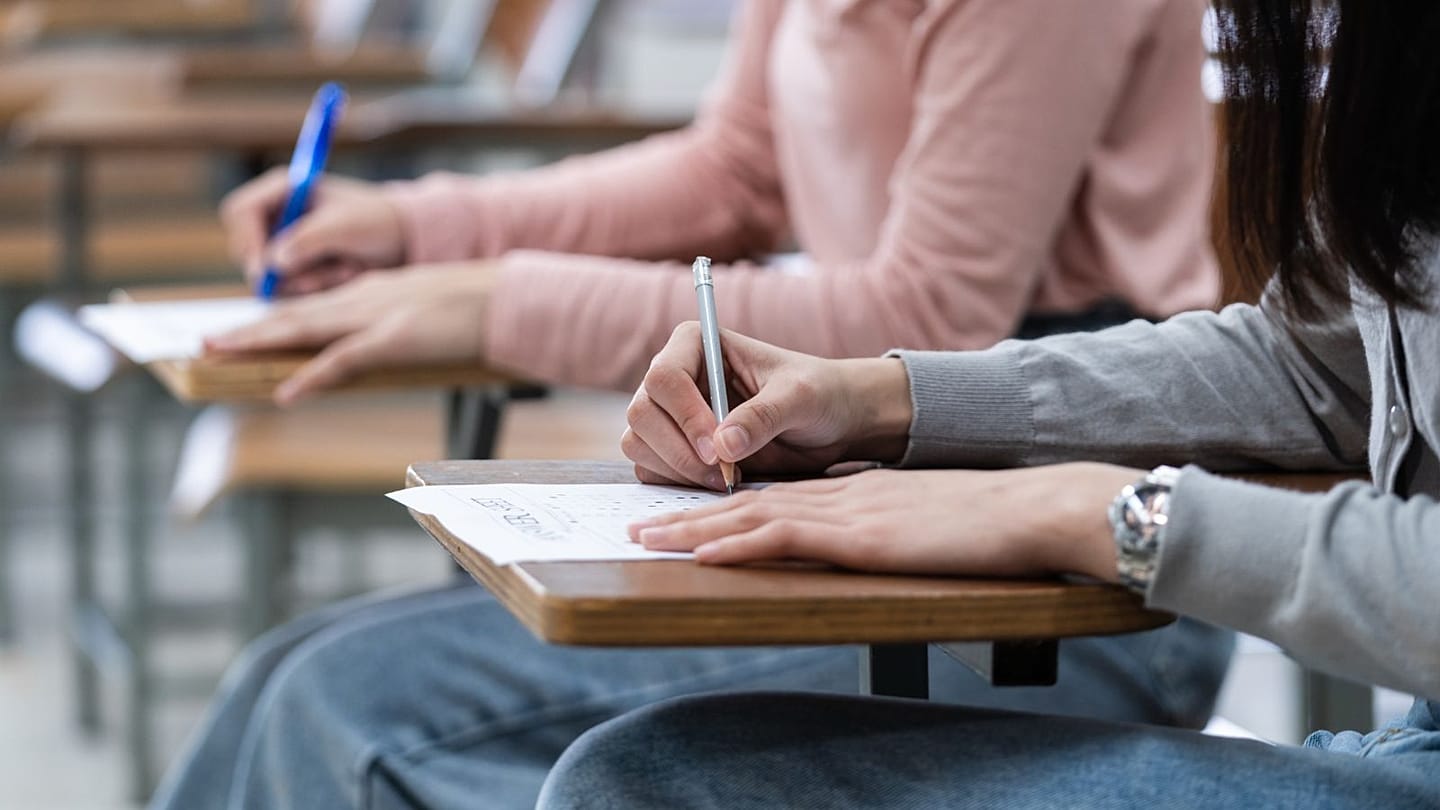
Test yourself: Are you smarter than a 15-year-old?
To give you a sense of what the PISA assessment actually measures, we've selected a few sample questions from the OECD's public release. These are not the easiest items, but they are representative of the kind of problem-solving and critical thinking that the test rewards.
Mathematics question: A car travels at a constant speed of 80 km/h. How many kilometres does it travel in 2 hours and 30 minutes?
Answer: 200 km. (If you got that right, you're on par with the average 15-year-old in many OECD countries.)
Reading question: Read the following short text and answer the question: "The library is open from 9:00 to 18:00 on weekdays, and from 10:00 to 14:00 on Saturdays. It is closed on Sundays." On which day can you visit the library at 11:00 in the morning?
Answer: Saturday. (This tests your ability to extract information from a simple schedule.)
Science question: Which of the following is a renewable energy source? A) Coal, B) Natural gas, C) Solar power, D) Nuclear power.
Answer: C) Solar power. (This checks basic understanding of sustainability concepts.)
These questions may seem straightforward, but the full PISA assessment includes more complex tasks that require students to apply their knowledge to real-world scenarios, such as interpreting data on climate change or evaluating arguments in a news article.
Can adults do better?
The question on many people's minds is whether adults, with their life experience and accumulated knowledge, would outperform the teenagers. The OECD's own adult version of the test suggests that the answer is not always yes. In fact, many adults struggle with the same types of problems, particularly in mathematics, where skills can atrophy without regular use.
For European readers, this is more than a trivia challenge. The PISA results have direct implications for the continent's future competitiveness. As the EU pushes for a green and digital transition, a workforce that is numerically and scientifically literate is essential. The alarming number of young Europeans struggling with basic reading is a red flag for social cohesion and democratic participation.
Some countries are already taking action. In France, President Emmanuel Macron has announced a "choc des savoirs" (knowledge shock) plan, which includes smaller classes in priority education networks and a greater emphasis on rote learning in primary schools. In the Netherlands, the government has earmarked billions of euros to tackle teacher shortages and improve digital literacy.
But as the OECD's Schleicher warns, there is no quick fix. "Improving education is a long-term investment," he says. "It requires political will, sustained funding, and a willingness to learn from the best-performing systems."
So, how did you fare on our sample questions? If you aced them, congratulations—you're officially smarter than the average 15-year-old. If not, perhaps it's time to brush up on your skills. After all, in a rapidly changing world, learning never really stops.