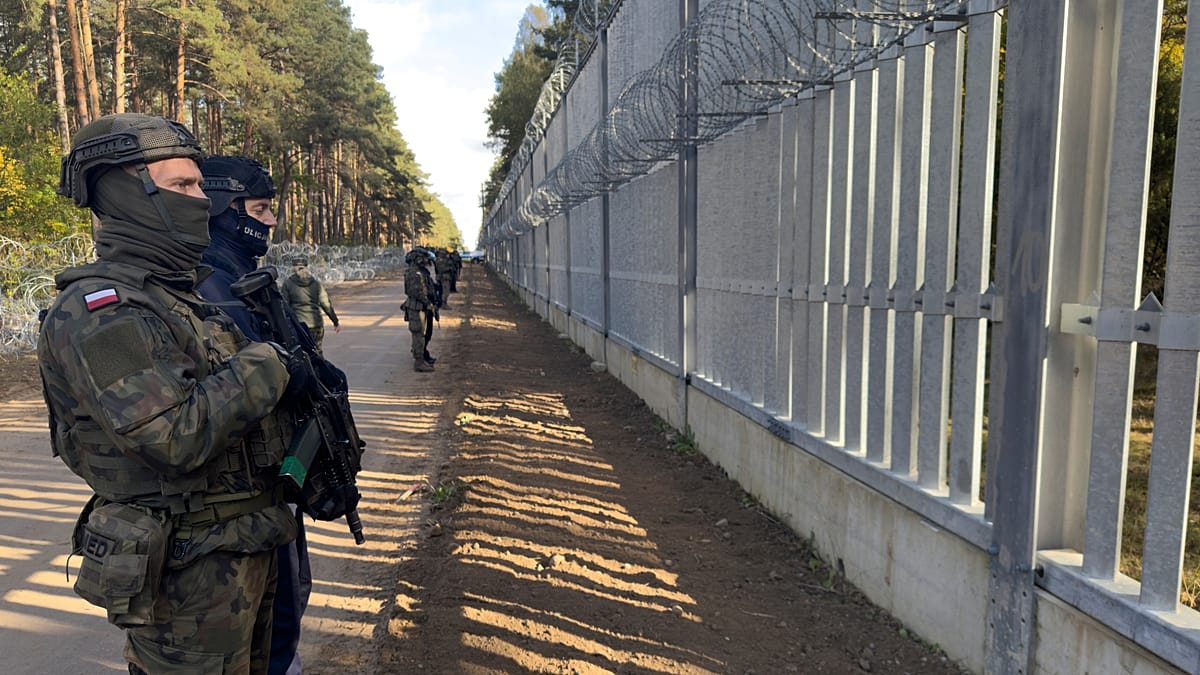
The Polish government has announced a precipitous decline in illegal migration attempts across its heavily fortified frontier with Belarus. Data from the Ministry of the Interior and Administration shows a near-total collapse in such activity, which Warsaw presents as validation of its stringent border protection strategy.
In the first quarter of 2026, Polish Border Guard officers recorded just 158 attempts to cross the border illegally from Belarus. This figure stands in stark contrast to the 3,306 attempts logged during the same three-month period in 2022, representing a decrease of approximately 96 percent. The ministry directly linked this sharp reduction to what it termed a "consistent government policy" and significant investment in securing the state border.
A Policy of Deterrence and Defense
Polish officials pointed to several key measures as instrumental in achieving this result. A central pillar has been the construction of a formidable physical barrier along the border. Since 2022, a 5.5-meter-high steel fence topped with barbed wire has spanned much of the frontier, supplemented by networks of cameras and electronic sensors.
Legislative changes have also played a critical role, according to the government's communiqué. Authorities highlighted the temporary suspension of the right to apply for asylum in designated border zones, a controversial mechanism they argue was being systematically exploited by individuals seeking illegal entry. The government contends this policy has closed a critical loophole.
The human element of border security has been equally emphasized. "The key role was played by the actions of Border Guard officers, who secure the country's eastern border on a daily basis," the ministry stated, acknowledging the demanding and often dangerous conditions faced by personnel. The border region has been the scene of repeated violent clashes in recent years, culminating in the fatal stabbing of a Polish soldier during an incident in June 2024.
Vigilance Maintained Despite Declining Numbers
Despite the reported success, Warsaw has signaled no intention of scaling back its security posture. The Ministry of the Interior insisted that further measures to strengthen border protection are ongoing, including continued investment in infrastructure along the Belarusian section.
"Migration is under control, but we are not losing vigilance," the ministry declared, adding that ensuring citizen security remains a top state priority. This sustained alertness is reflected in the maintenance of temporary internal border controls with fellow Schengen Area members Germany and Lithuania, a measure initially implemented during the peak of the migration crisis.
The situation on Poland's eastern border remains a flashpoint in the broader European debate on migration and security. Poland's approach, while hailed by some member states as a necessary model of firm border management, has drawn criticism from human rights groups and international bodies concerned about the treatment of migrants and the right to seek protection.
The dramatic decrease in crossing attempts also raises questions about shifting migration routes and the evolving tactics of state actors. The 2021-2022 crisis was widely characterized by the European Union and NATO as a hybrid attack orchestrated by the regime of Belarusian leader Alexander Lukashenko, which facilitated the travel of thousands of migrants, primarily from the Middle East and Africa, to the EU's doorstep.
Poland's experience stands in contrast to other European border scenarios, such as the ongoing challenges in the Mediterranean. However, it shares thematic parallels with other regional security concerns, including the scrutiny of defense spending in neighboring Hungary and the EU's collective effort to manage the humanitarian fallout from the war in Ukraine, which has seen nations like Germany, Poland, and Czechia host millions of refugees.
For now, the fortified fence stretching through the forests and wetlands separating Poland and Belarus stands as a potent symbol of Warsaw's resolve. The government's latest data suggests its physical and policy barriers are proving effective in drastically reducing illegal crossings, even as it prepares for potential future escalations along what remains one of the EU's most tense and heavily guarded frontiers.



