For the European Heritage Days, the Pompeii Archaeological Park is staging an extensive programme of historical re-enactments and hands-on activities on Saturday 26 and Sunday 27 September 2026. The event, coordinated in Italy by the Ministry of Culture, is part of the continent-wide initiative promoted by the Council of Europe and the European Commission under the theme “Protecting heritage. Renew, resist, reinvent.”
Gladiators in the arena
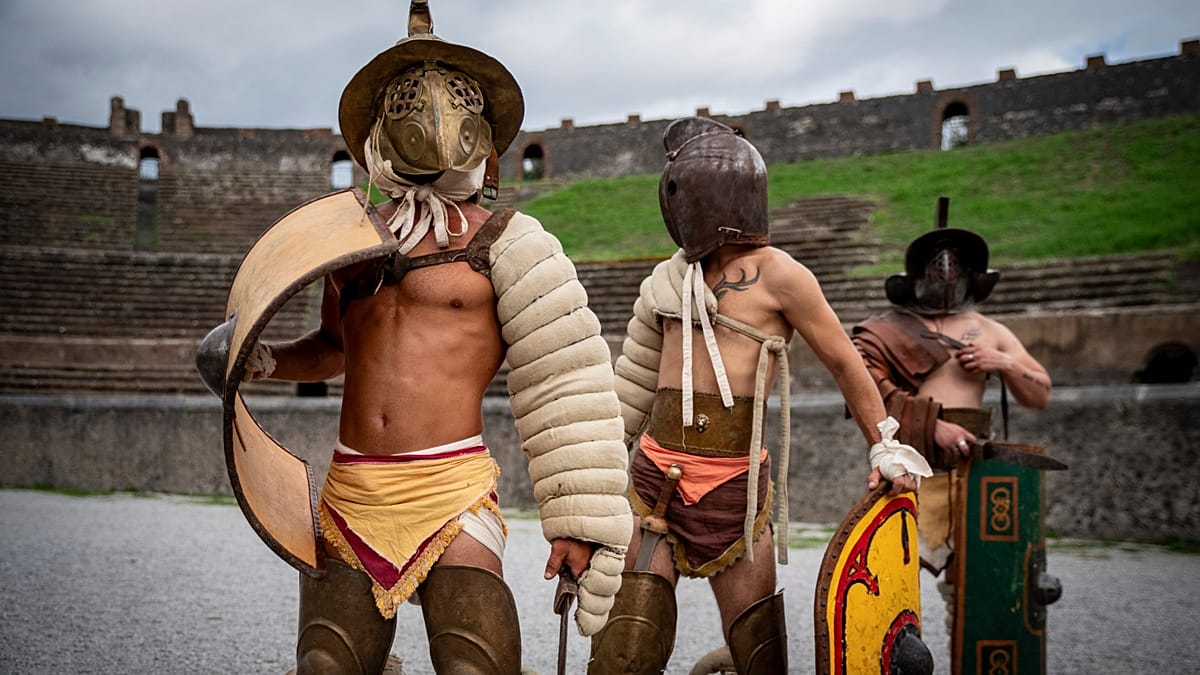
On the first day, the park’s focus turns to the brutal and ritualised world of Roman gladiatorial combat. The event, titled Dies in Arena, is curated by the Gruppo Storico Romano with Ars Dimicandi, and features the participation of Militum Schola, the Gruppo Storico Lucerino, and Taberna Anticae Arelatensis.
The morning opens at 11.00 in the Basilica with “People and Power,” an introduction to the munus gladiatorium as a cultural, political, and social phenomenon of the 1st century AD. At 12.30, the Quadriporticus of the Theatres hosts “The Ludus,” a reconstruction of a gladiatorial school, with detailed explanations of the different fighter types, their armour, and the internal hierarchies and rituals that governed their lives.
Throughout the morning, educational stands around the Quadriporticus display ancient weaponry. A procession then winds its way along Via Stabiana and Via dell’Abbondanza to the Amphitheatre, where at 15.30 the final act, “Munera,” takes place. The imperial procession, court figures, and magistrates enter, followed by demonstrations by four pairs of gladiators, with spectators invited to judge the contests.
Roman life beyond the arena
Sunday 27 September sees the third edition of the Ludi Pompeiani, organised by Dyron Consulting. Inside the Amphitheatre, the opening ceremony and the ovatio municipale honour Gaius Cuspius Pansa, a prominent local magistrate. The day alternates between historical dance, gladiatorial and legionary games, the rite of manumissio (the freeing of a slave), and a full Roman wedding. Educational stands and workshops run from 9.30 in the camp set up next to the Amphitheatre.
At Boscoreale, the Antiquarium’s entrance forecourt becomes a living museum of daily life, with stands on weaving, cosmetics, perfumery, pharmacopoeia, surgery, games, and numismatics, where visitors can mint their own coins. Small-group workshops, limited to eight participants per session, run from 10.00 to 13.00 and 15.00 to 18.00, led by the association Legio XXX Ulpia Victrix.
In Stabia, Villa San Marco hosts “Rectina! The day the sky fell on Pompeii,” a performance that evokes the eruption of Vesuvius in 79 AD. Visitors are welcomed from 10.00, with repeat performances throughout the day, interspersed with educational talks. At the Villa of Poppaea in Oplontis, the Gruppo Archeologico Kyme and partners offer guided itineraries and stalls on “Theatre, music and masks of the ancient world,” including a performance on the double flute.
The European Heritage Days are the largest cultural event of their kind on the continent, with thousands of venues opening their doors across the 27 member states and beyond. In Italy, state museums will offer special late openings on the evening of Saturday 26 September at the symbolic price of 1 euro. The initiative underscores the enduring relevance of heritage, not merely as a relic of the past but as a living resource for renewal and reinvention.
For those unable to travel to Campania, the park’s digital channels will stream selected moments, ensuring the spirit of the event reaches a wider audience. As the Lisbon LEGO exhibition shows, heritage can take many forms, but few places evoke the ancient world as vividly as Pompeii.