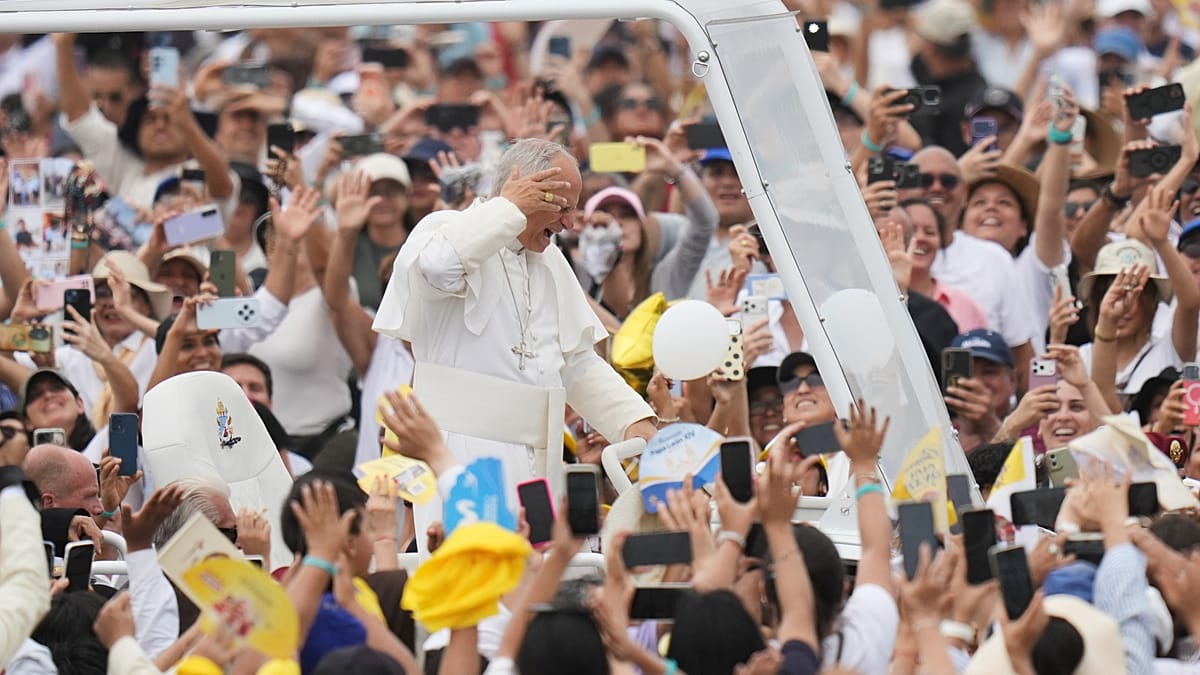
Pope Leo XIV was struck in the eye by an object identified as a rosary on Monday as his popemobile moved through crowds in Peru, according to video footage of the incident. The 71-year-old pontiff was seen rubbing his eye after the item was thrown toward him ahead of a farewell mass at Las Palmas air base. He was able to continue with his schedule and showed no visible signs of injury.
"My journey is coming to an end, but the mission continues," Leo told the crowd later. "At the conclusion of my Apostolic Journey, I too wish to confirm you in faith and charity and assure you that I will always carry you with me. Yes, the Peruvian people are my people too!"
The episode occurred on the final leg of a South American tour that also took the pope to Uruguay and Argentina. It came just weeks after he underwent surgery for lung cancer in Rome, a procedure that had raised questions about whether he could undertake such a demanding trip.
A demanding tour after serious surgery
The Vatican confirmed in October that the lower lobe of Leo's right lung had been removed and that a diagnosis of pulmonary adenocarcinoma had been made, consistent with pre-operative tests. Doctors subsequently reported that a chest X-ray showed good recovery of the affected lung, though the operation had cast some doubt over the feasibility of the South America visit.
His performance on the tour will have done much to ease concerns about his recuperation. The pope maintained a busy schedule across three countries, meeting crowds and presiding over large public liturgies. The trip also drew attention for unrelated public health reasons, as authorities monitored measles concerns during the South America visit.
In Argentina, the pope used the occasion to raise social questions with President Javier Milei, pressing him on disability care during the visit, a notable exchange given Milei's libertarian profile and the pope's longstanding advocacy on behalf of vulnerable groups.
Return to Chiclayo and a personal homecoming
Leo also returned to his former hometown of Chiclayo in northern Peru, where he presided over an open-air mass for around 500,000 people. The pope previously served as a missionary and then as bishop in Peru and holds Peruvian citizenship, a connection he has emphasised throughout his pontificate.
The tour began with a visit to Uruguay, where the pope opened his South American journey before moving on to Argentina and then Peru. Each stop combined pastoral duties with political and social engagement, reflecting the pope's approach of using travel to highlight issues beyond the strictly religious.
The rosary incident in Peru is unlikely to alter the broader assessment of the trip. Objects are occasionally thrown toward popemobiles during public appearances, and the Vatican has not indicated that the pope required medical attention. Leo's ability to complete the tour, weeks after major surgery, will be read in Rome and across Europe as a sign that he intends to maintain an active international schedule.
For European observers, the visit also carried a wider significance. Leo's engagement in South America touches on migration, inequality and the role of the Catholic Church in societies where European missionary history remains a live and contested subject. His willingness to address disability care and public health during the trip suggests a pontificate that will continue to mix doctrine with direct social commentary.
The pope's next scheduled appearances will be watched closely for any sign that the eye injury or his recovery from surgery has affected his pace. For now, the Vatican's message is that the mission continues, and the Peruvian faithful who filled the air base on Monday appeared to take him at his word.