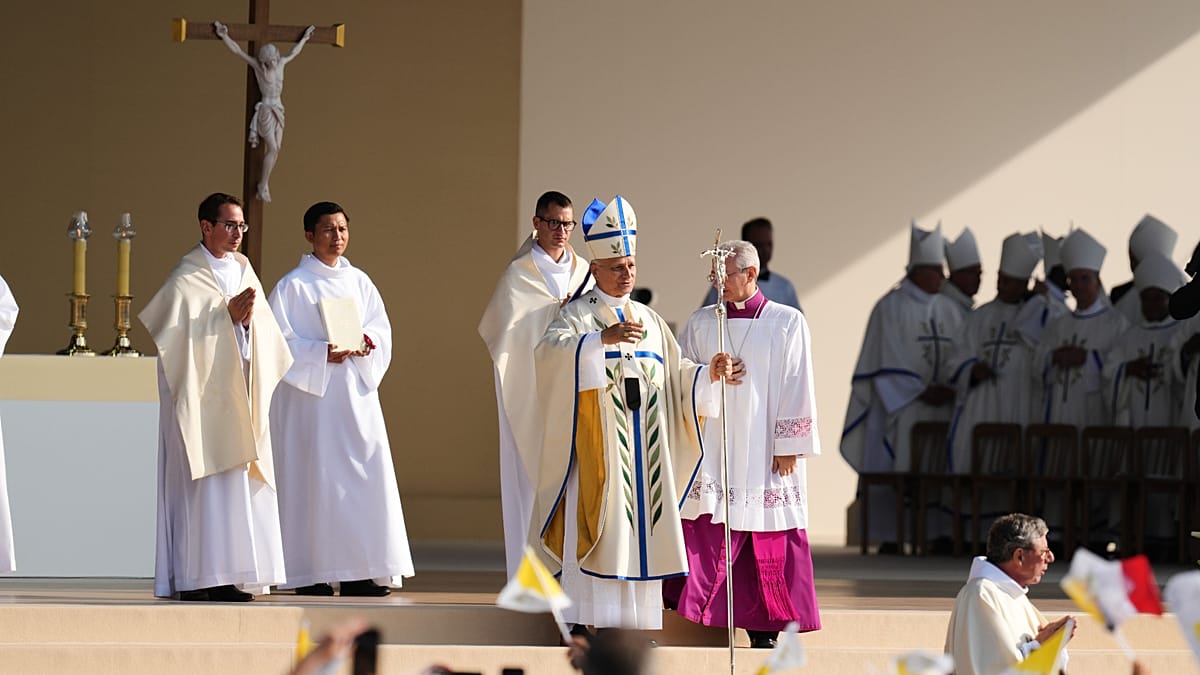
Pope Leo XIV passed the third day of his apostolic journey through France at the Marian sanctuary of Lourdes on Sunday, where the programme combined public liturgy with one of the most closely watched private encounters of the trip: a meeting with men and women who were abused by clergy.
The American pontiff began the morning at the Saint Bernadette auditorium inside the Shrine of Our Lady of Lourdes, addressing the assembled bishops of France. He then moved to the prairie adjoining the sanctuary to celebrate Mass, the central public moment of his stay in the Pyrenean town.
A pilgrimage with an uncomfortable chapter
Lourdes, in the foothills of the Pyrenees in south-western France, draws millions of pilgrims each year, many of them seeking healing at the spring associated with Bernadette Soubirous. But the visit also places the Church's handling of sexual abuse at the centre of the agenda, following the findings of the Sauvé commission, which in 2021 estimated that some 216,000 minors had been abused by French clergy since 1950.
The pope's meeting with survivors was scheduled for Sunday, away from the cameras. The Vatican has not disclosed the names of those taking part, and the encounter is expected to shape how the French episcopate is judged in the months ahead. Survivor groups have repeatedly argued that gestures must be matched by concrete changes to canonical procedure and to the way dioceses compensate victims.
Sunday's events build on a visit that has already produced one of the largest religious gatherings in recent French history. The Mass in Paris earlier in the trip drew crowds estimated in the hundreds of thousands, with organisers putting the figure at 800,000 — a scale that underlined the pope's pull in a country where Mass attendance has fallen for decades. Coverage of that Paris Mass and the Lourdes pilgrimage has dominated French broadcasters since the pope landed.
From the Pyrenees to Lorraine
On Monday the itinerary shifts sharply north-east. Pope Leo XIV is due to arrive in Metz, the capital of Moselle in the Grand Est region, where he will take part in an interreligious meeting. He is then expected to deliver an address framed around "the roots of Europe for peace and unity" — a theme that resonates in a city whose history has been shaped by the Franco-German border, by the annexations of 1871 and 1940, and by the postwar reconciliation that made European integration possible.
The choice of Metz is not incidental. The city sits within a short drive of Luxembourg, Germany and Belgium, and its cathedral, Saint-Étienne, is one of the tallest Gothic naves in France. A papal appeal for unity delivered from Lorraine carries a different weight than one delivered from Rome or Paris, and it lands at a moment when the European Union is debating enlargement, defence spending and its relationship with Washington.
The visit closes with a farewell ceremony at Metz–Nancy–Lorraine airport. It is the first papal trip to France in 18 years, and the first by a pope born in the United States. Leo XIV has used the journey to press a message that mixes traditional Marian devotion with an explicit call for the Church to confront its own record — a combination that has drawn both praise from reform-minded Catholics and caution from those who fear the abuse file will overshadow the pastoral purpose of the trip.
For the roughly 27 million baptised Catholics in France, the immediate question is what follows the spectacle. The bishops' conference has promised to publish a response to the pope's remarks, and survivor associations have said they will measure the visit by whether it produces binding commitments rather than statements. The Lourdes leg of the visit was always going to be judged on that basis.
Beyond France, the trip is being read as a signal of how this papacy intends to engage with a continent that is increasingly secular, politically fragmented and uncertain about its own Christian inheritance. The Metz address on Europe's roots will be scrutinised in Brussels, Berlin and Warsaw as much as in Rome — not for doctrine, but for what it says about the pope's willingness to enter the continent's political conversation.